

Starting an interior design business means selling space planning, styling and project oversight to homeowners or companies. The U.S. Bureau of Labor Statistics, which publishes federal job data, counted 26% of interior designers as self-employed in 2025.
My name is Michal Sieroslawski, and I’m an entrepreneur who helps interior design businesses get found online. As AI search grows, homeowners ask ChatGPT for suggestions, and being recommended there counts.
The order puts the niche and prices first. Budget, paperwork and suppliers then fit the studio the owner plans to run. To start an interior design business, follow the nine steps below.
- Choose Your Interior Design Niche
- Price Your Design Services
- Fund the First Year
- Set Up a Studio Workspace
- Register, License and Insure the Firm
- Open Trade Accounts and Software
- Market Your Portfolio
- Grow Beyond Solo Projects
- Gain Designer Mentions in Google AI Overviews
1. Choose Your Interior Design Niche
Choosing an interior design niche decides which clients the studio serves and which rooms it designs. A clear niche shapes the services, the pricing and the portfolio.
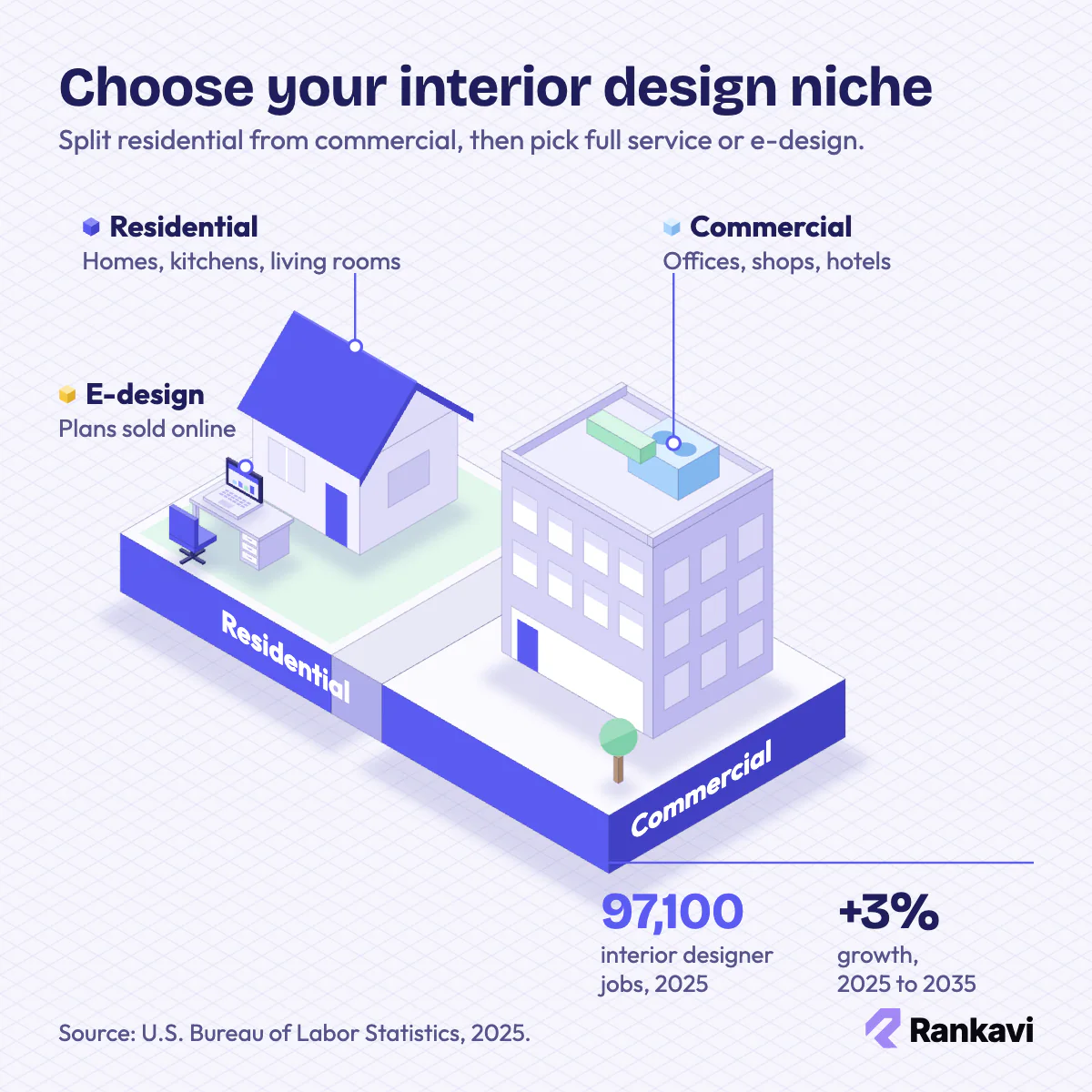
Residential and commercial work are the first split. Residential designers work with homeowners on living rooms, kitchens and bedrooms. Commercial designers plan offices, shops, restaurants and hotels, where codes and budgets differ.
Service depth is the second choice. Full-service design covers concept, sourcing, ordering and installation. E-design sells mood boards, floor plans and shopping lists online, so clients finish the room themselves.
A style specialty helps a new studio stand out. Mid-century modern, rustic, traditional or kitchen and bath work each attract a distinct client. Designers who show one look consistently get remembered for it.
Client type matters as much as room type. Homeowners decide alone and quickly. Developers, property managers and businesses decide through budgets and approvals, so projects run longer but can repeat. Each niche also changes the portfolio, because buyers want proof of similar work.
Competition shapes the choice too. The U.S. Bureau of Labor Statistics (BLS), publishes federal job data and counted 97,100 interior designer jobs in 2025. It projects 3% growth from 2025 to 2035, with about 7,700 openings a year.
Local research tests the idea. New owners study nearby studios, their services, their styles and their prices. Gaps in that market point to the clearest opening.
A niche needs enough nearby demand to feed the studio. Checking local home values, new construction and the number of listed designers shows whether the area can support the idea. A niche with no competitors may also have no buyers, so a gap needs evidence of demand.
Startup money at a glance:
| Item | Figure |
|---|---|
| Startup cost | From $500 (insurance only) to several thousand dollars for a full setup |
| Main costs | Insurance ($500 to $1,200 a year), entity formation ($300 to $1,000), software ($5 to $150 a month), a basic website (from $250 a year) |
| Typical margin | No published margin survey for solo studios; DesignFiles suggests building a 15% profit margin into rates |
| Time to open | Days to weeks; the federal tax number is free and issued online immediately, while state filing times vary |
Sources: Houzz (Houzz Pro software maker), vendor estimates, December 2025; DesignFiles (design software maker), vendor guidance, August 2026; Internal Revenue Service, which issues tax numbers, 2026.
2. Price Your Design Services
Pricing interior design work sets how the studio earns money from time, products and project scope. The fee model also shapes how clients judge value.
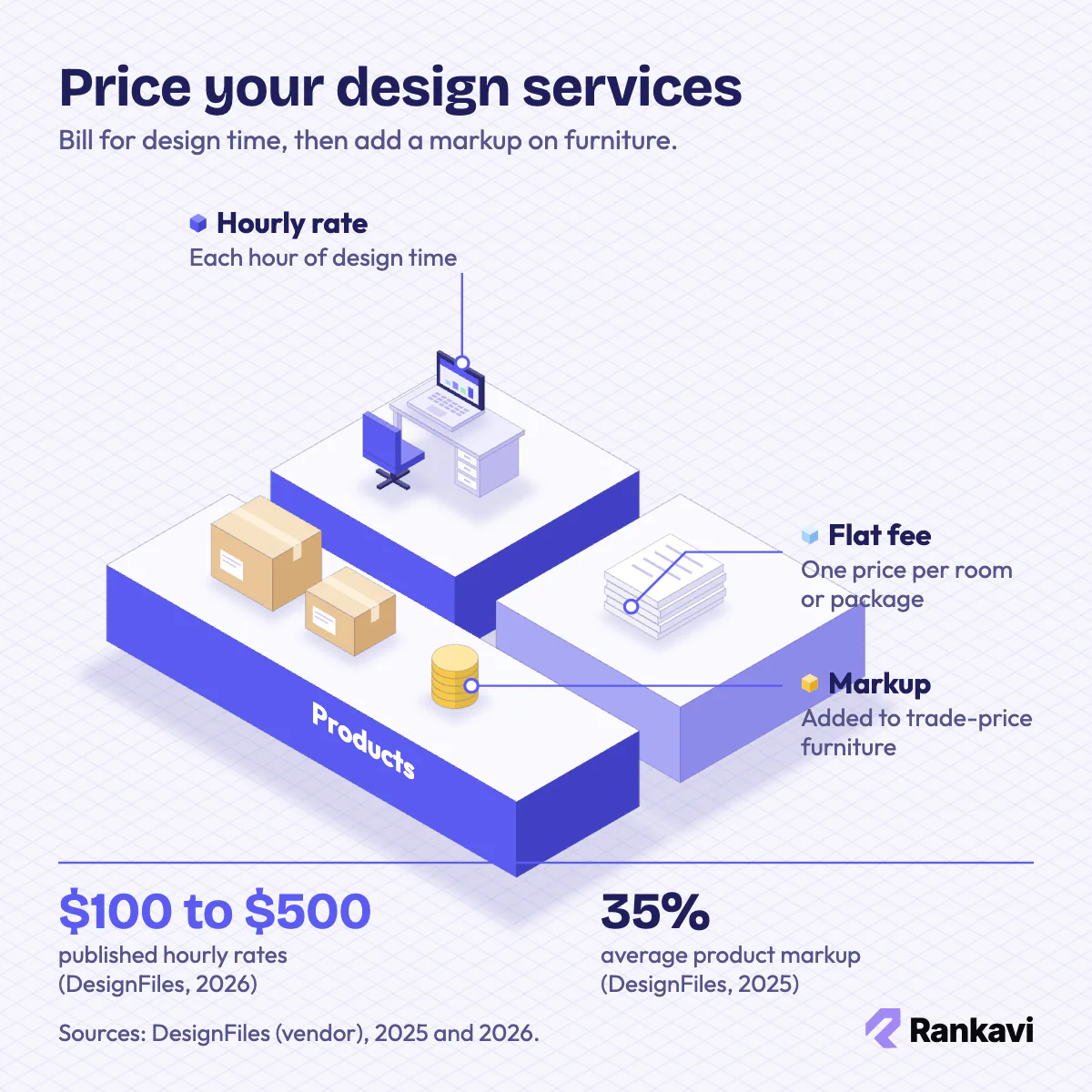
Common fee models:
| Model | How it works |
|---|---|
| Hourly rate | The client pays for each hour of design time |
| Flat fee | One price covers a defined room or package |
| Percentage of project cost | The fee follows the total budget |
| Cost plus markup | The studio adds a margin to furniture it buys at trade prices |
DesignFiles, which makes software for design studios, put published hourly rates at $100 to $500 in August 2026. Its August 2026 guide also listed $450 to $1,500 per room for design-only work.
Those vendor figures come mostly from buyer-side price guides, which lean toward larger markets. A new designer in a smaller town usually starts near the low end.
Product markup adds a second income line. DesignFiles called 35% the industry average markup in an April 2025 vendor article, without naming a survey. Larger projects often pair a design fee with that markup.
Example: a solo designer bills hourly at the low end of the published range (illustrative).
| Input | Amount |
|---|---|
| Hourly rate | $100 |
| Billable hours per week | 20 |
| Working weeks per year | 46 |
| Yearly design fees | $92,000 |
| Professional liability insurance per year | $660 |
| Fees after insurance | $91,340 |
| Result | Above the $67,190 employee median, before software, taxes and other costs |
A written design contract makes the fee model enforceable. It lists the scope, the number of revisions, the payment schedule and who orders furniture.
Each model has a trade-off. Hourly billing suits work with an unclear scope but worries clients about cost. A flat fee gives clients certainty, but the designer absorbs extra hours if the project grows. Markup rewards sourcing, but clients may question the price of each item.
A minimum rate comes from simple arithmetic. Target income plus yearly overhead, divided by billable hours, gives the lowest workable hourly rate. Billable hours are fewer than working hours, because sourcing, client calls, marketing and bookkeeping are not billed.
Scope limits protect the fee. Contracts often cap revision rounds and price extra rounds separately. A change order records any added work before it starts. Late-payment terms and cancellation fees belong in the same document.
3. Fund the First Year
Funding an interior design studio covers a modest launch budget and the slow months before projects pay. Service businesses usually start smaller than shops or restaurants.
Startup costs fall into a few groups. Legal setup, insurance, design software, a website, branding and samples take most of the money. An accountant and lawyer-drafted contracts add professional fees.
The budget usually splits into six groups:
- Legal: entity filing and lawyer-drafted contracts
- Insurance: liability policies
- Software: design and project tools
- Brand: website, logo and business cards
- Samples: fabric, paint and flooring
- Accounting: bookkeeping and tax help
Owner pay is the key benchmark. The BLS reported a median wage of $67,190 a year, or $32.31 an hour, for interior designers in May 2025. A studio breaks even for its owner once fees beat that employee salary.
Personal savings fund most new studios. A business loan or a credit line helps when the owner needs a vehicle or a larger sample library. Lenders expect a business plan with revenue projections.
Working capital keeps the studio steady between deposits. Design projects run for weeks or months, so cash arrives in lumps. A reserve covers bills while the first projects finish.
Deposits shape the cash flow. A design deposit funds early work, and furniture deposits cover orders placed on the client’s behalf. Who pays vendors changes the risk. A studio that buys first carries the cost until the client pays.
Self-employment tax and health insurance also come out of fees. Gross fees overstate what the owner keeps, so a tax reserve belongs in the first-year budget.
4. Set Up a Studio Workspace
Most new designers start from a home office. The address keeps overhead low while the client list grows.
A coworking space or small rented studio comes later. It offers a professional meeting room and keeps work apart from home life. Some designers rent a studio once they hold regular client presentations.
Each option has a trade-off. A home office costs the least but limits client visits and blurs work and home life. A rented space costs more each month and adds a lease. That commitment is hard to carry before income is steady. Zoning rules and lease terms are worth checking before a studio opens at home or elsewhere.
A sample library needs real shelf space. Fabric swatches, paint decks, tile and flooring samples fill a room quickly. Good lighting helps clients judge colors correctly.
Storage and shipping need a plan too. Ordered furniture arrives at a receiving address, and delivery damage is found at unpacking. Studios without space often use a freight receiver, which handles deliveries and holds them until installation.
Client meetings often happen on site. Designers visit the home being redesigned, or meet at showrooms where clients can touch the materials.
5. Register, License and Insure the Firm
Registering an interior design business gives the studio a legal identity, a tax number and protection for personal assets. Most new designers choose a sole proprietorship or a limited liability company (LLC).
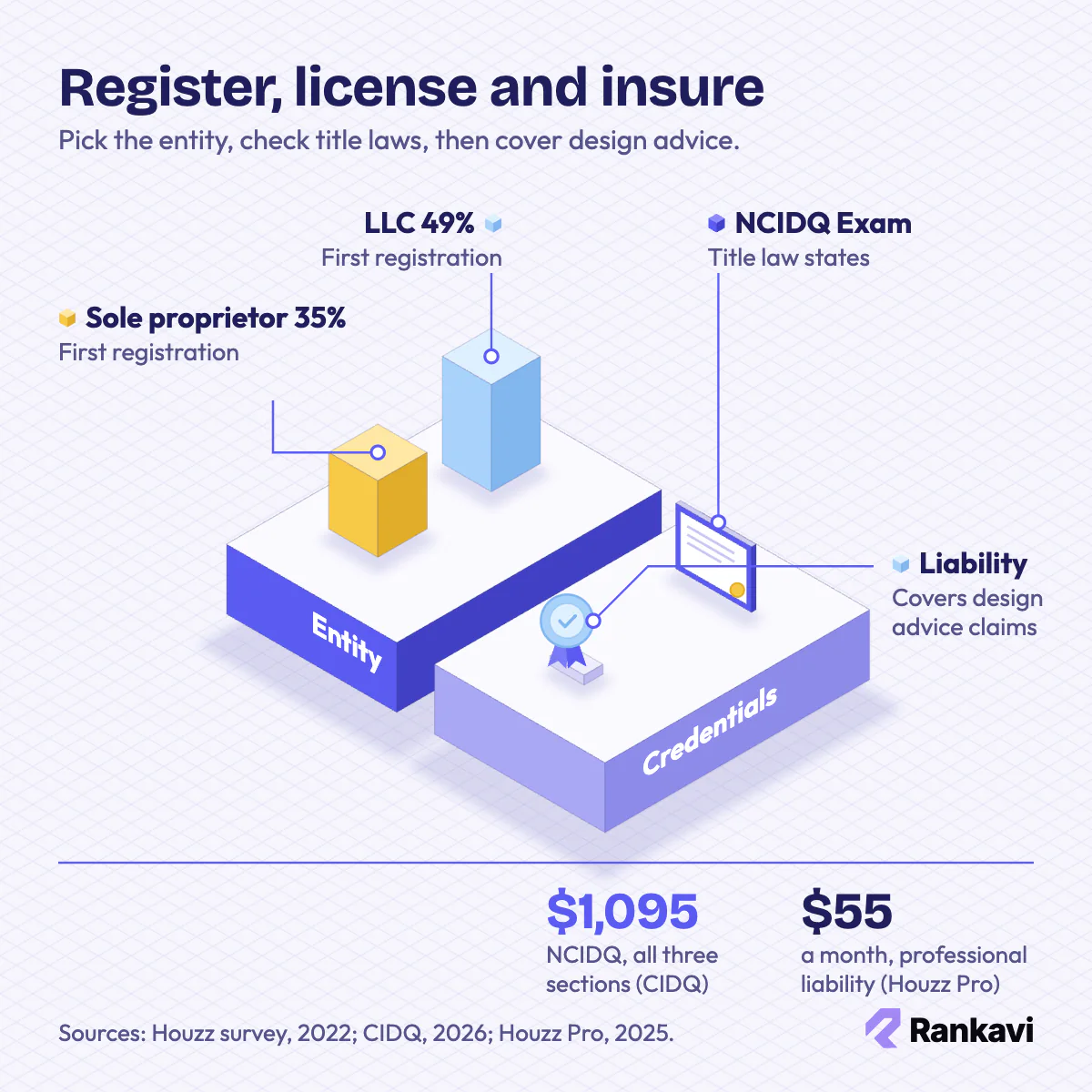
An LLC separates the owner’s home and savings from business debts and client lawsuits. An older Houzz survey from 2022 found 49% of designers first registered as an LLC and 35% as sole proprietors.
An employer identification number (EIN) comes free from the Internal Revenue Service (IRS). The studio uses it to open a business bank account and to apply for trade accounts.
Licensing depends on the state. In states that restrict the title “interior designer,” only candidates who pass a state-approved exam may use the registered title. The NCIDQ Exam is a national qualification test that many of those candidates take.
The Council for Interior Design Qualification (CIDQ) runs that exam and charged $1,095 for all three sections as of 2026. Candidates usually need a degree and work experience first.
Title laws and practice laws differ. A title act limits who may call themselves an interior designer. A practice act limits who may do certain work, such as plans filed for permits. Designers in states with either rule check the state licensing board before advertising services. Decorating and styling work often needs no license.
A seller’s permit lets the studio buy furniture for resale without paying sales tax up front. Houzz Pro listed professional liability insurance near $55 a month in its December 2025 vendor guide.
Insurance covers different risks. Professional liability responds to claims of design errors. General liability covers property damage and injury at a client site. Workers’ compensation applies once the studio hires staff. A written contract and a business bank account kept apart from personal funds support all of these protections.
6. Open Trade Accounts and Software
Trade accounts give a registered studio access to furniture and fabric lines sold only to the design trade. Showrooms usually ask for a resale certificate and proof of business.
Design software turns ideas into drawings clients understand. SketchUp is a three-dimensional modeling program for room models. AutoCAD is Autodesk’s drafting software, which produces precise floor plans.
Core studio tools:
| Tool | Job in the studio |
|---|---|
| SketchUp | Three-dimensional room models |
| AutoCAD | Precise floor plans |
| Canva | Mood boards and early concepts |
| Notion or a spreadsheet | Orders, invoices and timelines |
Project management software tracks orders, invoices and timelines. Free tools work at the start. Industry platforms add client portals, product clipping and purchase orders.
A reliable contractor network finishes the work. Painters, cabinet makers, electricians and installers turn plans into rooms.
Trade programs differ by seller. Some require a resale certificate, others a business license or a portfolio. Terms cover trade pricing, minimum orders, lead times and return rules. Comparing these terms before the first order avoids surprises on custom items, which are often not returnable. Designers build those relationships before promising dates to clients.
7. Market Your Portfolio
Marketing an interior design studio turns a portfolio into booked consultations. Clients hire designers whose past rooms match their own taste.
A portfolio comes first, even without paid projects. Three-dimensional renderings, mood boards and photos of the owner’s own home show style and skill. Real client projects replace them over time.
A professional website hosts the portfolio, the services and a contact form. Squarespace and WordPress let owners update it without a developer. A blog about local projects helps search engines find the studio.
Instagram and Pinterest suit a visual business. Before and after posts, short videos and room details reach homeowners planning a project.
Photography decides how the portfolio looks. Good photos of finished rooms outperform renderings, and clients usually need permission before their home is published. A short case study per project, covering the problem, the solution and the result, helps visitors judge fit. Houzz, a home remodeling and design platform, adds a directory profile where homeowners compare local designers.
Referrals bring the warmest leads. Friends, past clients, real estate agents and contractors pass names along. The American Society of Interior Designers (ASID), a professional membership organization with 43 chapters, adds credibility and local networking events.
8. Grow Beyond Solo Projects
Growth starts when the owner’s calendar is full. At that point, the studio needs help to take on more projects.
Outsourcing comes before full hires. Virtual assistants handle orders and invoices, while freelance drafters produce drawings. The designer keeps the client relationship and the creative direction.
Repeat clients and referrals lower the cost of each new project. A studio that stays in touch after installation often designs the next room too.
Hiring changes the risks. Employees bring payroll, workers’ compensation and management time, while contractors bring flexibility but less control over quality. Moving from one-off help to regular staff makes sense once work is steady for several months.
New income streams spread the risk. Workshops, virtual consultations, collaborations with architects and commercial projects all build on the same skills.
9. Gain Designer Mentions in Google AI Overviews
Visibility in AI search puts an interior design studio in front of homeowners before they contact anyone. Many now ask Google or ChatGPT to suggest a local designer for a kitchen remodel or a full home.
Answers in Google AI Overviews draw on design directories and articles the engine already trusts. Houzz profiles, local press, design blogs and “best interior designers” roundups feed those summaries. A new studio benefits from appearing on those pages early, while its name is still unknown.
Rankavi is a software as a service (SaaS) platform that publishes brand mentions in articles on indexed third-party websites. Design studios can use it to earn third-party mentions for AI Overviews in articles about their style and city.