

Etsy is an online marketplace for handmade, vintage and craft supply items. Starting an Etsy business takes a focused product idea, a verified seller account and findable listings. Etsy, Inc. reported 86.5 million active marketplace buyers at the end of 2025 in its Form 10-K.
A bit about me: my name is Michal Sieroslawski, and I help Etsy shops get noticed by shoppers online. Chat-based search is changing how shoppers find Etsy shops. That makes a place in those answers worth working toward.
The order moves from proof of demand to legal and money basics before the shop opens. Product, price and delivery come next, so every listing can sell at a profit from day one. Opening an Etsy business follows the twelve steps below.
- Choose What Your Etsy Shop Sells
- Validate Demand With Etsy Research
- Register Your Business Basics
- Budget for Etsy Fees and Startup Costs
- Price Each Item for Profit
- Open Your Etsy Storefront
- Check Licenses and Product Rules
- Source Materials and Production Partners
- Set Up Shipping and Fulfillment
- Write Listings That Get Found
- Grow the Shop After First Sales
- Show Up When Shoppers Ask AI for Gifts
1. Choose What Your Etsy Shop Sells
An Etsy niche means one product type for one clear customer with one distinct twist. The niche guides every later choice, from the shop name to the listing photos.
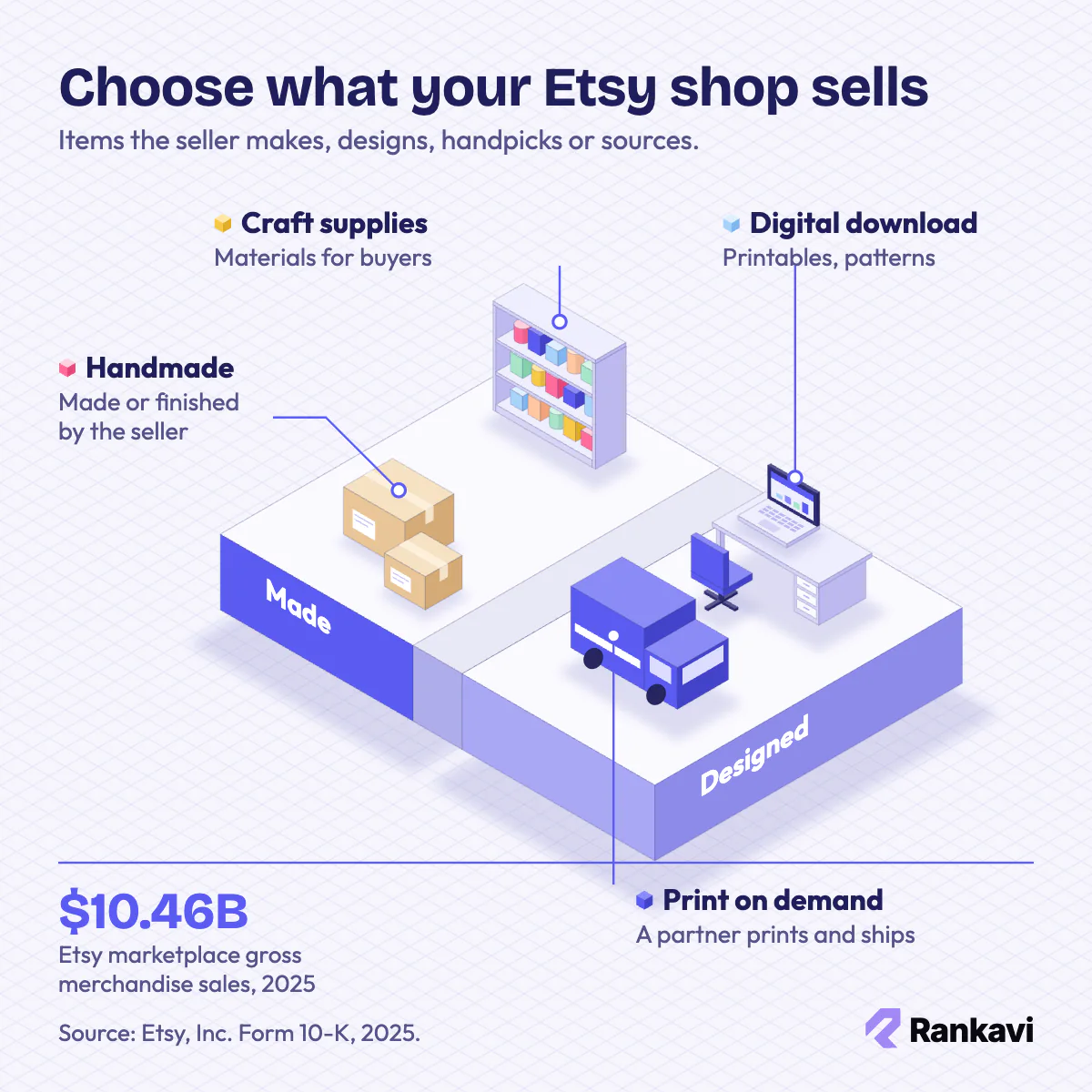
Etsy, Inc. reported $10.46 billion in Etsy marketplace gross merchandise sales for 2025 in its annual Form 10-K. The marketplace accepts items made, designed, handpicked or sourced by the seller. Handmade goods, original designs, vintage pieces and craft supplies all fit these groups. Mass-produced goods bought for resale do not.
New sellers also pick an offer type. Handmade products need materials and making time. Print on demand (POD) puts an original design onto items made by a production partner. Digital downloads, such as printables and patterns, need no shipping.
A narrow focus helps Etsy show the right listings to the right shoppers. “Home decor lovers” is too broad a target. “Nursery wall art for modern parents” gives the shop a clear audience. Extra product ideas can wait until the first range sells.
Each offer type trades cost against control. Handmade work gives full control, but making time limits output. Print on demand removes stock, yet the partner’s fee adds to each item’s cost. Digital downloads need no shipping, though each listing must stand out from similar files.
A niche choice weighs five points: skill fit, startup cost, profit margin, shipping size and seasonality. Evergreen products give steady sales. Seasonal lines can follow once the shop has orders.
Common mistakes include picking a category as broad as jewelry. Others are copying a bestseller without a twist and choosing fragile items without checking shipping. A shop can start with one offer type. A matching one, such as a printable version of a physical print, can follow later.
Etsy offer types:
| Offer type | What the seller does |
|---|---|
| Handmade | Makes or finishes each item |
| Print on demand | Creates the design for a production partner |
| Digital download | Sells a file the buyer prints or uses |
| Vintage and handpicked | Curates older items or themed sets |
| Craft supplies | Sells materials that help buyers create |
2. Validate Demand With Etsy Research
Product validation involves checking buyer interest before spending time and money on stock. Validation replaces guesswork with evidence from the marketplace itself.
The Etsy search bar is the first research tool. Its autocomplete suggestions come from real shopper searches. The results page then shows common styles, popular colors and where prices cluster.
Validation works best with a pass mark set before research starts. One example is how many competing listings show recent sales. A clear rule stops hopeful guessing.
eRank is a keyword research and shop analytics tool built for Etsy sellers. It adds search volume, competition scores and trend data. A specific phrase with steady searches and moderate competition beats a broad term. “Nursery animal wall art” usually outperforms “wall art” for a new shop.
Competition is real, because Etsy, Inc. counted 5.6 million active Etsy marketplace sellers on December 31, 2025, in its Form 10-K. Reviews show whether similar items still sell. Recent reviews on competing listings prove current demand.
A gap, such as few listings for one occasion, points to room for a new shop. Seasonal products need a plan for the months when searches fall. Some sellers also post draft listings in maker communities and ask for honest feedback before launch.
3. Register Your Business Basics
Registration decides how the shop is taxed and whose name stands behind each sale. Etsy asks for a seller type during payment setup, so the choice comes before the shop opens.
Most Etsy sellers file as sole proprietors under their own name. Etsy, Inc. reported in its 2025 Form 10-K that 89% of its sellers, per its 2024 Seller Census, are businesses of one. A limited liability company (LLC) suits candle, cosmetics and toy makers, since claims then stay with the business.
Business sellers enter a legal name, address and registration number. US businesses add an employer identification number (EIN) from the Internal Revenue Service (IRS), which issues it free. Individual sellers give a personal taxpayer number instead. Before filing, the name gets checked against Etsy shops, social handles, domains and the state business database.
A separate bank account keeps Etsy deposits apart from household spending. One spreadsheet that logs every sale, fee and receipt turns tax season into an afternoon.
Registration choices can change later. Many sellers start as sole proprietors and form an LLC once sales grow. Local rules differ, so the state business agency or a tax professional confirms the details.
4. Budget for Etsy Fees and Startup Costs
An Etsy startup budget covers a one-time setup fee, per-order selling fees and the first batch of stock. A standard shop pays no monthly fee, so most costs arrive only when listings go up or orders come in.
Startup money at a glance:
| Item | Typical figure |
|---|---|
| Startup cost | $20 to $50 for a digital shop; $200 to $500 for a handmade shop |
| Main costs | One-time $15 US setup fee, $0.20 per listing, materials and first stock, packaging, photo setup |
| Typical margin | 25% to 40% gross margin after fees, materials and labor |
| Time to open | Same-day setup once identity checks clear; first sale often 30 to 60 days later |
Sources: Etsy 2026; Bootstrapping Ecommerce 2026; Craftybase 2026; Printify 2026.
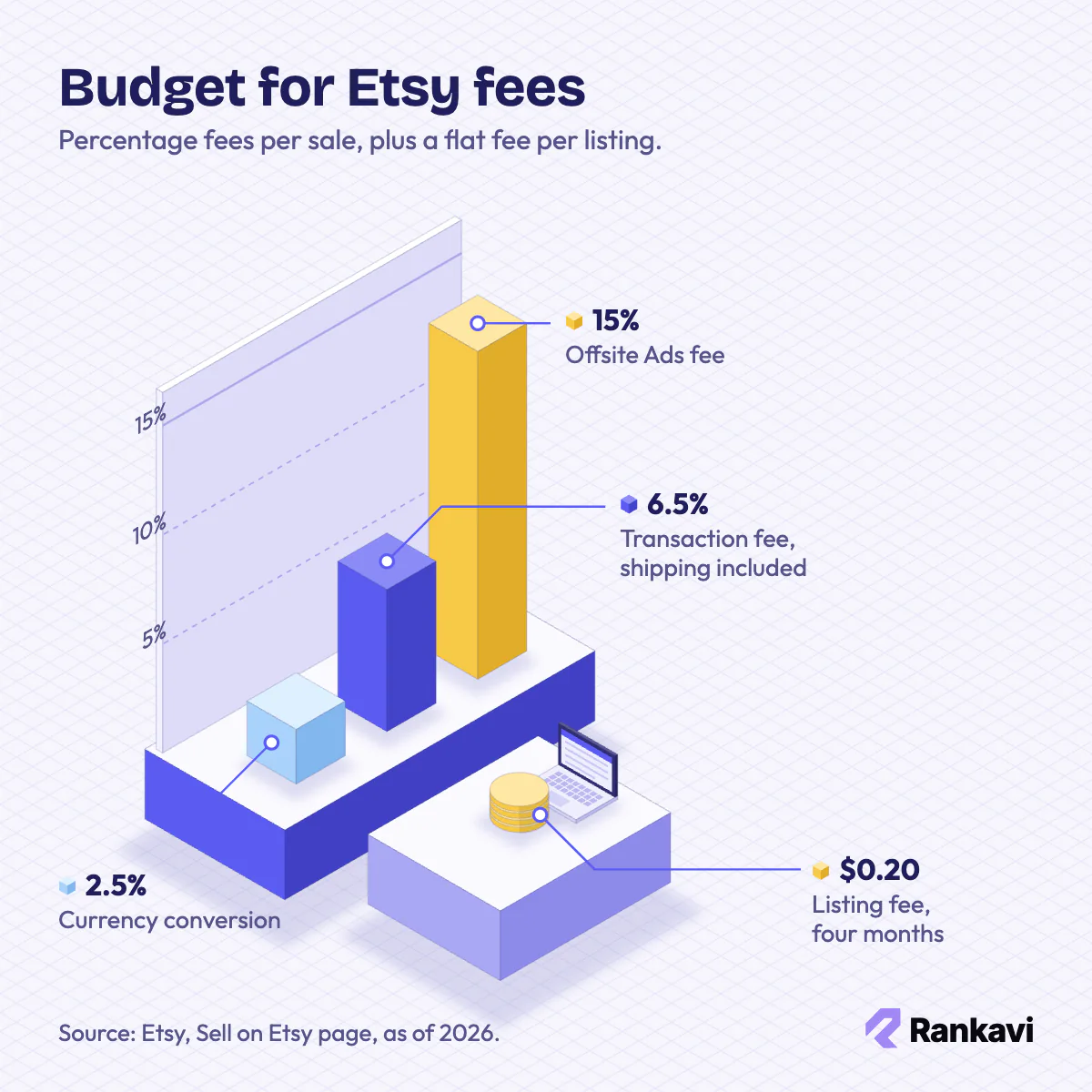
As of 2026, Etsy’s Sell on Etsy page lists a $0.20 listing fee lasting four months. The same 2026 page lists a 6.5% transaction fee, shipping included, and US payment processing at 3% plus $0.25 per order. It also lists a 2.5% currency conversion fee in 2026. Etsy’s Seller Handbook announced a one-time $15 setup fee for some new shops in 2025.
Offsite Ads cost 15% of an attributed sale in 2026, or 12% once a shop reaches $10,000 in yearly sales, per Etsy’s Help Center.
The cost, margin and timing rows come from seller-tool vendors, not from Etsy. Bootstrapping Ecommerce, an ecommerce blog, estimates $20 to $50 to start a digital shop and $200 to $500 for a handmade one in 2026. Craftybase, an inventory software vendor, calls a 25-40% margin healthy in 2026. Printify, a print-on-demand vendor, estimates 30 to 60 days to a first sale.
Total fee share per order is the number experienced sellers check first. Marmalead’s 2026 example of a $50 item with $7 shipping paid $5.87 in base fees, about 10.3% of the order. On an Offsite Ads sale, Marmalead’s 2026 figures put fees at 28.8% of the item price. A price that only covers base fees loses money on ad-driven sales, which pushes break-even further out.
Worked example: An illustrative tea towel shop charges $30 plus $6 shipping, so each order brings in $36. Etsy fees come to about $3.87. Fabric, printing and packaging cost $9, and postage $6. About $17 per order remains. A $400 start, setup fee included, breaks even after roughly 24 orders. That is before Etsy Ads, owner pay and income tax.
Costs differ by offer type. Digital shops pay little upfront, while handmade and print on demand shops carry the cost of materials or sample orders. A sample of each print on demand item shows the true quality and shipping cost before listing.
Most sellers fund the start from savings, because the first batch stays small. The Small Business Administration (SBA) microloan program, crowdfunding and credit cards suit makers buying a heat press or kiln.
5. Price Each Item for Profit
Etsy pricing sets whether each sale covers its full cost and still pays the seller. A sound price starts from real costs, not from the cheapest competing listing.
The cost per item adds materials, packaging, Etsy fees and the seller’s time. A small buffer covers mistakes and returns. Underpriced items keep a shop busy without making money.
Competitor prices show the range, but value sets the final figure. Better photos, personalization, faster turnaround and nicer packaging justify a higher price. Buyers on Etsy often pay for quality and story over the lowest price.
Small price tests show how buyers respond. Sellers adjust one price, then track views and sales over the following weeks. A healthy margin also leaves room to fund Etsy Ads later.
Free shipping works best when the shipping cost sits inside the item price. Etsy’s search gives free shipping extra weight for US shoppers. The listing price then carries the delivery cost.
Price tiers help buyers compare. A small, standard and premium version of one product lets shoppers pick a budget. Each tier needs its own cost check so none sells at a loss.
Handmade sellers often forget wages. Paying the seller’s own time at a fair rate keeps the shop from becoming an unpaid hobby.
An Etsy price covers five cost elements:
- Materials
- Packaging
- Etsy fees
- The seller’s time
- A buffer for mistakes and returns
6. Open Your Etsy Storefront
Storefront setup turns a personal Etsy account into a verified shop that can take payments. Etsy requires the setup to start in a desktop web browser.
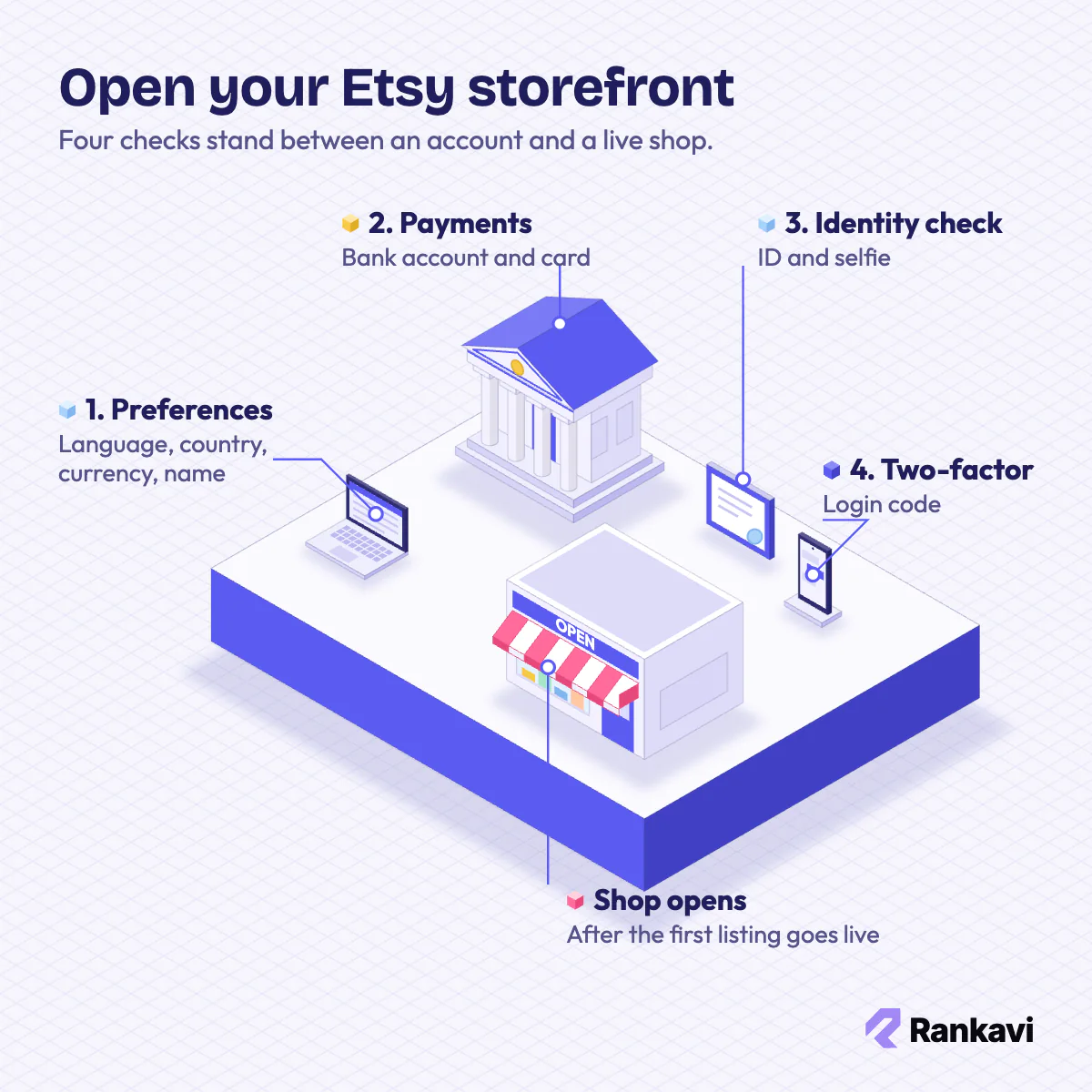
The seller first picks the shop language, country and currency. The default language cannot change later, so it should be the language used with buyers. Translations can be added after the shop opens.
The shop name must fit Etsy’s length limit, with no spaces, special characters or profanity. It also cannot copy an existing shop or a trademark. Etsy lets sellers change the name after opening.
Etsy Payments is required, so the shop can only open in a supported country. US sellers link a bank through Plaid, which provides bank connections for apps. Some other countries use Payoneer, which runs cross-border payouts. A credit or debit card pays Etsy’s own bills, including the setup fee.
Identity checks run through Persona, which compares a photo of a government identity document with a selfie. Two-factor authentication is also required. These checks protect buyers and the seller’s earnings.
The shop goes live once a first listing is published, so the next step’s product rules come first. A logo, shop banner, About section and shop policies complete the storefront. A simple first version works well, and sellers refine it as they go.
Shop policies set expectations on processing time, returns and exchanges. Clear wording reduces disputes later. Custom items need policy text that explains why returns are limited.
Storefront setup sequence:
- Set the shop language, country, currency and an available name.
- Connect a bank account and billing card.
- Pass the Persona identity document and selfie check.
- Turn on two-factor authentication.
- Publish the first listing.
- Add a logo, banner, About section and policies.
7. Check Licenses and Product Rules
Checking the rules protects the shop from suspension and the owner from legal claims. Etsy sets its own marketplace rules, and local laws apply on top of them.
Etsy does not require a business license to sell on the platform. Sellers still follow every law that applies to a small online business where they live. City, county or state rules may ask for registration or sales tax accounts as sales grow.
Etsy’s Prohibited Items Policy, Creative Standards and seller policies all apply before that first listing goes live. Reselling mass-produced goods as handmade breaks these rules. Etsy closes shops that misrepresent how items are made.
Intellectual property rules catch many new sellers. Copyrighted characters, fan art and brand logos lead to listing removals and account suspensions. The shop name also must not infringe another business’s trademark.
Some products carry safety rules of their own. Candles, cosmetics and children’s toys face labeling and testing requirements in many countries. Sellers in these categories confirm the rules before listing.
Rules differ by country and by product, so a seller outside the US checks local law. Notes on where materials came from help when a buyer asks how an item was made.
New sellers check five groups of rules before the first listing:
- Local business and sales tax rules
- Etsy’s Prohibited Items Policy
- Etsy’s Creative Standards
- Copyright and trademark rules
- Product safety rules for candles, cosmetics and toys
8. Source Materials and Production Partners
For handmade, print-on-demand and digital shops alike, sourcing determines how each product gets made, stored and delivered. The right supply setup depends on the offer type chosen in the first step.
Handmade sellers list every material a product needs. Wholesale suppliers beat craft store prices once orders become regular. The first order should cover a small batch, not a warehouse of stock.
Each supply route carries its own risk. Handmade sellers risk running short of materials. Print on demand sellers depend on a partner’s quality. Digital sellers depend on their own design time. A backup supplier limits delays if the first one runs out.
Print on demand sellers choose a production partner and connect it to the shop. Printful is a print-on-demand company that prints, packs and ships products for online sellers. The partner prints, packs and ships each order after the sale. The seller holds no inventory.
Digital sellers decide on file types, such as printable documents and high-resolution image files. They match the common paper sizes in their niche, such as US Letter and the European standard sheet. Clear instructions explain how buyers open and print each file.
Design and photo tools round out the setup. Canva, Procreate and Adobe Illustrator cover most product and shop graphics. A phone camera, natural window light and basic editing produce listing photos good enough to sell.
9. Set Up Shipping and Fulfillment
Once an order arrives, fulfillment keeps it moving from sale to doorstep on the promised date. Shipping choices affect costs, reviews and the seller’s working week.
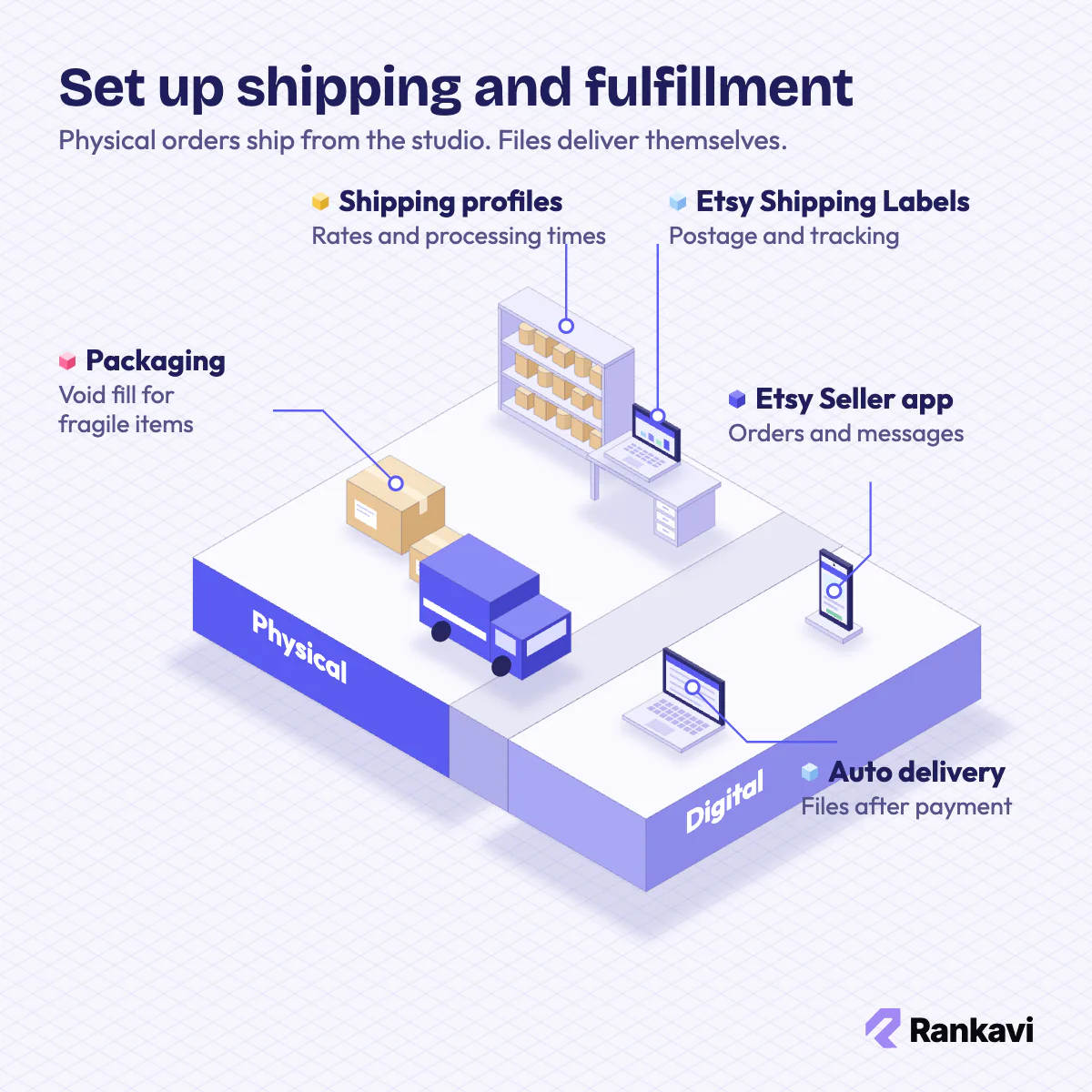
Shipping profiles store rates, destinations and processing times for groups of listings. Accurate processing times set fair buyer expectations. Fast estimates win sales only when the shop can meet them.
Etsy Shipping Labels let sellers buy postage from US and international carriers inside the shop. Labels purchased this way come with postage discounts. They also add tracking to each order automatically.
Good packaging stops breakage in transit. Kraft paper and packing peanuts fill empty space around fragile items. Tracking, signature confirmation and shipping insurance suit valuable orders, and expedited options help last-minute gift buyers.
Digital products deliver themselves once payment clears. Buyers download files from their order page or by email. The Etsy Seller app handles orders and messages on the go, and quick replies build buyer trust.
Free shipping and paid shipping suit different products. Heavy or fragile items change the math, so weight and box size get checked before the price is set. Delays and damage can lead to bad reviews. A clear processing time on the listing and a prompt reply to any delivery problem protect the shop’s rating.
10. Write Listings That Get Found
Before any ad spend, listing copy gives each item the words and images it needs to reach a first buyer. The first sale can take weeks or months while Etsy tests new listings.
Etsy search ranks listings on tag and title relevance, attribute relevance, listing quality and customer experience. The seller controls most of these factors. Each listing therefore works as the shop’s main marketing asset.
Titles start with the phrase a buyer would type. “Lavender eye pillow for sleep” beats a cute collection name. Every available tag and attribute should carry a real search phrase. Descriptions explain what the item is, who it suits, sizing and care.
Photos act as the shop’s handshake. A strong listing shows the whole product, close-up details, a scale shot and a lifestyle image. A short phone video adds texture and movement.
Etsy Ads work best on listings that already earn views or favorites. A small daily budget limits risk while sellers learn which ads convert. Outside Etsy, one social platform, such as Pinterest, Instagram or TikTok, brings steady extra traffic.
Listings improve through testing. After a few weeks, sellers review which titles and photos earn views, then update weak listings one at a time. Changing one element at a time shows what made the difference.
What a strong Etsy listing includes:
| Element | Job |
|---|---|
| Title | Matches the buyer’s search phrase |
| Tags and attributes | Add related search phrases |
| Description | Answers buyer questions |
| Photos | Show the whole item, details and scale |
| Video | Shows texture and movement |
11. Grow the Shop After First Sales
After the first orders, growth involves expanding what already sells, rather than guessing at new products. Sales, views and favorites show where the next listing should go.
A fuller catalogue widens the shop’s reach. Each listing targets its own long-tail searches. Variations in color, size or style and small bundles add listings without a new product line.
New products grow from proven best sellers. A design that sells on t-shirts can move to hoodies next. A popular wedding sign can expand into matching table numbers. Unrelated products confuse buyers and dilute the brand.
Customer service drives reviews, and reviews drive sales. Etsy awards a Star Seller badge to shops with consistently excellent service. Fast replies and on-time shipping keep that badge within reach.
Automation saves time as order volume grows. Saved message replies, scheduling tools and production partners remove daily admin. Many sellers later build an email list or their own website, with Etsy still a core sales channel.
Growth carries trade-offs. More listings mean more upkeep, and more orders mean more packing time. Sellers decide early which tasks to automate or hand off so quality holds.
12. Show Up When Shoppers Ask AI for Gifts
AI visibility means a shop’s name appears when a buyer asks a chatbot for a handmade or vintage item. Questions like “where to buy a custom dog portrait” now often go to ChatGPT, Gemini or Perplexity.
Assistants build those replies from pages they already trust. Gift roundups, maker features, craft blogs and “small shops to support” lists supply most of the names. A shop that appears across several of those pages gives the assistant a reason to suggest it.
Earning those features by emailing editors takes months for a one-person shop. Rankavi is a software as a service (SaaS) platform that publishes brand mentions in articles on indexed third-party websites. Shops pay from $12 per article. Those articles act as AI brand mentions on pages ChatGPT can read when a buyer wants a handmade gift.