

Starting a window cleaning business takes a lean tool kit, liability insurance, a registered company and a dense local route. IBISWorld, an industry research firm, counted 35,344 window washing businesses in the United States in 2024.
My name is Michal Sieroslawski, and I work on helping window cleaning companies get found online. ChatGPT and Google’s AI Overviews now suggest window cleaning companies by name, and that list matters.
This order sets prices before any money is spent, then lines up funding before registration and insurance fees. Tools come only after the company can legally take paid work. Here are the eleven steps to start a window cleaning business, from first idea to first customers, listed below.
- Choose Residential or Commercial Window Work
- Research Local Demand and Competitors
- Write a Window Cleaning Business Plan
- Price Windows, Screens and Add-Ons
- Fund the Starter Kit and Vehicle
- Register and License the Company
- Insure Against Falls and Broken Glass
- Buy Squeegees, Poles and Ladders
- Set Up Routes and Scheduling Software
- Win the First Window Cleaning Customers
- Land on Claude’s AI Window Cleaner Shortlists
1. Choose Residential or Commercial Window Work
Choosing a market decides which customers, tools and insurance a window cleaning company needs first. Most new owners pick between homes and commercial buildings before buying anything.
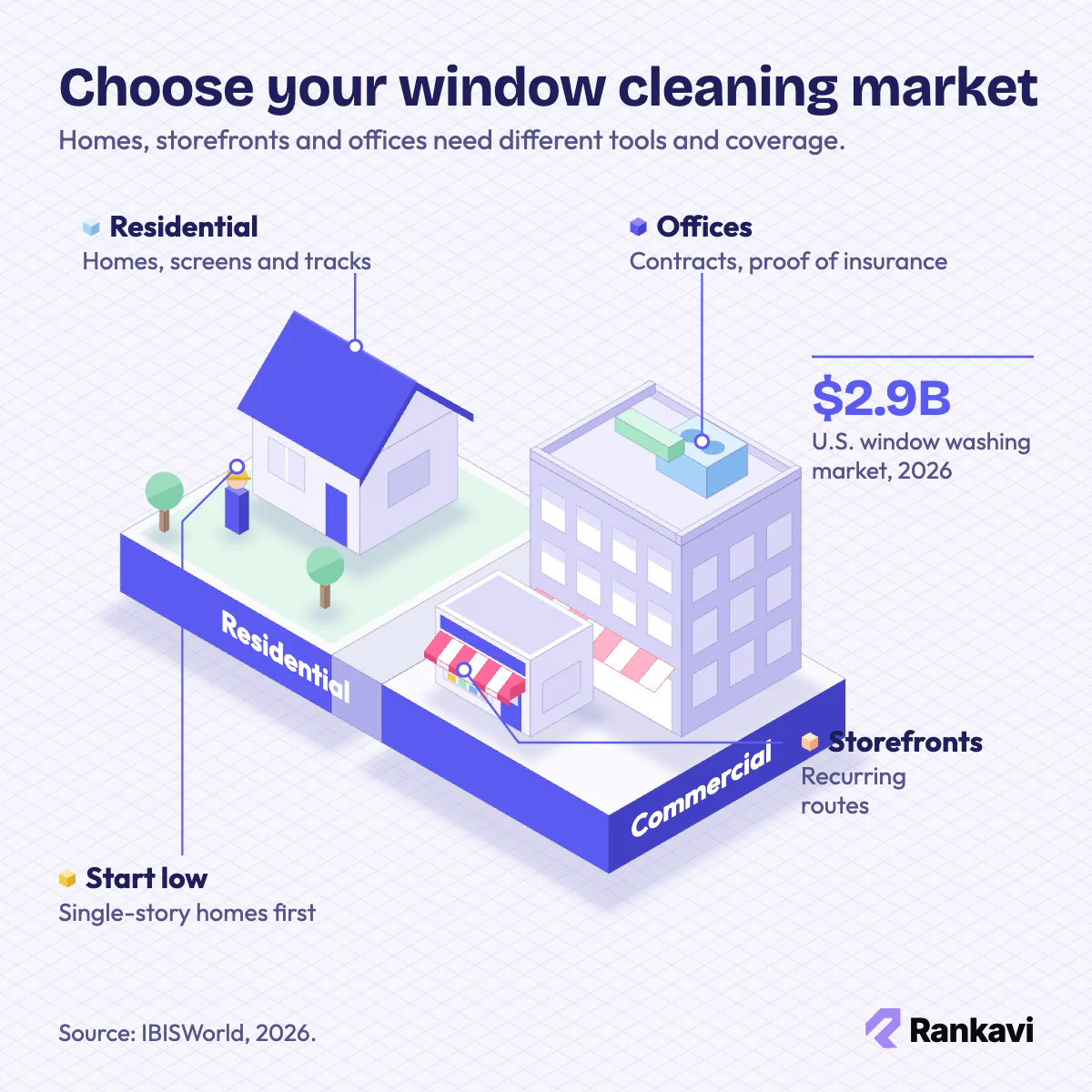
Residential work covers houses, townhomes and small apartment buildings. Homeowners book seasonal cleans and often add screens, tracks and sills. Referrals and door hangers reach this market quickly.
Commercial work covers storefronts, offices and managed properties. Storefront routes repeat on a set frequency, so income stays steady. Storefronts are street-level shops, while commercial covers offices and managed properties. IBISWorld estimated the U.S. window washing market at $2.9 billion in 2026, with commercial services making up most sales.
The two markets differ in how they pay and how they hire. Homeowners usually pay when the job ends. Commercial accounts are often invoiced, so cash arrives later, and proof of insurance is commonly requested first.
The two markets also differ in how work is won. Residential jobs come from referrals and online listings. Commercial jobs come from written bids, property managers and subcontracting for larger cleaning firms.
High-rise work forms a separate specialty. Rope descent systems, suspended scaffolds and lifts call for advanced training and much higher coverage. Most new window washers stay on low buildings until they gain experience. Ladders and water-fed poles cover low buildings. Taller work needs rope descent or suspended platforms, which fall under federal safety rules covered in step 8.
A common path starts with residential jobs and adds a few storefront accounts that fill quiet weekdays. A commercial base follows once insurance and invoicing are in place. Starting residential suits a small budget and quick payment, while storefronts suit an owner who wants recurring income and can handle paperwork.
“Stick with single story homes as best that you can at first as your practice morphs into experience.”
— A window cleaner on the WindowCleaner.com community forum
Add-on services raise the value of each visit. Screen cleaning, hard water stain removal, gutter cleaning, solar panel washing and post-construction cleanup fit the same route.
Common window cleaning markets:
| Market | Typical customers | Main demand |
|---|---|---|
| Residential | Homeowners and townhome owners | Seasonal cleans plus screens and tracks |
| Storefront | Retail shops, restaurants and dealerships | Frequent recurring routes |
| Commercial | Offices and managed properties | Contracts and proof of insurance |
| High-rise | Tall buildings | Rope access and specialty safety gear |
2. Research Local Demand and Competitors
A local market study shows whether a town has room for one more window cleaner. A short list of nearby competitors answers most of that question.
The field is wide open nationally. IBISWorld reported in 2026 that no window washing company holds more than 5% of the U.S. market.
Competitors include more than other window cleaners. Franchises, pressure washing firms and janitorial companies that sell windows as an add-on chase the same customers. Part-time operators often undercut prices, so a full-time company is the real benchmark.
Google Maps lists nearby window cleaners with ratings, review counts and photos. Nextdoor is a neighborhood network where homeowners ask neighbors for service recommendations. Angi and Thumbtack are lead marketplaces that show who bids for local jobs.
A quick phone survey works well. Calling the top local results as a customer reveals prices, lead times and service menus. Slow callbacks or unprofessional answers point to unmet demand. Useful questions cover the price per window or per house and extra charges for screens and tracks. Others cover how soon a crew can start and whether recurring plans and insurance are offered. Asking as an honest prospective customer is enough.
Online reviews show what customers dislike about current companies. Missed appointments, streaks and damaged screens all hint at a gap a careful newcomer can fill. Tallying the complaints in low-star reviews shows which problem repeats most. Five-star reviews show the standard to match.
The U.S. Census Bureau is the federal agency that publishes local data on household income, home ownership and business counts. Its County Business Patterns data counts existing companies, with window cleaning grouped under janitorial services. Zillow and county property records show home age, size and number of stories.
Housing stock shapes the whole business. Neighborhoods full of two-story homes need longer ladders or a water-fed pole. Single-story streets suit a beginner with basic tools.
Weather matters too. Cold or rainy regions slow exterior work for part of the year. Owners there plan interior jobs, storefronts or a cash reserve for the slow months. Pollen, dust, hard water and salt air raise demand in some towns, so local conditions can offset the slow season.
A spreadsheet with one row per competitor keeps the findings comparable. Columns for services, quoted prices, review count, response time and weak points are enough. The research ends in a decision: enter the town, adjust the niche or service area, or pick another town.
3. Write a Window Cleaning Business Plan
A window cleaning business plan sets the route size and average job value the company needs to cover its costs. Lenders ask for one before they fund a van or equipment. A solo owner who self-funds still gains from a plan, because it shows how many jobs a week cover costs and owner pay.
Core plan sections:
| Section | What it covers for a window cleaner |
|---|---|
| Executive summary | The business, the service area and the revenue goal in half a page |
| Target market | Homes, storefronts or commercial buildings |
| Competitor analysis | Nearby companies, their prices and gaps |
| Services and pricing | The service menu and pricing method |
| Operations | Crew size, service radius and the winter schedule |
| Equipment and costs | Tools, vehicle, insurance and supplies |
| Marketing plan | How the first customers find the company |
| Financial projections | Startup budget, 12-month cash flow and break-even |
| Income goals | Short- and long-term revenue targets |
| Risks | Weather, seasonal slowdowns, injury and lost customers |
The plan should state whether high-rise and rope work are in or out. That choice changes insurance and equipment costs. Services such as screens, gutters and pressure washing belong in the service menu.
Route density is the key assumption in a window cleaning plan. Jobs packed into a few neighborhoods earn more per hour than scattered stops.
Average job value, jobs per day and drive time between stops decide whether the numbers hold. Break-even can be stated as jobs per week once monthly costs are known. Conservative, expected and best-case versions show how a slow winter changes cash flow.
A one-page plan works as a first draft. It grows into a full plan when a bank asks for one. The Service Corps of Retired Executives (SCORE) is a nonprofit that offers small business owners free volunteer mentors. A mentor can review a draft plan.
4. Price Windows, Screens and Add-Ons
Window cleaning prices determine whether each stop pays for the drive, the insurance and the owner’s time. Most companies quote per window, per hour or by building size.
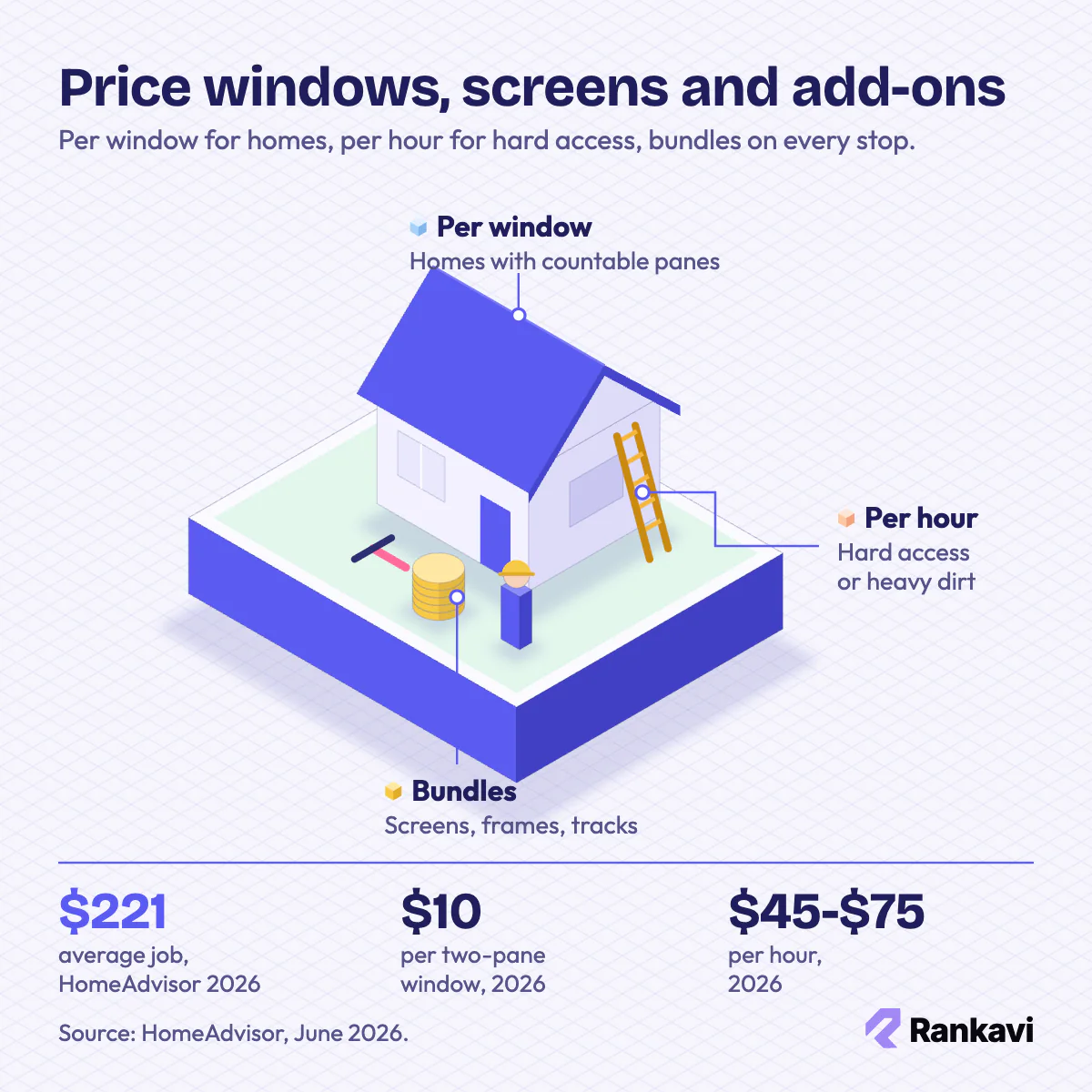
HomeAdvisor is an Angi-owned marketplace that matches homeowners with service pros. Its June 2026 guide put the average residential window cleaning job at $221, within a $150 to $302 range. That average job is the number to check first, because break-even becomes a count of homes per week.
Per-window pricing suits homes, because owners can count their windows. HomeAdvisor’s June 2026 guide listed about $10 per standard two-pane window, within a $4 to $15 range. Pros who bill by time charged $45 to $75 an hour in that 2026 guide.
Several factors move a quote. These include the number of panes and stories, interior or exterior work, screens and tracks, hard water stains and access. Per-window pricing can undercharge French-pane windows with many small panes. Interior and exterior work are often priced separately.
Commercial buildings usually get quotes based on square footage, height and scope. Access and setup time vary far more than on homes.
Bundles raise the average ticket without an extra trip. HomeAdvisor’s 2026 guide priced screen cleaning at about $5 per screen. A package of glass, screens, frames and tracks earns more on a stop already on the schedule.
A minimum charge protects the route. Small or distant jobs can cost more in drive time than they bring in. Some owners simply decline jobs that break up a dense route. Recurring customers can justify a lower price per visit, because the route stays full without new marketing.
Early discounts help a new company collect reviews. A small discount in exchange for a photo review builds trust fast. Deep, lasting discounts trap the business in low prices.
5. Fund the Starter Kit and Vehicle
Startup funding covers the tools, the vehicle, insurance and cash for the first slow weeks. A window cleaning company needs far less money than most service trades.
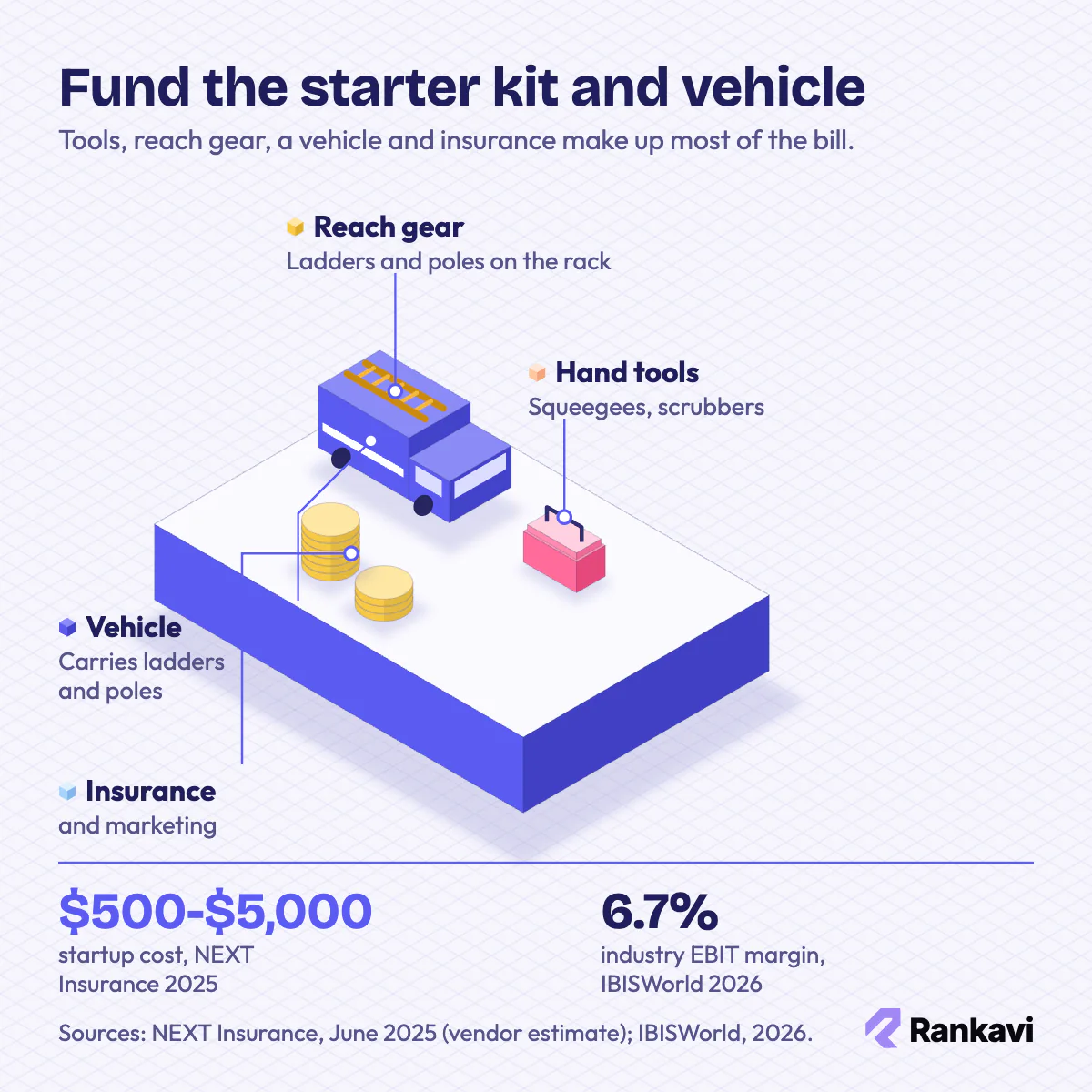
NEXT Insurance is an online small business insurer that publishes startup guides. It estimated in June 2025 that window cleaning startups often cost $500 to $5,000, depending on gear.
Startup money at a glance:
| Item | Typical figure |
|---|---|
| Startup cost | $500 to $5,000 (vendor estimate) |
| Main costs | Hand tools, ladders and poles, a water-fed pole system, a vehicle, insurance, marketing |
| Typical margin | 6.7% of revenue as earnings before interest and taxes, industry-wide |
| Time to open | A few weeks with basic tools; no published average exists |
Sources: NEXT Insurance (an online insurer), June 2025, vendor estimate; IBISWorld (an industry research firm), 2026.
Example: An illustrative solo cleaner books eight homes a week at the HomeAdvisor average and launches on a $3,000 budget.
| Input | Figure |
|---|---|
| Average job | $221 |
| Homes per week | 8 |
| Weekly job revenue | $1,768 |
| Jobs to equal the $3,000 launch budget | About 14 |
Fuel, supplies, insurance and owner pay come out of that revenue, so real payback takes longer than 14 jobs.
Hand tools, reach equipment, a vehicle, insurance, registration and marketing make up the main startup lines.
Personal savings fund most window cleaning launches. Owners start with basic tools and buy bigger equipment from early profits. A traditional kit keeps funding small, while a water-fed pole system and a van can wait until jobs justify them.
Owners short on savings can turn to the U.S. Small Business Administration (SBA), whose microloans flow through nonprofit lenders. As of 2026, the SBA says its average microloan is about $13,000. That size suits a used van or a water-fed pole system. Equipment financing and business credit cards spread costs over time. Borrowing adds a monthly payment that a slow winter does not pause.
A franchise is the costly path. Fish Window Cleaning is a window cleaning franchise with more than 270 territories. As of 2026, it lists a total initial investment of $106,800 to $171,500.
6. Register and License the Company
Registering a window cleaning company creates the legal entity that signs contracts and holds the insurance. A limited liability company (LLC) is the usual choice. A ladder accident or a cracked pane can lead to a lawsuit.
A sole proprietorship costs less to set up but leaves the owner’s home and savings exposed. A doing business as (DBA) name lets a sole owner trade under a brand.
A free employer identification number (EIN) comes online from the Internal Revenue Service (IRS), which is the federal tax agency. Window cleaners use it for payroll and supply accounts. A separate bank account keeps job income apart from personal money. Commercial clients often ask a new vendor for an IRS Form W-9. The form gives them the company’s tax number for reporting payments.
No occupational window washer license exists in most areas. Cities and counties still require a general business license, and states collect sales or income taxes.
Some cities regulate water use and runoff near storm drains. Water-fed pole systems on large buildings may need a local permit.
7. Insure Against Falls and Broken Glass
Window cleaning insurance protects the business when a ladder slips or a pane cracks during a job. Many homeowners and property managers ask for proof of coverage before they book.
Main window cleaning policies:
| Policy | What it covers |
|---|---|
| General liability | Damage to client property and injuries to the public |
| Workers’ compensation | Medical bills and lost wages for injured employees |
| Commercial auto | Accidents involving the work vehicle |
| Tools and equipment | Theft or damage to poles, ladders and squeegees |
General liability is the cheapest line to start with. NEXT Insurance reported in October 2026 that most of its window cleaning customers paid $19 to $51 a month for it.
Workers’ compensation becomes mandatory in most states once the first employee joins. A stolen water-fed pole system is a common claim for tools coverage.
A certificate of insurance (COI) is a one-page proof of coverage that the insurer issues on request. Some clients ask to be named as an additional insured, which extends the policy’s protection to them for that job.
Commercial clients often expect more paperwork. Homeowners associations and property managers may ask for bonding and written contract terms before signing.
8. Buy Squeegees, Poles and Ladders
A traditional kit of squeegees, scrubbers and towels handles most first jobs. Experienced cleaners advise learning traditional technique before buying expensive reach systems.
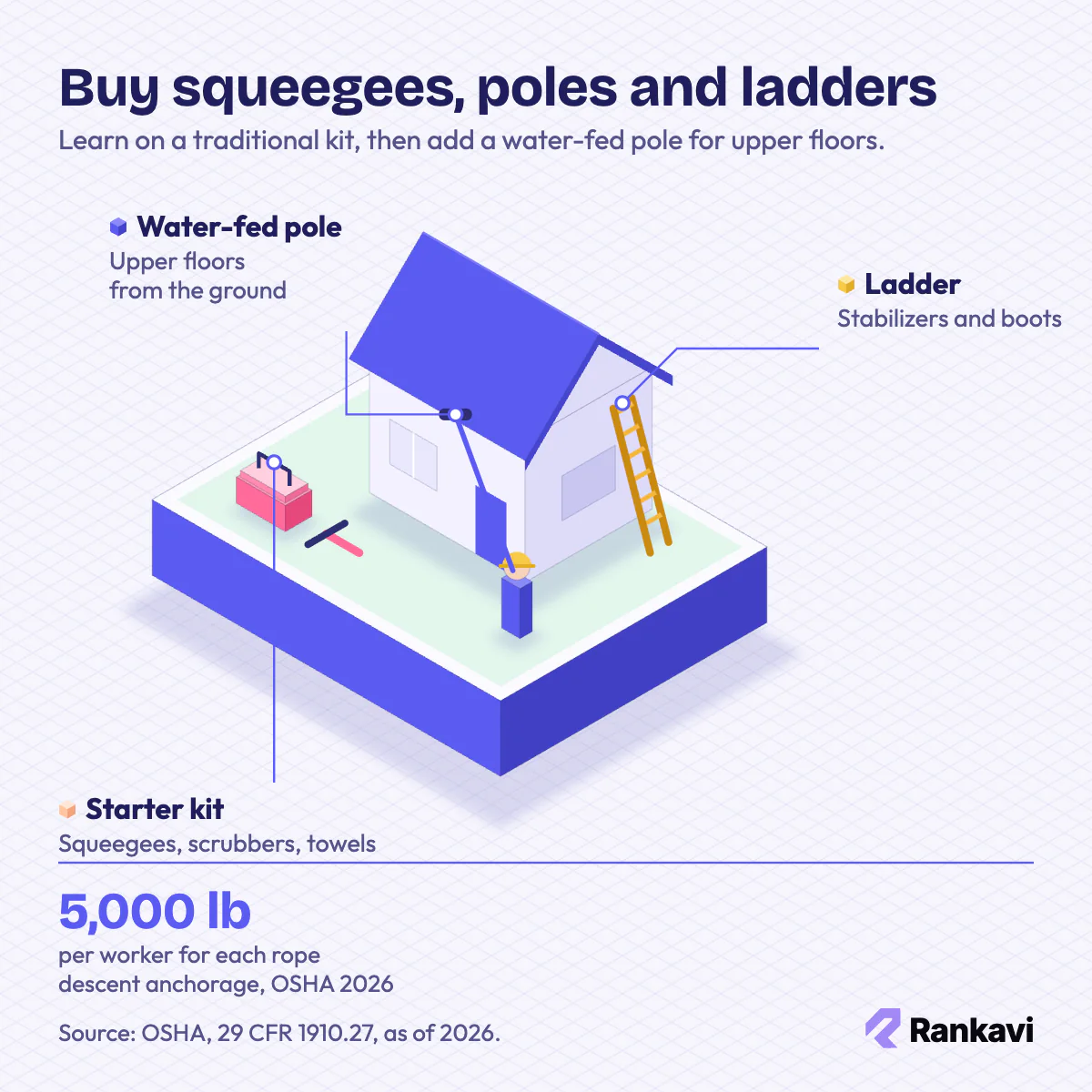
A basic starter kit holds six items:
- Squeegees: several sizes for small panes and sliding doors
- Scrubbers: also called applicators or mops
- Scrapers: with safety blades for paint and debris
- Buckets and solution: a glass cleaning soap mix
- Towels: microfiber cloths and huck towels for edges
- Reach gear: an extension pole and a sturdy ladder
A water-fed pole system pumps purified water through a long pole and brush. Crews clean upper windows from the ground, which cuts ladder time and risk. Purified water leaves little residue, so panes dry without wiping.
The two methods trade cost for reach. Traditional tools cost less and give control over detail. Water-fed poles cost more but cover upper floors and large volumes. Ettore and Unger are two well-known makers of professional squeegees and window cleaning poles.
“Do you have business cards? Do you have insurance? Not one has asked if I have a basement full of equipment that sits there.”
— A newer window cleaning business owner on the WindowCleaner.com community forum
Ladder stabilizers, non-slip boots and gloves lower the risk of falls. Harnesses matter on any roof work.
High-rise work falls under the Occupational Safety and Health Administration (OSHA), which enforces workplace safety rules. As of 2026, OSHA requires each rope descent anchorage to hold 5,000 pounds (2,268 kg) per worker.
The International Window Cleaning Association (IWCA) is a trade association for professional window cleaners. The International Window Cleaning Association wrote the main window cleaning safety standard for work three or more stories up. The Society of Professional Rope Access Technicians (SPRAT) certifies rope access technicians. The Industrial Rope Access Trade Association (IRATA) is an international body that also certifies rope access technicians. That training suits owners who plan high-rise work.
A van or pickup carries the ladders and poles. Roof racks and organized storage keep each stop quick.
9. Set Up Routes and Scheduling Software
Operations software keeps quotes, schedules, routes and invoices in one place. A window cleaner who works from a phone saves hours of evening paperwork.
Jobber is field service software for home service businesses. It handles quote forms, scheduling, billing and customer messages. Route planning tools order each day’s stops to cut drive time.
Recurring scheduling matters most, because quarterly and twice-yearly customers rebook on a set cycle. Notes on each property, such as gate codes and pets, let a repeat visit run without a walkthrough.
Online card payments speed up cash flow. Crews skip waiting for checks or cash at the door.
Accounting software such as QuickBooks tracks income and expenses for tax time. Many field service apps sync with it. Software has a monthly fee, so an owner with a handful of customers may start with a spreadsheet and a calendar.
Tool upkeep is part of operations. Fresh squeegee rubber and clean pole clamps keep every job streak-free.
10. Win the First Window Cleaning Customers
Local marketing turns a new window cleaning company into the name neighbors call each season. Most first jobs come from door hangers, referrals and search listings.
Door hangers and business cards reach whole streets in an afternoon. Friendly talks with homeowners in their yards build trust faster than ads.
Google Business Profile is a free Google listing that puts a window cleaner on Maps beside local rivals. Photos and reviews on it sway homeowners. Before-and-after photos on Facebook and Instagram show the work. Asking each happy customer for a Google review right after the job builds the profile that local searches show. Nextdoor posts reach whole neighborhoods at once.
Storefront routes start with a walk down a retail street. Owners offer one free cleaning, then pitch nearby shops on recurring service.
Commercial buyers expect a written bid and proof of insurance, so a short, clear proposal works better than a flyer. Property managers and general contractors can also hire post-construction cleaning.
Referral partners send steady work. Real estate agents, painters and house cleaners all meet homeowners who want clean glass.
Recurring plans turn one-off jobs into a route. Quarterly or monthly service keeps the calendar full without new marketing.
11. Land on Claude’s AI Window Cleaner Shortlists
Homeowners now ask AI assistants such as Claude to name a reliable window cleaner nearby. Those assistants repeat what local directories, review sites and “best window cleaners” articles already say.
A new window cleaning company gains from appearing on those third-party pages early. Mentions build slowly, and AI answers draw on what is already published.
Rankavi is a software as a service (SaaS) platform that publishes brand mentions in articles on indexed third-party websites. Window cleaners hoping Claude names them can start with Claude mention packages on sites the assistant already reads.