

Starting a wholesaling real estate business means contracting discounted homes and assigning those contracts to cash investors. Most buyers are flippers. ATTOM Data Solutions is a property data company, and it counted 297,045 US home flips in 2025.
I’m Michal Sieroslawski, and I work on helping real estate wholesaling businesses get found online. Chat-based search is changing how motivated sellers find real estate wholesaling businesses. Those suggestions often decide who gets contacted first.
The order puts state law and deal math ahead of marketing spend. Buyers get lined up before the first seller signs. Each of the eleven steps below builds on the last, from wholesaling real estate idea to first paying customer.
- Learn How Wholesale Real Estate Deals Work
- Research Your Market and Its Cash Buyers
- Run Every Deal Through the 70% Rule
- Fund Marketing, Deposits and Legal Fees
- Form an LLC and Separate the Money
- Check Your State’s Wholesaling Laws
- Draft Assignable Contracts With a Title Company
- Set Up Lead Data and Deal Software
- Market to Motivated Sellers
- Hire Help and Expand to New Markets
- Show Up When Sellers Ask AI for Offers
1. Learn How Wholesale Real Estate Deals Work
Real estate wholesaling means signing a purchase contract with a seller, then selling that contract to an investor. The wholesaler never takes title to the home.
The fee is the gap between the seller’s contract price and the investor’s price. At closing, the title company collects the investor’s funds, pays the seller and pays the wholesaler’s assignment fee.
A signed contract gives the wholesaler an equitable interest in the home, which is a legal right to buy it. That right is why the contract can be sold without owning the house. Getting a property under contract is called acquisitions, and selling the contract is called dispositions.
A double closing is the second way to wholesale. The wholesaler buys the house and resells it to the investor the same day. Two closings cost more, but the wholesaler’s margin stays private. In an assignment, the fee usually shows on the settlement statement, so the seller can see it.
Wholesalers usually pick one property type:
| Type | Typical end buyer |
|---|---|
| Residential, up to four units | Flippers and landlords |
| Land and teardowns | Developers and builders |
| Commercial buildings | Investors who raise rents and occupancy |
Flipping differs from wholesaling. A flipper buys, renovates and resells, which needs far more cash and months of holding time.
Wholesaling is legal in most states, but some regulate it, so Step 6 covers the rules. It needs little cash and no renovation skills, yet it carries risks. A buyer can back out, a seller can cancel, or title problems can stop a closing. Inheritance, probate, foreclosure or a vacant property usually motivates the sellers in such deals.
2. Research Your Market and Its Cash Buyers
Market research starts with the homes investors actually buy. Recent sale prices, repair costs and investor activity by neighborhood show where wholesale deals can work.
Zillow, Redfin and county property records supply most of that data. Older neighborhoods with dated houses and many absentee owners tend to produce distressed sellers.
Cash buyers come first, before any seller is contacted. Public records list recent cash purchases, and those buyers are likely active investors who want more deals.
Buyers differ by what they want. Flippers want deep discounts and quick repairs, landlords want rentable homes in steady areas, and builders want land or teardowns. Each group pays a different price for the same house. A deal that fails for one group may still work for another.
Local real estate investor clubs gather flippers, landlords and lenders in one room. The National Real Estate Investors Association is a nonprofit that supports independent investors through local chapters. As of 2026, the National Real Estate Investors Association listed about 40,000 members.
BiggerPockets is an online forum for real estate investors, and it adds buyers in the same area. A good buyer list records each investor’s property type, neighborhoods, price range and repair appetite.
A buyer list needs proof that each name can close. Recent purchases in public records, a short call and a question about funding show who buys with cash. Hard money lenders and local title companies also know which investors close on time. Contacts that never reply drop off the list.
3. Run Every Deal Through the 70% Rule
Deal math sets the most an investor will pay: seven-tenths of after-repair value minus repairs. AmeriSave’s 2026 guide calls this the 70% rule, and wholesalers use it to cap every offer.
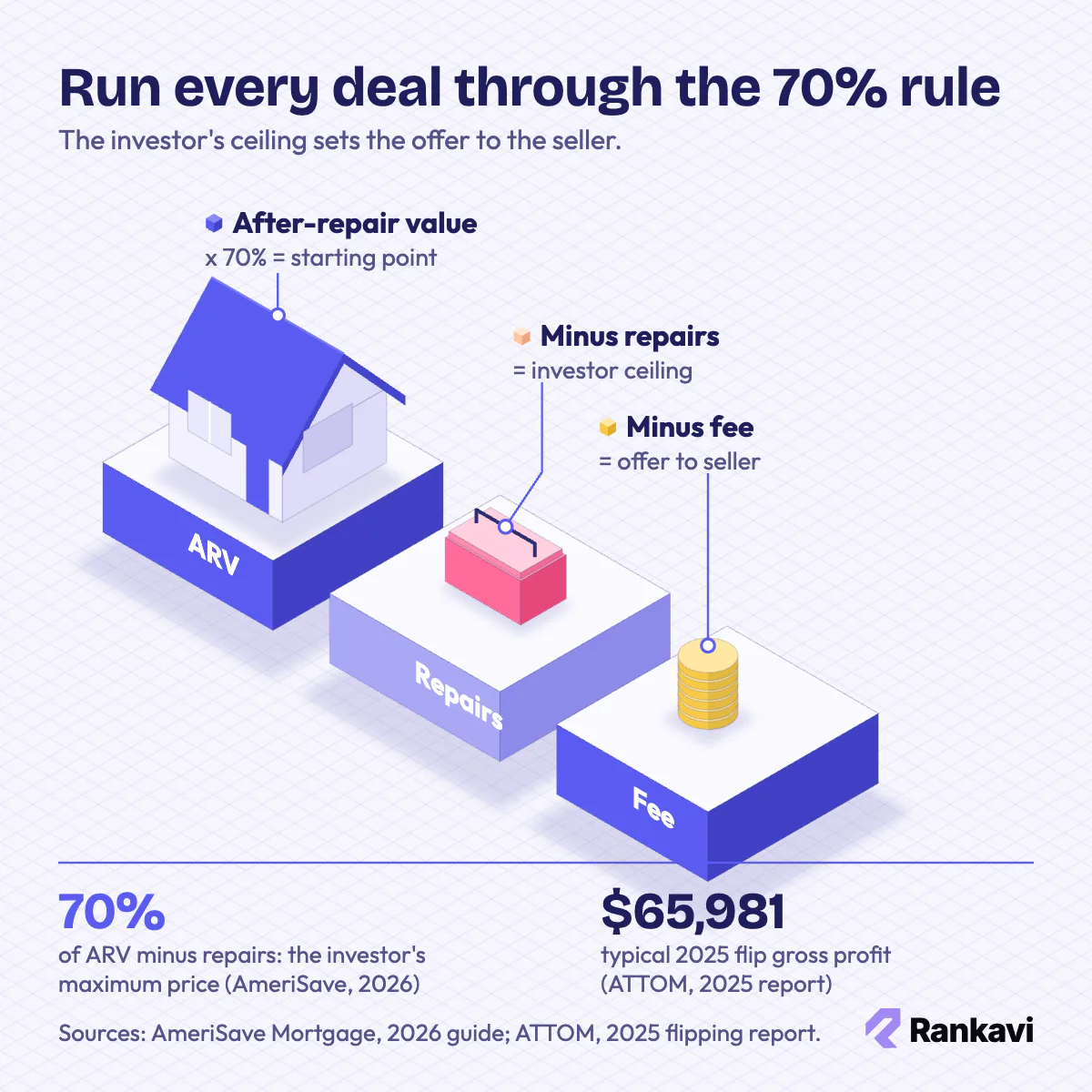
After-repair value (ARV) is the expected sale price once the home is fixed. Wholesalers estimate it from three to five recent nearby sales, using average price per square foot.
Repair estimates come next. A contractor walk-through beats guesswork, and a cushion for surprises protects the deal. Roofs, kitchens and foundations move the number most.
The maximum allowable offer (MAO) to the seller equals the investor’s ceiling minus the assignment fee. A fee that eats the investor’s profit leaves a contract no buyer will take.
Written out, the investor’s ceiling is ARV times 0.70, minus repairs. The offer to the seller is that ceiling minus the assignment fee. The remaining three-tenths covers the investor’s profit, holding costs, closing costs and the agent’s commission at resale.
Buyer margins set that ceiling. ATTOM, which publishes home flipping reports, put the typical 2025 flip’s gross profit at $65,981. Its 2025 gross return of 25.5% was the lowest since 2008, so investors now push for deeper discounts.
The rule is a rule of thumb, not a law or a valuation. Wholesalers adjust the percentage by market. Hot markets can support a higher share, and slow markets call for a lower one.
Good comparables are recent sales, not listing prices, near the house and similar in size, age and condition. Unseen problems such as mold or code violations are where repair estimates fail. When the numbers do not work, the wholesaler walks away, renegotiates or looks for a landlord buyer.
4. Fund Marketing, Deposits and Legal Fees
Funding a wholesaling startup covers seller marketing, earnest money deposits and contract review until the first fee arrives. No down payment or renovation budget is needed.
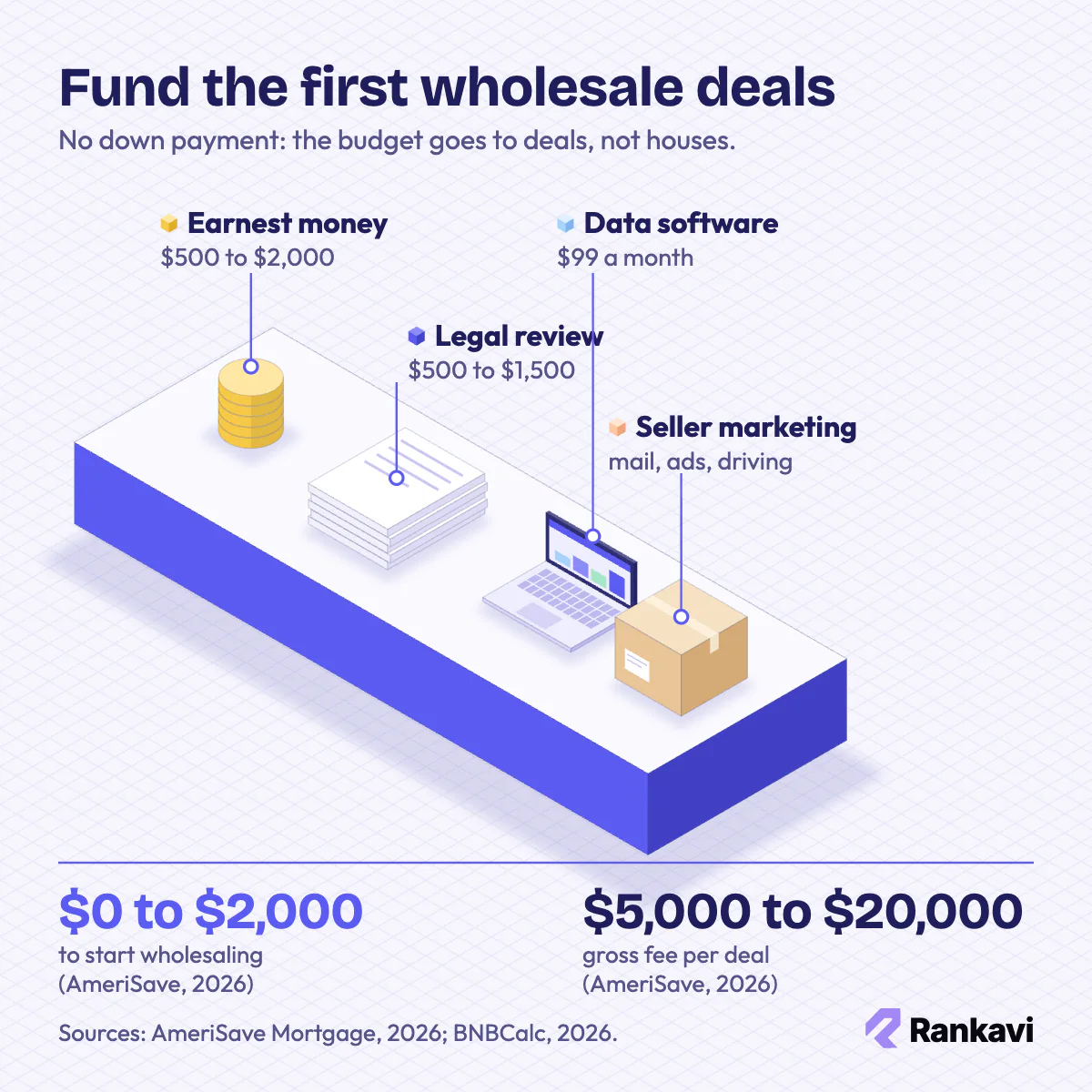
Earnest money is the deposit that shows the seller the offer is serious. An inspection contingency lets the wholesaler cancel and recover it if the deal fails.
Transactional funding pays for the first purchase in a double closing. These short-term loans last hours or days. Hard money loans, secured by the property itself, move faster than banks.
Startup money at a glance:
| Item | Figure |
|---|---|
| Startup cost | $0 to $2,000 |
| Main costs | Seller marketing; earnest money of $500 to $2,000 per contract; contract review of $500 to $1,500; property data software at $99 a month |
| Typical margin | Gross assignment fee of $5,000 to $20,000 per deal, before marketing costs (no net margin published) |
| Time to open | 30 to 60 days from signed contract to closing; the first contract often takes months of marketing |
Sources: AmeriSave Mortgage, a mortgage lender, Wholesale Real Estate 2026 guide (startup cost, deposits, legal fees, fee range, closing time; lender estimates citing industry data). BNBCalc, a rental analytics vendor, 2026 review of PropStream, which is a property data platform (software price, vendor review).
Working capital matters because early months can bring no income. Marketing keeps running while the first contracts wait for buyers and closings.
Costs arrive in a set order. Marketing and software come first. The deposit follows once a contract is signed, and legal review comes before the first closing. A deposit stays at risk if the deal breaks outside the contingency. The contract terms matter as much as the amount. Fees vary by market, and a fee that leaves the buyer a fair margin closes faster.
Worked example: In this illustrative deal, ARV is $325,000 and repairs are an assumed $50,000. Seventy percent of ARV is $227,500, so the investor’s ceiling is $177,500. A $10,000 fee means a $167,500 offer to the seller. Costs are $520 for 2,000 postcards, $297 of software and $500 of legal review. The $1,000 deposit returns at closing. The wholesaler nets $8,683 before taxes.
5. Form an LLC and Separate the Money
Forming a limited liability company (LLC) gives a wholesaler a separate legal entity for contracts and fees. A sole proprietorship is simpler but offers no liability shield.
Contracts can name the LLC as buyer “and/or assigns,” which keeps the right to transfer the deal. The Internal Revenue Service (IRS) issues the employer identification number (EIN). That number opens the business bank account.
Assignment fees count as ordinary income, not capital gains. The IRS expects estimated tax payments from anyone who expects to owe $1,000 or more at filing, as of 2026.
A certified public accountant (CPA) who knows real estate keeps quarterly payments on track. Records cover every marketing piece, mile driven and phone bill.
An LLC protects personal assets only when business money stays apart from personal money. One bank account for deposits, fees and expenses keeps that line clear. Some states and lenders also ask for the LLC to be in good standing, so annual filings should stay current. An attorney can confirm how the LLC, the contract and the state rules fit together.
6. Check Your State’s Wholesaling Laws
State real estate law decides whether a wholesaler needs a license, a disclosure form or both. Rules differ sharply from state to state.
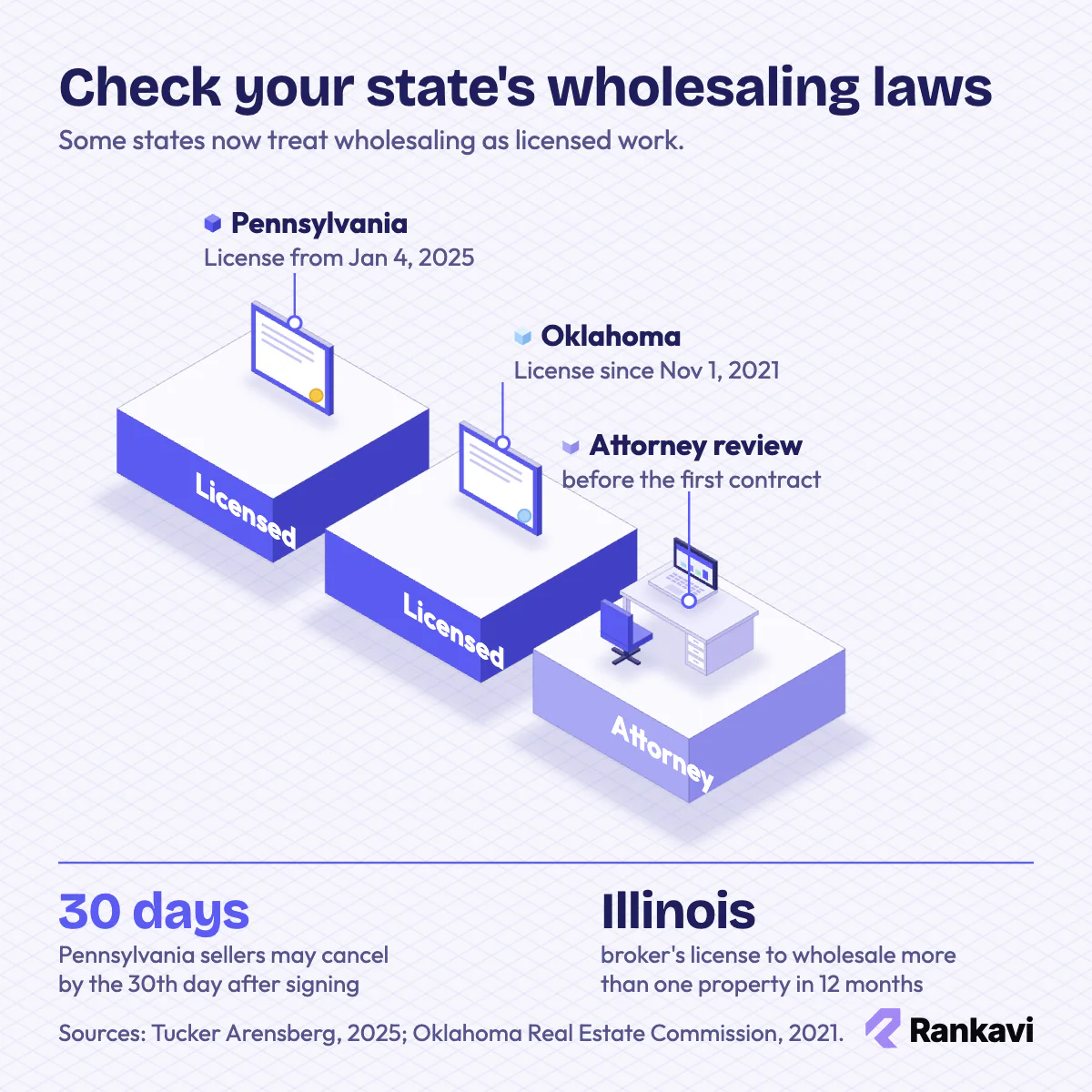
Many states let a principal assign its own contract without a license. Others treat repeated wholesaling as unlicensed brokerage, which brings fines.
Whether a license is needed depends on a few facts. One is whether the wholesaler holds an equitable interest through a signed contract. Another is whether the contract is assigned or the house itself is marketed to buyers. How many deals are done and whether the property is residential also matter. Consequences can include fines, a seller voiding the contract and civil suits.
Pennsylvania’s Act 52 required a real estate license for wholesale deals from January 4, 2025. The Pennsylvania State Real Estate Commission, which licenses the state’s brokers, takes complaints. Sellers there may cancel by the 30th day after signing.
The Oklahoma Real Estate Commission (OREC) licenses the state’s real estate professionals. OREC has required wholesalers to hold a license since November 1, 2021. Illinois requires a broker’s license to wholesale more than one property within 12 months.
A local real estate attorney reviews the plan before the first contract. That review costs far less than a regulator’s complaint.
Some states require written notice that the wholesaler may assign the contract and will not keep the house. Safer routes include getting a license or working under a licensed broker. A double closing is another route, though some states regulate it too. State laws change often. The state commission’s website, the statute text and an attorney give the current rule.
7. Draft Assignable Contracts With a Title Company
Deal operations involve a purchase agreement, an assignment contract and a title company that closes both. Each document carries specific clauses.
The purchase agreement needs an inspection contingency and an assignment clause. The contingency allows a clean exit, and the clause allows transfer to the investor.
An assignment contract moves the wholesaler’s rights to the investor and states the fee. Attorneys draft both documents to match state law, including any required disclosure language.
A title company that understands assignments checks for liens, collects funds and pays out the fee. Investor-friendly title firms keep wholesale deals moving.
A title search finds problems such as mortgage, tax or judgment liens, unpaid code violations and missing heirs. The buyer’s title insurance covers some title defects. Fixing a defect is called a title cure, and some cases need a court action. In some states, an attorney closes the deal instead of a title company.
Due diligence, buyer marketing and title work all fit inside the contract period. Liens or a missing heir can stretch that clock, so contracts allow time for title cleanup.
The purchase agreement also states the deposit and refund terms, the closing date, as-is terms and what happens on default. Some contracts bar assignment without the seller’s consent. The seller’s written acknowledgment that the buyer may assign avoids disputes later. The settlement statement then shows who was paid what.
8. Set Up Lead Data and Deal Software
Data tools replace hours of courthouse research. PropStream, a nationwide property data platform for investors, filters owners by equity, vacancy, liens and foreclosure status.
BNBCalc, a rental analytics vendor, listed the PropStream Essentials plan at $99 a month in its 2026 review. PropertyRadar and REIPro offer similar lists for wholesalers.
A wholesaler’s starter tech stack has three parts:
- Property data: owner lists filtered by equity, vacancy and distress.
- Skip tracing: phone numbers and emails for owners on those lists.
- Customer relationship management (CRM): a record of every lead, call and follow-up.
Tax records give mailing addresses, and paid lookups add phone contacts. Most wholesale deals close after several contacts, so missed follow-ups cost money.
Owner lists are only a starting point. Wholesalers check each list against county records and then sort leads by how motivated the owner seems. A CRM tracks the stage of each lead, from first call to signed contract. Calling and texting rules also apply to outreach, so a list should be screened before dialing.
9. Market to Motivated Sellers
Motivated sellers are owners who need a fast, as-is sale. Pre-foreclosure, probate, vacancy, code violations and tired landlords mark the best lists.
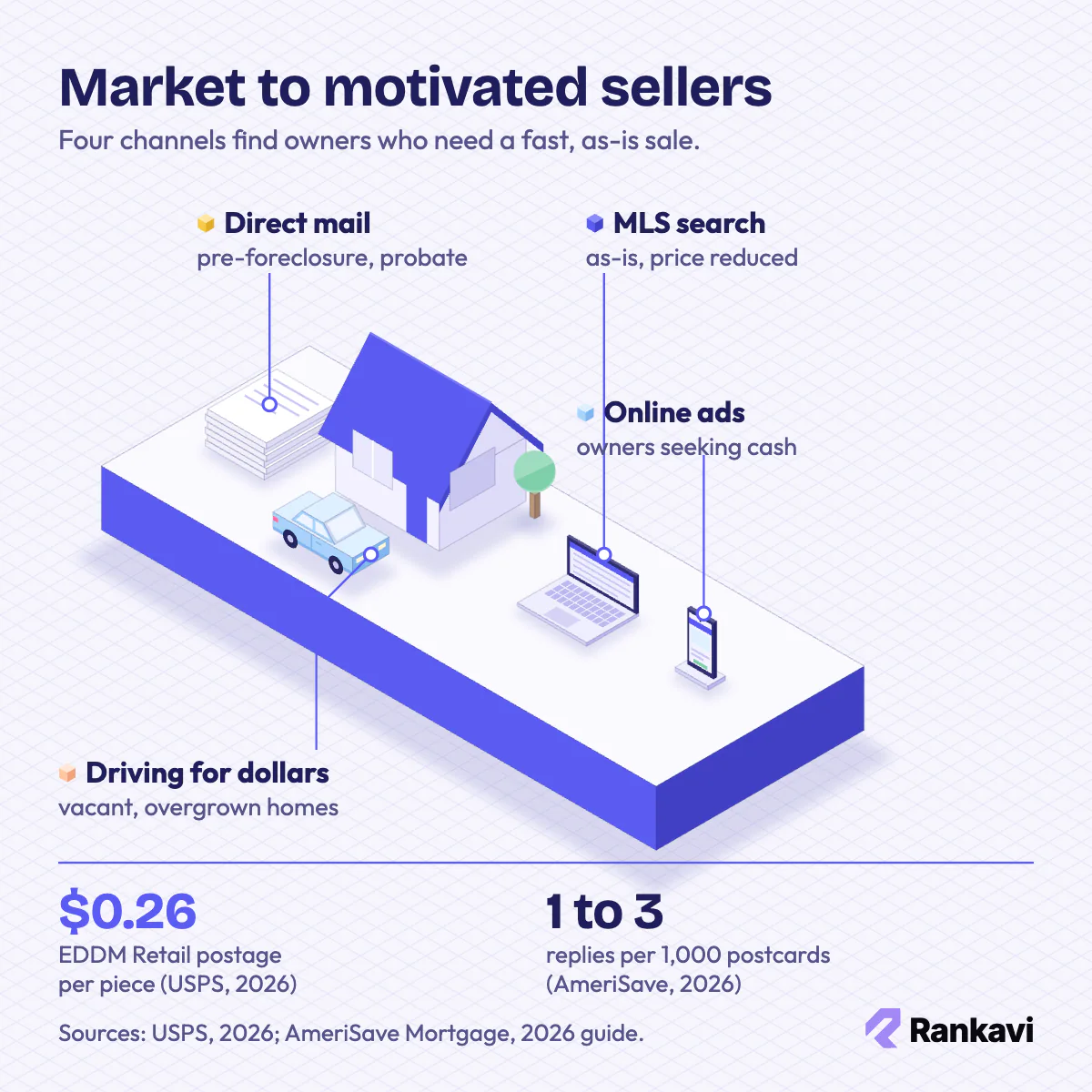
Main seller channels:
| Channel | What it targets |
|---|---|
| Direct mail | Pre-foreclosure, probate and absentee owners |
| Driving for dollars | Vacant homes with overgrown lawns or boarded windows |
| Multiple Listing Service (MLS) search | Listings marked as-is, fixer-upper or price reduced |
| Online ads | Owners searching for a cash sale |
The United States Postal Service (USPS) runs Every Door Direct Mail (EDDM), which mails to every address on a route. As of 2026, EDDM Retail postage cost $0.26 per piece, up to 5,000 pieces per ZIP Code daily.
Response rates stay low. AmeriSave’s 2026 guide said 1,000 postcards typically bring one to three replies, so mail goes out repeatedly.
Each channel has trade-offs. Mail is steady but slow, and driving for dollars finds homes that lists miss but takes time. MLS listings reach sellers who already have an agent, and online ads bring fast leads at higher cost. A simple script keeps seller calls on track. It covers the owner’s situation, the timeline and the price the owner has in mind. Offers go out only after the numbers fit the rule.
A simple cash home buyer website catches sellers who search online. Google and Facebook ads point local owners to it.
Each signed contract then goes to the buyer list. The deal blast shares price, estimated ARV, repair budget and photos.
10. Hire Help and Expand to New Markets
Growth usually starts with a second person. An acquisitions role talks to sellers, while a disposition role sells contracts to buyers.
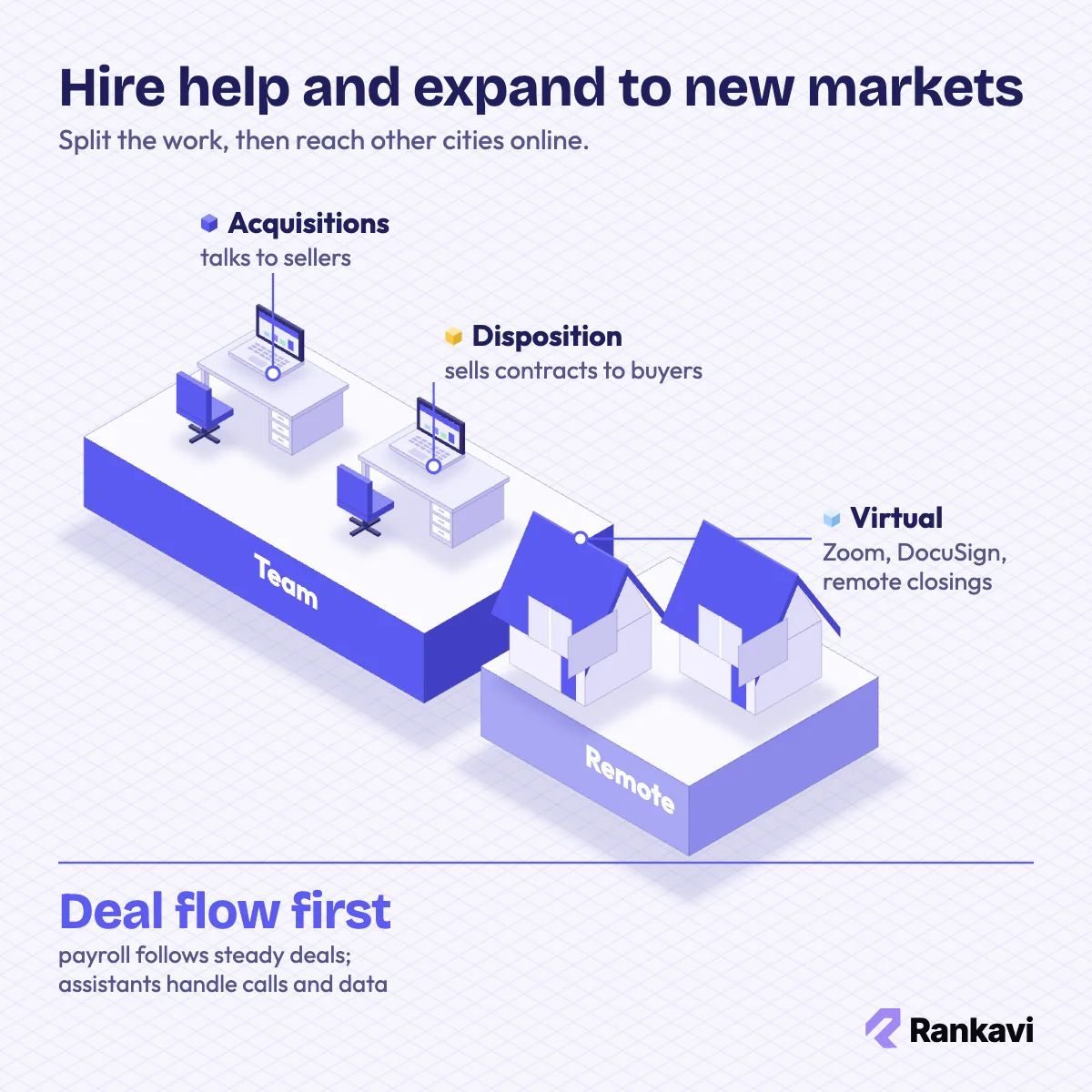
Overhead climbs with every hire, so payroll follows steady deal flow. Virtual assistants often handle cold calls and data work first.
Hires can be paid per task, by commission or by salary. Commission ties cost to closed deals, while salary adds a fixed cost before deals close. Clear scripts, a shared CRM and written steps let a new hire work without constant checks.
Virtual wholesaling opens markets far from home. Zoom, DocuSign, local contractors and remote closings let one team work several cities, within each state’s own wholesaling rules.
Each new market needs its own buyer list, comparable sales and title company. Repair estimates from a local contractor replace guesses made from afar. Starting in one new market at a time keeps mistakes small.
HomeVestors is a home-buying franchise that runs DealVestors, a listing platform for investor buyers. Many wholesalers later move into flipping or rentals once capital builds.
11. Show Up When Sellers Ask AI for Offers
Homeowners facing foreclosure or an inherited house now ask AI assistants who buys homes for cash. ChatGPT often answers with named local companies.
Those names come from third-party pages: review sites, local news and “best cash home buyers” lists. A new wholesaler that appears there early has a better chance of being named.
Rankavi is a software as a service (SaaS) platform that publishes brand mentions in articles on indexed third-party websites. Wholesalers who want to get recommended in ChatGPT can begin with those placements.