

Starting a wedding planning business takes organizing skill, a clear service menu and trusted local vendors. The Knot is a wedding planning website whose 2025 Real Weddings Study put the average U.S. wedding cost at $33,000.
My name is Michal Sieroslawski, and I’m an entrepreneur. I help wedding planning businesses get found by couples on Google and in AI chats. More couples now ask ChatGPT to recommend a wedding planning business. For a new wedding planning business, being part of those recommendations is a real advantage.
The order fixes the niche and skills before money goes into filings or software. Contracts then sit ready before the first couple books a consultation. Opening a wedding planning business follows the seven steps below.
- Choose Your Wedding Planning Niche
- Train With Certified Wedding Planners
- Price Your Planning Packages
- Register and Insure the Business
- Set Up Contracts and Client Software
- Build a Portfolio and Vendor Network
- Appear in Couples’ ChatGPT and AI Planner Picks
1. Choose Your Wedding Planning Niche
A wedding planning niche combines a service tier with a wedding style. That pairing tells couples exactly what the planner handles and for whom.
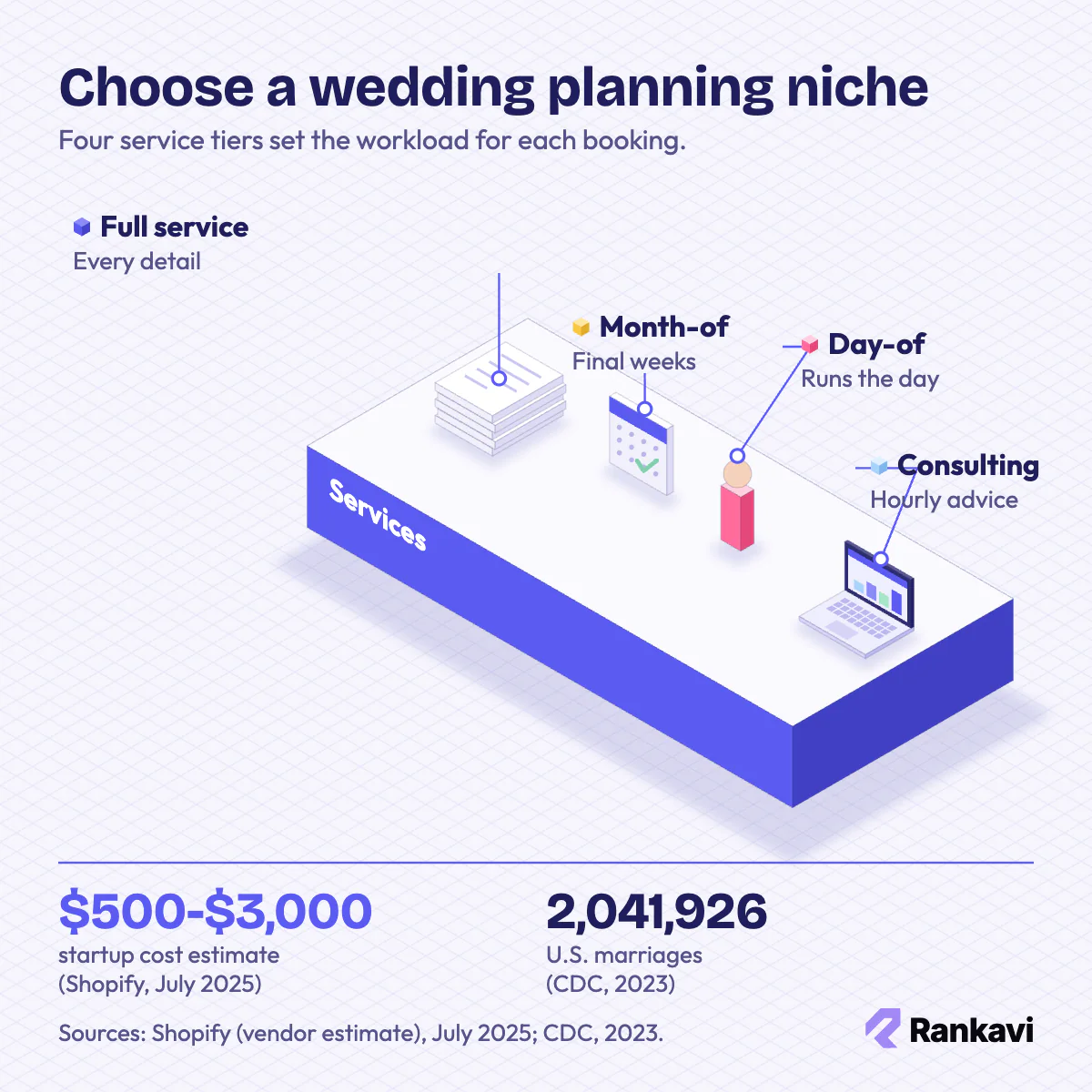
Service tiers set the workload for each booking:
| Service tier | What the planner handles |
|---|---|
| Full service | Every detail, from venue search to the last guest leaving |
| Month-of coordination | Logistics in the final weeks after the couple has planned |
| Day-of coordination | Running the schedule and vendors on the wedding day |
| Consulting | Hourly advice while the couple plans alone |
Wedding style narrows the audience further. Destination weddings, elopements, budget weddings and luxury events each attract different couples and vendors.
Demand is large but local. The Centers for Disease Control and Prevention (CDC), the federal health agency that tracks vital records, counted 2,041,926 U.S. marriages in 2023.
Venue calendars, competitor planner websites and local wedding groups show which styles are crowded nearby. Gaps in those lists point to the niche worth claiming.
New planners usually start with a lighter tier. Day-of and month-of work needs fewer hours per couple and builds a portfolio sooner. Full service suits a planner with finished weddings to show.
Partial planning sits between full service and month-of work. The planner handles a set list of tasks, such as vendor selection and design, while the couple handles the rest.
Wedding style can be split into several kinds of couples:
- Destination: couples marrying away from home need travel logistics and local vendor contacts.
- Elopements and micro-weddings: small guest lists call for permits, intimate venues and tight timelines.
- Cultural and religious: ceremony order, multi-day events and dress and food customs need real knowledge.
- Same-sex, second marriage and military: each group needs inclusive vendors, blended families or short-notice dates.
- Budget and luxury: budget couples need vendor negotiation, while luxury couples need design teams and large guest logistics.
Budget and guest count also decide the niche. The Knot publishes average wedding costs and guest counts in its Real Weddings Study. Comparing those averages with local venue prices shows which budget band has many couples and few planners.
A national count hides local demand. County clerks publish marriage license counts, and Google Trends shows search interest in a style by state. Searching “[style] wedding planner [city]” on Google Maps shows how many planners already serve that style. Asking local venues and photographers which couples struggle to find a planner adds a second check.
A niche is a focus, not a limit. A planner can accept other weddings while leading marketing with one style. That gives couples a clear reason to choose. Too broad a niche gives couples no reason to pick one planner. Too narrow a niche leaves too few local couples to fill a year.
A one-sentence positioning statement turns the niche into a bio line. One example is “Full-service destination planning for Austin couples.”
Startup money at a glance:
| Item | Figure |
|---|---|
| Startup cost | $500 to $3,000 for a home-based launch |
| Main costs | Business registration, liability insurance, website, branding, marketing materials |
| Typical margin | 33.38% gross and 7.03% net for listed U.S. business and consumer services firms (a proxy, not solo planners) |
| Time to open | A few weeks for most solo planners; state filing times vary and no published average exists |
Sources: Shopify, which is an e-commerce platform (vendor estimate, July 2025); Aswath Damodaran, New York University Stern School of Business, margins by sector (January 2026, proxy).
A one-page plan ties these choices together. It names the niche, the packages, the weddings needed per year and the main costs.
2. Train With Certified Wedding Planners
Training as a wedding planner gives a new owner the vendor, budget and timeline skills couples expect. No state license or degree is required to plan weddings.
Assisting an established planner offers the fastest practical lesson. A few weddings as an assistant show how timelines, vendor calls and emergencies really work.
The American Association of Certified Wedding Planners, a Texas-based group that trains planners, runs online courses with daily exams. Graduates become Trained Wedding Planners and can later earn Certified Wedding Planner status.
That later title needs a year of membership and ongoing continuing education. Couples often prefer a trained planner, even though the credential stays optional.
The credential is private, not governmental. It adds credibility but does not replace experience, because couples judge planners mostly on references and real weddings. The section title does not mean every mentor must be certified.
The Association of Bridal Consultants and the Wedding Planning Institute offer other wedding courses. University extension programs in event management suit readers who want an academic route. General event credentials, such as the Certified Meeting Professional from the Events Industry Council, lean toward corporate events.
A low-quality program is easy to spot. Warning signs include no published curriculum, unclear pricing and promises of guaranteed income. Fees, course length and renewal terms differ by provider. Each should be checked on the provider’s own site.
An assistant role is the cheapest way to learn. Some roles are unpaid shadowing and others pay per event, so the terms should be agreed before the first wedding. Planners are easiest to approach with a short email, an offer to work a full wedding day and open weekends. Many couples marry in warm months, so winter and early spring are good times to ask.
An assistant learns the work behind the schedule: run-of-show timelines, vendor check-ins, rain plans and family conflicts. Mentor agreements may limit taking the mentor’s clients, so any non-solicitation terms deserve a read first.
Venue and hotel event jobs, and planning a friend’s wedding, also build experience without a course.
Self-employment is common in this field. The U.S. Bureau of Labor Statistics (BLS), the federal wage and jobs agency, counted 172,100 event planner jobs in 2025, 10% of them self-employed.
3. Price Your Planning Packages
Pricing a wedding planning business sets fees that cover planning hours, wedding-day work and overhead. Planners can pick a structure for every couple.
Three pricing models dominate the trade:
- Flat-fee packages: one price for full service, month-of or day-of work.
- Hourly rates: used for consulting sessions.
- Percentage of the budget: used for large, high-budget weddings.
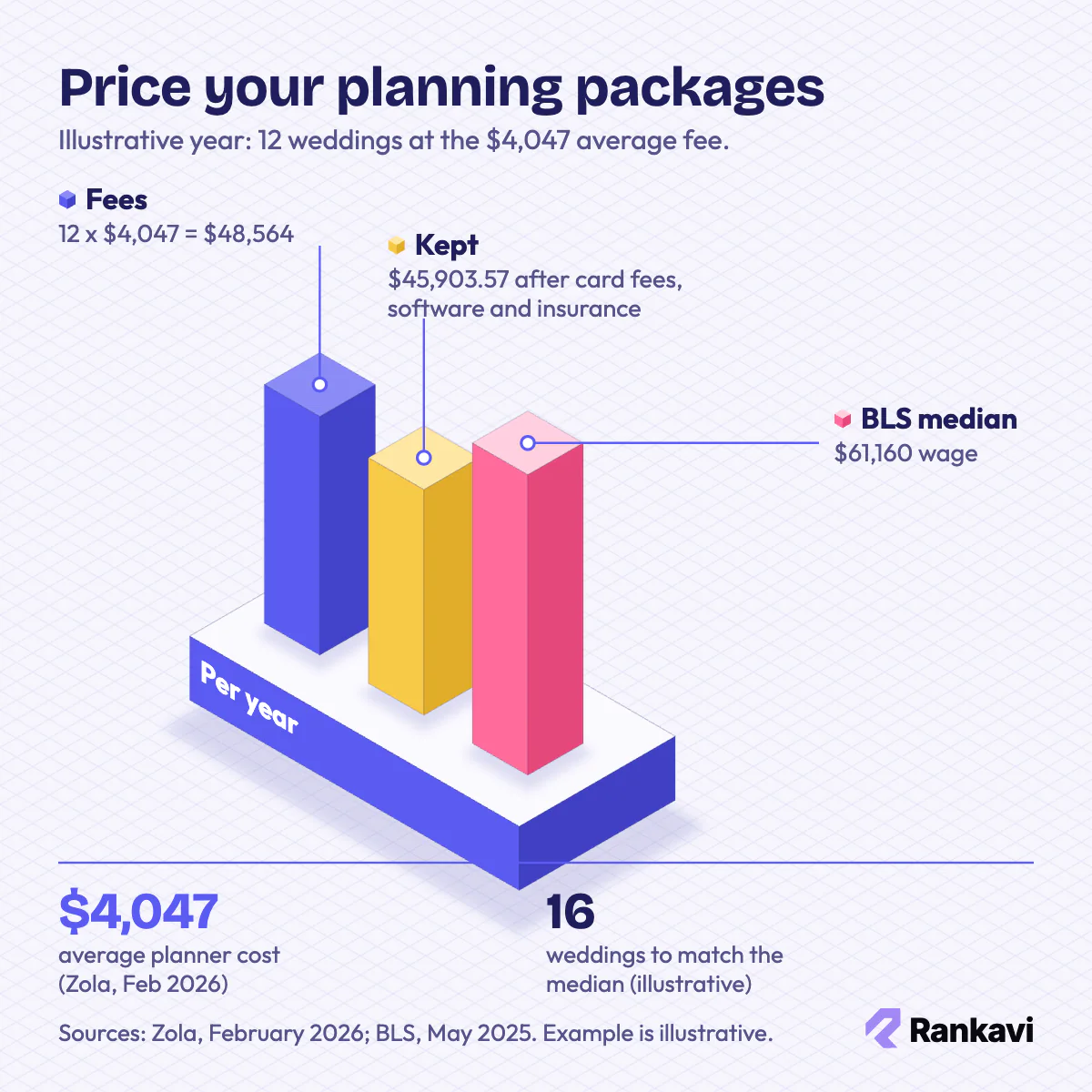
Zola is a U.S. wedding planning platform with a vendor marketplace. Its Zola Wedding Cost Index put the national average planner cost at $4,047 in February 2026.
Zola’s ranges show how far tiers spread. Day-of coordination ran $800 to $3,000, while full service started near $4,000 and passed $10,000 in February 2026.
Zola reported in February 2026 that percentage fees usually land at 10% to 20% of the budget and hourly consulting at $75 to over $200.
Employed planners give a useful income yardstick. The BLS reported a median annual wage of $61,160 for meeting, convention and event planners in May 2025.
Worked example: An illustrative solo planner books 12 weddings a year at $4,047 each, for $48,564 in fees. Card fees of 2.7% plus 10 cents on one payment per wedding cost $1,312.43. Software at $29 a month adds $348, and insurance adds $1,000. That leaves $45,903.57 before taxes and marketing. Matching $61,160 takes about 16 weddings at the same fee, or a higher price.
New planners sometimes discount their first weddings. The discount works best when couples agree in writing to share photos for the portfolio.
Each tier carries a different scope, and the scope drives the price. Full service covers design, vendor sourcing, budget management and the wedding day. Partial planning covers a fixed list of tasks. Month-of work covers the final weeks, with a set number of meetings and vendor calls. Consulting is hourly advice with no execution.
A price starts from the income the planner wants. Target income, overhead, taxes and profit are added up and divided by the number of weddings the planner can handle. Dividing a package price by the hours worked gives the effective hourly rate. A minimum fee keeps small weddings from costing more time than they pay.
The worked example leaves out marketing, assistant pay and travel, so real take-home pay is lower. Self-employment tax and quarterly estimated payments to the Internal Revenue Service also reduce what is left.
Fees beyond the base package keep scope fair. Extra meetings, rehearsal coordination, rush work, travel and a second planner on the wedding day can each be priced separately.
Payment terms matter as much as the price. A deposit secures the date, and later installments end before the wedding. The contract should state whether the deposit is refundable.
Local markets differ. A planner in a large metro area may charge more than a rural planner. The national average is only a starting point.
Planners can show prices as “starting at” figures and settle the final fee after a discovery call. Raising rates once the calendar fills is a common way to grow income without taking more weddings.
4. Register and Insure the Business
Registering a wedding planning business protects the owner and lets the company sign venue and vendor contracts. Many planners start as sole proprietors, while others form a limited liability company (LLC).
An LLC separates personal assets from claims after a wedding goes wrong. The filing goes to the Secretary of State, and a tax adviser helps pick the structure.
An employer identification number (EIN) comes from the Internal Revenue Service (IRS), which issues these numbers to new businesses. Planners need one before hiring assistants or opening some business bank accounts.
A separate bank account keeps couples’ deposits apart from personal money. Clean records also support tax deductions.
A sole proprietorship is simple to set up, yet personal assets stay open to business claims. An LLC limits that exposure for business debts and claims. It does not cover every situation, such as personal negligence. A registered agent receives legal papers for the LLC, and many states require one.
Local rules vary. A city or county may require a business license, and a home-based planner should check zoning and homeowners association rules.
Insurance can reach beyond general liability. Venues often ask for a certificate of insurance naming them. Professional liability covers claims of planning errors, and a planner with employees may need workers’ compensation. Policies differ by insurer, so the coverage gaps are worth asking about before buying.
General liability insurance covers injuries and property damage at events, and many venues ask for proof. Shopify estimated $300 to $1,000 a year for an annual plan in July 2025.
5. Set Up Contracts and Client Software
A signed contract keeps the scope, payment schedule and cancellation terms clear for both sides. Planners send it before taking any deposit.
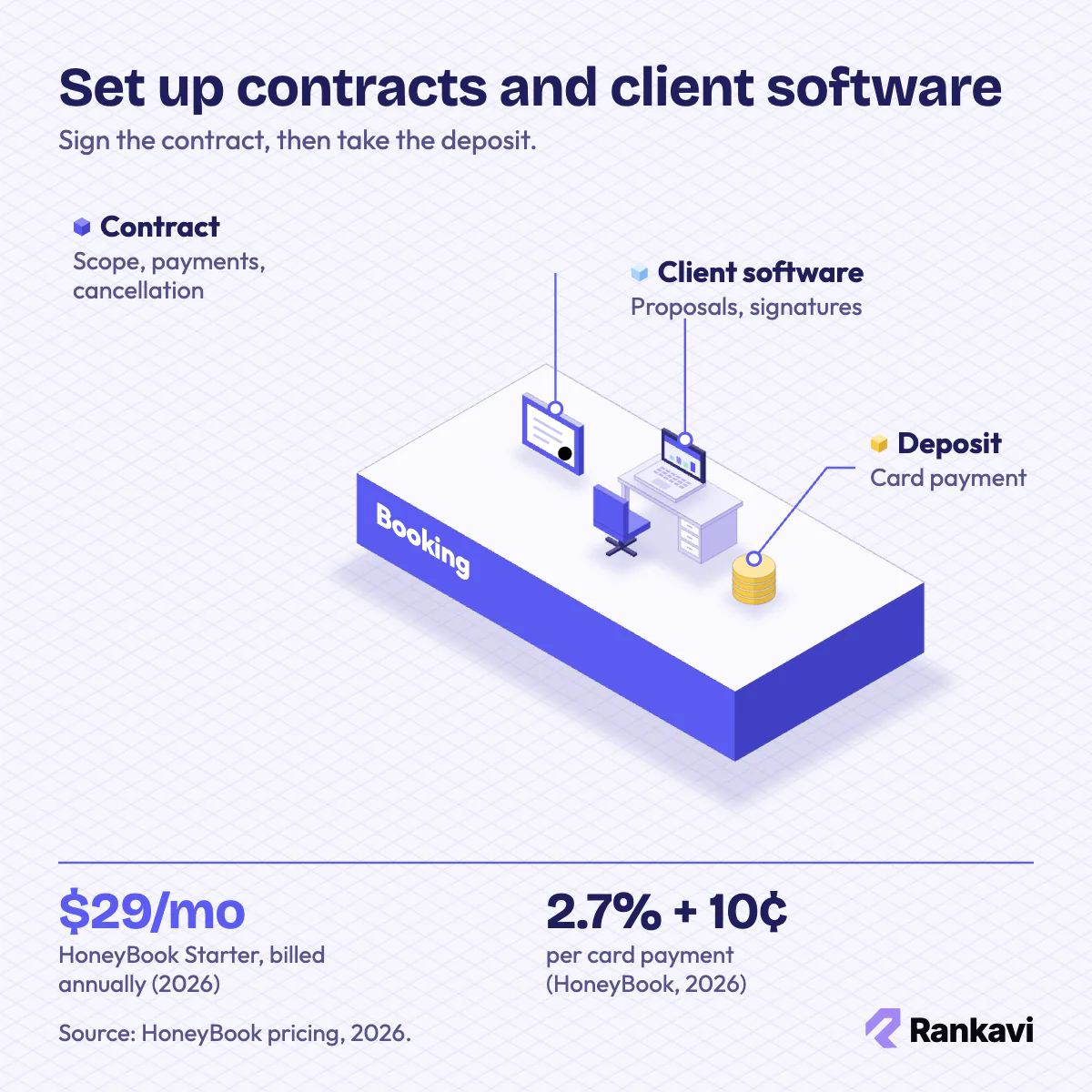
Contracts for this trade usually cover four points:
- Scope: the services included and the hours on the wedding day.
- Payment schedule: the deposit and the dates of later payments.
- Cancellation: what happens if the couple postpones or cancels.
- Vendor limits: the planner coordinates vendors but does not guarantee their work.
Client management software keeps bookings in one place. HoneyBook is client software for independent service businesses that sends proposals, collects signatures and takes card payments.
As of 2026, HoneyBook’s Starter plan cost $29 a month billed annually. As of 2026, its card payments started at 2.7% plus 10 cents each.
Templates save hours in the first season. A brochure, a proposal, a price guide and a contract template cover most inquiries.
A contract written for the wedding trade is safer than a generic one. Local rules on deposits and cancellations differ, so a lawyer’s review before first use is worth the cost.
The contract can also say what happens if a venue closes, the date moves or the guest count changes. Clear terms protect the planner and set the couple’s expectations.
Software choice is a trade-off. An all-in-one tool saves time but locks client data into one platform. Spreadsheets cost less but need more manual work. HoneyBook also offers contracts, invoices and scheduling in the same place.
6. Build a Portfolio and Vendor Network
Couples hire planners whose past weddings they can see. A portfolio therefore comes before paid advertising.
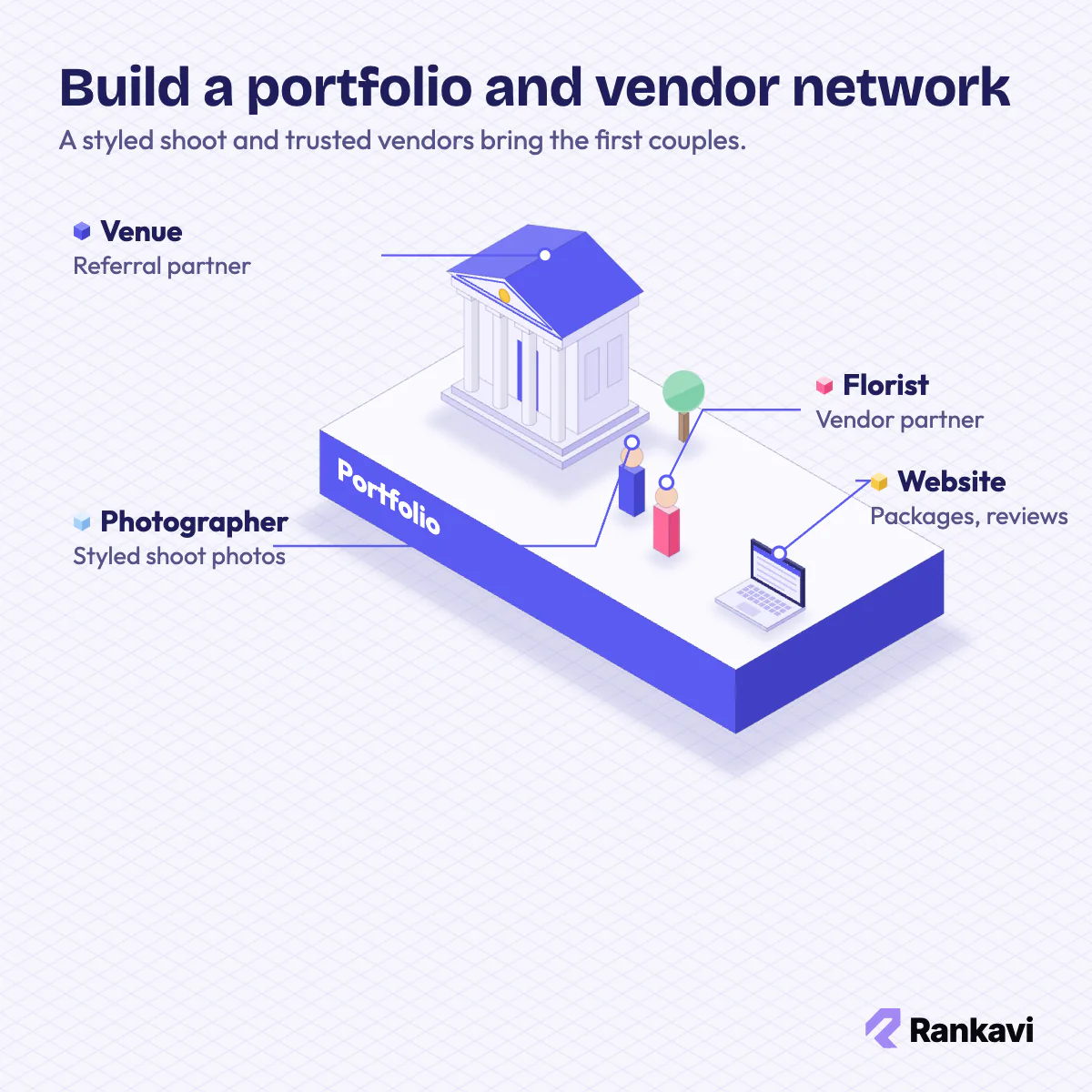
A styled shoot fills an empty portfolio. The planner, a photographer, a florist and a venue stage a mock wedding and share the photos.
Vendor relationships bring steady referrals. Venue managers, caterers and photographers often recommend planners they trust.
A website shows packages, photos and reviews. Pinterest is a visual discovery platform where couples collect wedding ideas. Instagram and TikTok also help couples find vendors.
Reviews keep the calendar full. A short request after each wedding often produces the strongest testimonial.
A styled shoot needs written agreements with each vendor on who may use the photos and how. Credit to every vendor builds goodwill, and the photographer’s license should allow the planner to post the images.
Vendor referrals work both ways. A planner who sends couples to a florist or caterer is likelier to get referrals back. A planner can build the network by meeting venue managers and attending local wedding events before the first booking.
A first-wedding discount works best when it comes with written photo and review permission. Couples are more likely to agree when the terms are clear before the wedding.
7. Appear in Couples’ ChatGPT and AI Planner Picks
AI visibility earns a wedding planner a place in the answers couples read before booking a consultation. Many engaged couples now ask ChatGPT which local planner fits their budget and style.
ChatGPT builds those answers from trusted third-party pages. Wedding directories, local wedding blogs and “best planners” roundups shape which names appear.
A planner’s own website also feeds those answers. Pages that state the niche, service area and packages plainly are easier for AI tools to read and repeat. Reviews and directory profiles on The Knot and Zola add outside confirmation.
Rankavi is a software as a service (SaaS) platform that publishes brand mentions in articles on indexed third-party websites. A new planner can pursue ChatGPT citation building through those articles so couples meet the name early.