

Starting a tow truck business takes a capable truck, licenses, heavy insurance and steady calls. The National Institute for Occupational Safety and Health (NIOSH) is a federal injury research institute. In 2019 it reported a towing death rate over 15 times the private-industry average, from historical 2011 to 2016 data.
My name is Michal Sieroslawski, and I’m an entrepreneur who helps towing companies build their visibility online. Many drivers now start by asking ChatGPT, so its suggestions can bring new customers.
The order below prices the work and lines up money before any truck or yard is bought. Licenses and insurance then come before the first paid tow. Starting a tow truck business comes down to the eleven steps listed below.
- Choose Your Towing Services
- Write a Tow Truck Business Plan
- Price Tows, Mileage and Storage
- Fund the Truck and First Months
- Register the Towing Company
- Secure a Storage Yard
- Get Towing Licenses and a USDOT Number
- Insure Trucks and Customer Vehicles
- Buy a Wrecker or Flatbed
- Market to Motor Clubs and Body Shops
- Earn Towing Citations in Perplexity AI Answers
1. Choose Your Towing Services
A new towing company first picks the kind of work its truck will do. That choice shapes the truck, the license, the insurance and the customers.
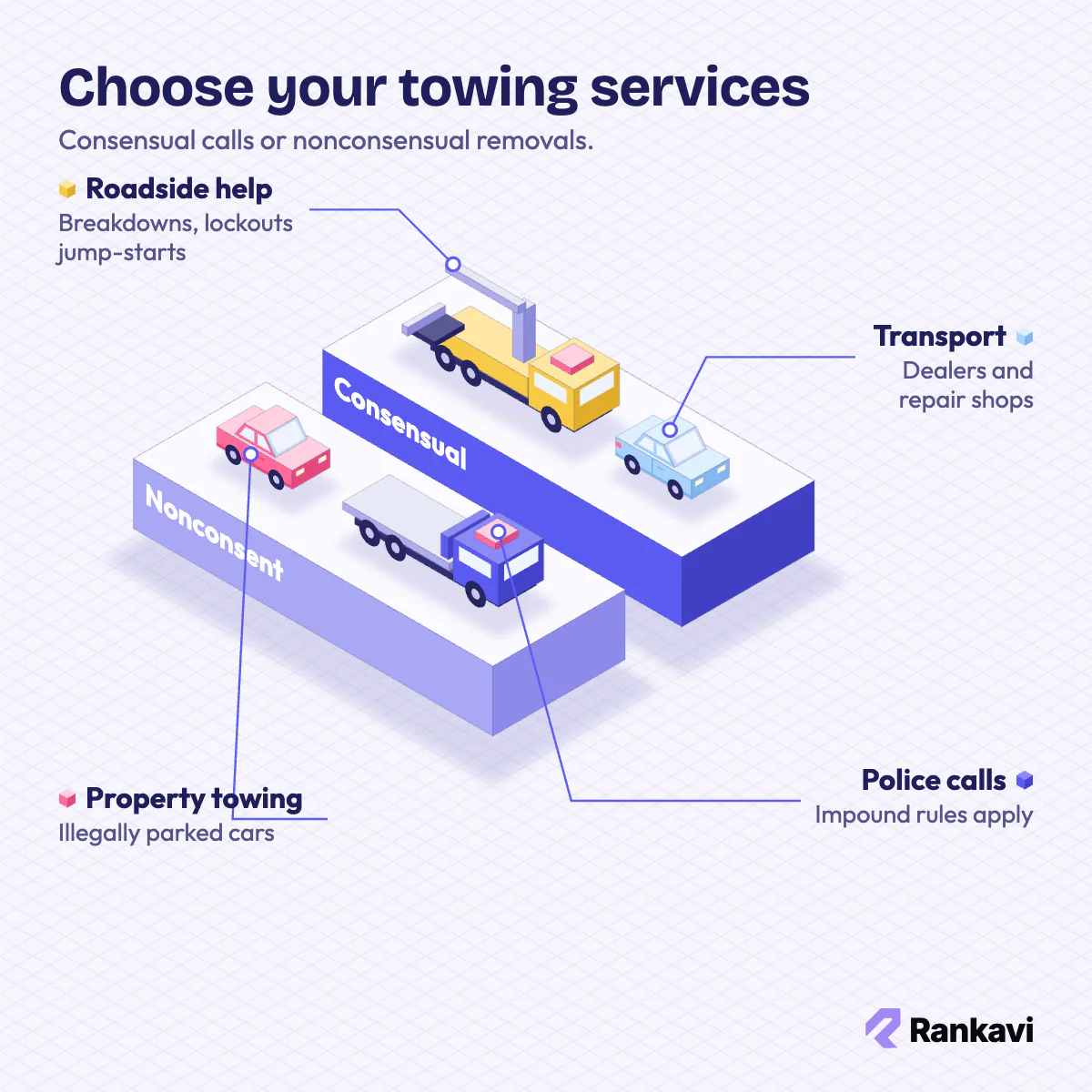
Towing splits into two models. Consensual towing serves drivers who ask for help, such as breakdowns and relocations. Nonconsensual towing removes vehicles for police or property owners, often without the owner present.
Nonconsensual work brings steady volume but more friction. Angry vehicle owners, strict impound rules and court hearings come with it. Many cities also cap what these tows may cost.
Truck size defines a second split. Light-duty work covers cars and pickups, while heavy-duty recovery handles buses, semis and rollovers. Most new owners start light and add capacity later.
Most towing companies build their offer from six common services:
- Roadside assistance: jump-starts, tire changes, lockouts and fuel delivery
- Accident recovery: clearing crashed cars from the road
- Nonconsent towing: police calls and private property removals
- Repossession: recovering vehicles for lenders
- Transport: moving cars for dealers and repair shops
- Heavy-duty recovery: buses, semis and rollovers
Each service has its own payer. Drivers and motor clubs pay for roadside work. Police, insurers and body shops send accident recovery. Police and property owners order nonconsent tows. Lenders order repossessions, and dealers and repair shops order transport.
Two services sit between the models. A lender hires a repossession, yet the borrower never agrees to it. Accident recovery is consensual when a driver calls and nonconsensual when police dispatch the truck.
Payment timing shapes the choice. Drivers can pay at the scene. Motor clubs and fleets usually pay after the job, so a cash-limited startup feels that gap first.
A common starter mix is one light-duty truck doing roadside, transport and accident work. Nonconsent and heavy-duty work can wait. Heavy-duty recovery needs costly trucks and trained operators, and nonconsent work brings the friction described above.
Availability counts as much as equipment. Roadside and accident calls arrive at night and on weekends, and storms push crashes and breakdowns up. Other jobs exist outside the six services, such as motorcycle and boat towing. Most new owners add them later.
2. Write a Tow Truck Business Plan
A tow truck business plan sets out the service area, the customers and the money needed to reach them. Lenders and equipment financiers usually ask for one.
The plan’s key assumption is call volume per truck. A truck that sits idle still costs insurance and loan payments every day. The plan should show where daily calls will come from.
Call sources include direct drivers, motor clubs, police rotation lists, body shops and property managers. The plan should name each source and give a cautious call estimate for it. Break-even sets the target. Daily fixed costs are divided by the profit on an average call. Fixed costs include the truck payment, insurance and yard rent.
A towing business plan usually holds six sections:
- Executive summary
- Company description and services
- Market and competitor analysis
- Organization and management
- Marketing and sales strategy
- Financial projections
The organization section should say who drives, who dispatches overnight and who handles billing. The financial section should include a monthly cash flow. Contract payers often pay after the job. Storm season and slow months also move income, so the cash flow should show both.
A risk section belongs in the plan too. Insurance rate changes, fuel prices and truck downtime are the main threats for a towing operator. Slow payment from contract accounts, driver turnover and the loss of one large account add to them. Each risk needs a stated response, such as a cash reserve or a backup truck.
Lenders expect the full plan. A self-funding owner can write a shorter version. The break-even math still shows whether the market can support a truck.
3. Price Tows, Mileage and Storage
Pricing a towing service sets a hook-up fee, a per-mile rate and extra charges for harder jobs. The structure must cover fuel, insurance and the truck’s time.
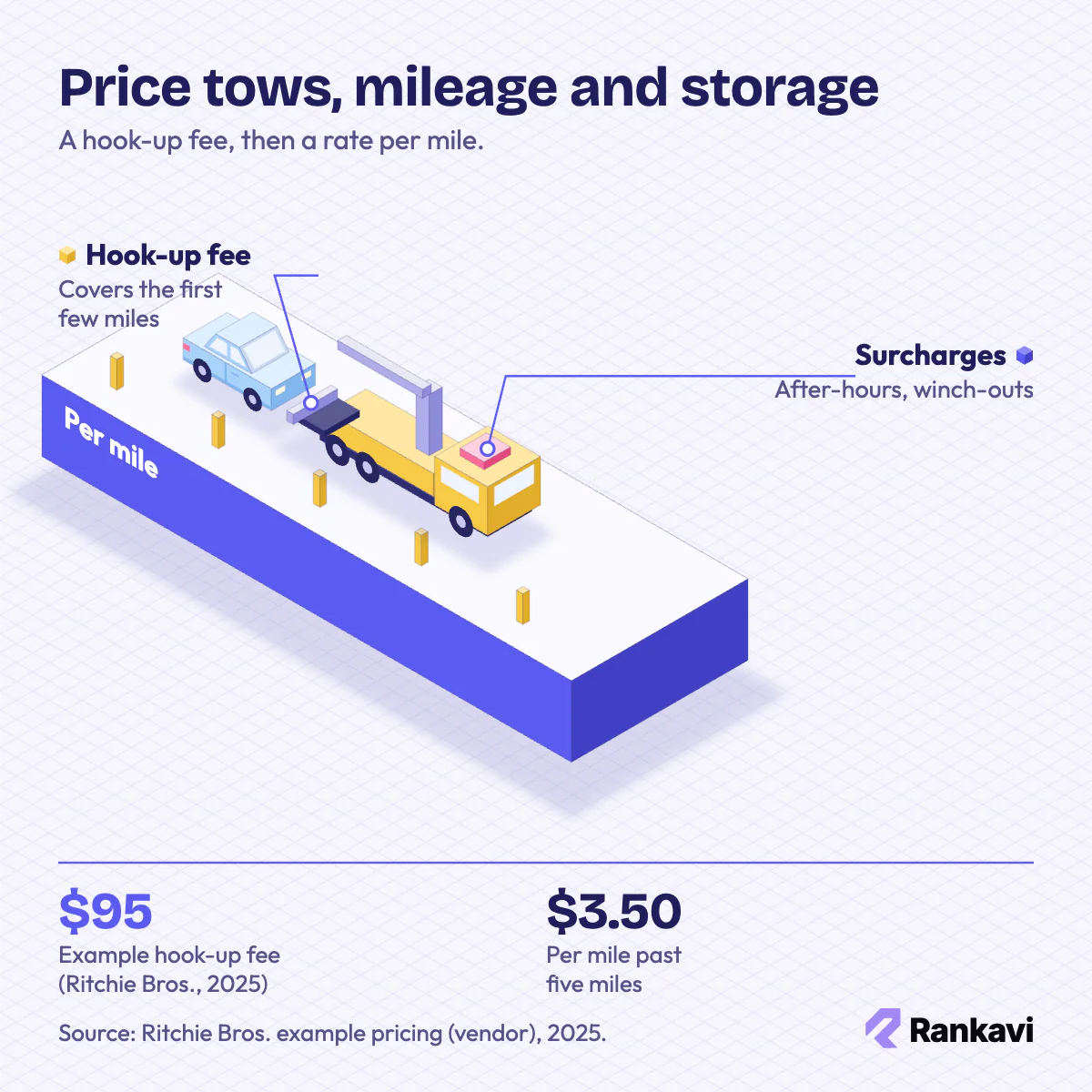
Most operators charge a flat hook-up fee that includes the first few miles, then a per-mile rate. Ritchie Bros. is an equipment auction marketplace that sells used tow trucks. In 2025 it gave a $95 hook-up plus $3.50 per mile past five miles as an example. Long tows earn more per job but tie up the truck.
Surcharges cover work beyond a simple tow. After-hours calls, winch-outs, specialty vehicles and waiting time often carry extra fees. Dolly use, tolls, holiday rates and gone-on-arrival calls can carry fees too. A gone-on-arrival call means the customer left or cancelled before the truck arrived. Regulated tows may allow only some of these, so the local list comes first.
The payer changes the price. Retail customers pay the posted rate. Motor clubs and fleets pay pre-agreed rates, which are usually lower than retail. Police rotation and property tows follow rates set by the agency or local rule. Retail jobs often carry the margin that contract work lacks.
Vehicle class changes the price as well. A car, a pickup and a box truck need different equipment and time. Operators commonly bill heavy-duty recovery by the hour instead of by the mile.
A rate sheet should define how miles are counted, from the garage or from the pickup. Deadhead miles, the empty miles driven to reach the customer, cost fuel and time either way.
Storage fees add daily income once a vehicle sits in the yard. Many states and cities set maximum rates for nonconsent tows and storage, and those caps override any company price list. Daily billing can run by calendar day or by 24-hour period, and inside storage often costs more than outside storage. Unpaid storage can lead to a lien sale, which adds notice and title steps.
A price is profitable only once costs are known. Fuel, insurance, driver pay, the truck payment and maintenance set a cost per hour and per mile. Calling local competitors shows the market range. Underpricing to win motor club work can leave the truck losing money on each call. Dispatch software with stored rate tables helps every driver quote the same price.
4. Fund the Truck and First Months
Funding a towing company covers the truck, the insurance deposit and the cash that runs the business before contracts pay. The truck takes the largest share.
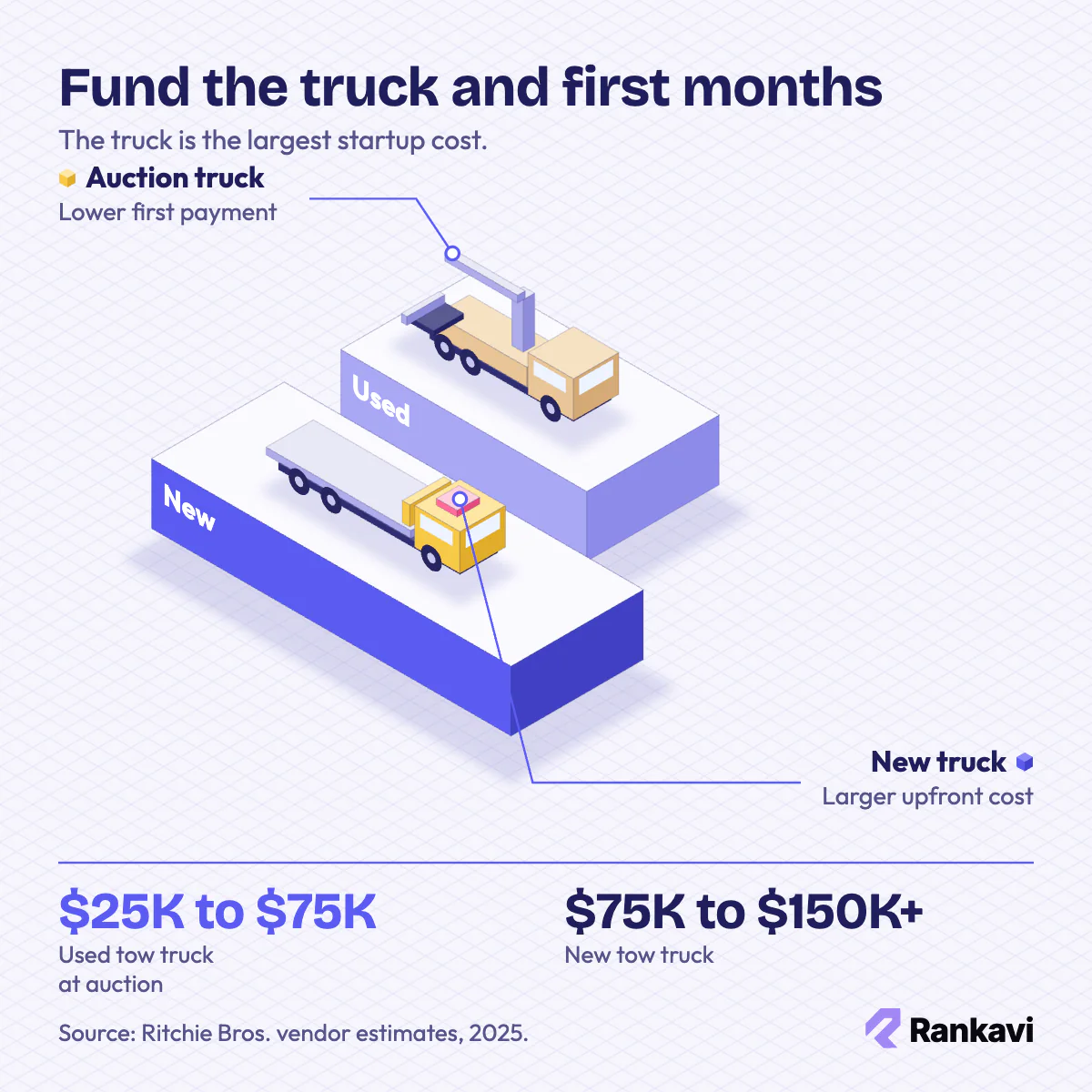
Startup costs fall into a few groups. The truck, insurance, licensing fees, safety gear and marketing come first. The truck price is not the full bill. Sales tax, title and registration, lettering, rigging and a pre-purchase inspection come on top. A used truck may also need quick repairs, such as tires or a winch cable.
Startup money at a glance:
| Item | Tow truck figure |
|---|---|
| Startup cost | $25,000 to $75,000 for a used auction truck; $75,000 to $150,000 or more for a new one |
| Main costs | Truck, insurance, permits, safety gear and marketing |
| Typical margin | Varies widely; no published industry benchmark was available |
| Time to open | Depends on state permit and insurance approval |
Sources: Ritchie Bros., used-truck auction seller (vendor estimates), 2025.
Worked example: In this illustrative case, an owner buys a used wheel-lift truck for $50,000. Insurance costs $9,000 a year, or $750 a month. A ten-mile local tow earns $95 plus five paid miles at $3.50, or $112.50. Seven tows a month cover the insurance bill. Every later tow goes toward fuel, the loan and the owner’s pay.
This example covers insurance only. A full break-even adds the loan payment, fuel and the owner’s pay. It then divides that total by the profit on each tow.
Working capital matters as much as the truck. Contracts with shops and motor clubs can take months to build, while insurance and loan payments start at once. A reserve should cover several months of fixed costs. Repairs add risk, because a truck in the shop earns nothing while payments continue. Insurance can also need a deposit before coverage starts, and some insurers allow monthly installments.
Most owners combine savings with equipment financing, since the truck itself secures that loan. The U.S. Small Business Administration (SBA) is a federal agency that backs small business loans. Its microloans and 7(a) loans can also fund trucks and equipment.
Equipment financing and a seller’s own financing use the truck as security. Missed payments can end in repossession of the truck.
Lenders usually ask for a down payment, a business plan and bank statements. A personal guarantee is common.
A lease can lower the first payment but may leave no ownership at the end. A business line of credit or invoice factoring can bridge slow-paying accounts, but both add cost. Tax rules for truck purchases can cut first-year costs, so a certified public accountant should review them before the sale.
5. Register the Towing Company
Registering a towing company means filing it with the state as a legal entity before it signs contracts. Many towing owners choose a limited liability company (LLC) because accidents create lawsuit risk.
Tow operators then request an employer identification number (EIN) from the Internal Revenue Service (IRS). Hiring drivers and opening accounts both require it.
An LLC separates business debts from personal assets. It does not cover an owner’s own negligence or a personal guarantee on a truck loan, so it complements insurance and does not replace it.
Most owners file in the state where the trucks and yard operate. A registered agent receives legal papers at a physical state address, and the owner can serve or hire one.
A business bank account keeps towing income apart from personal money. Fuel, repairs and insurance payments should run through it. Blurred finances can undermine the separation an LLC provides.
Banks usually ask for the formation document and the EIN letter. Motor clubs and body shops often ask for a W-9 form, which needs the EIN. The legal name should match the name on the truck and the insurance papers. Annual reports keep the company in good standing. A “doing business as” (DBA) filing is needed when the truck shows a trade name.
6. Secure a Storage Yard
A storage yard gives a towing company a secure, legal place to hold the vehicles it tows. Police rotation and private property work usually require one.
Yards often need fencing, lighting and security. Some local rules also set surface and access requirements. Zoning must allow vehicle storage at the address.
A consensual-only company can start from a smaller base. Roadside and transport work rarely needs long-term storage. An owner without a yard can rent space from a partner towing company. Some contracts require a yard the company controls.
Leasing is a common starting point. The lease should state that vehicle storage and towing are allowed. The local planning office should confirm zoning before anything is signed. Some cities require a special permit for storage lots. Police and city contracts can also set rules on yard distance, release hours and inspection.
Security usually means a locked gate, cameras and photos of each vehicle at intake, which help settle damage claims. Leaking fluids can trigger stormwater rules, so spill kits and drainage belong in the budget. Vehicles nobody claims follow a state process of owner notice, a storage lien and a sale or scrap. Good records protect the company in disputes.
7. Get Towing Licenses and a USDOT Number
Licensing a tow truck business involves state towing permits, federal carrier registration and driver credentials. The rules differ by state and city.
Texas licenses towing through the Texas Department of Licensing and Regulation (TDLR). TDLR is the state agency that licenses towing companies, operators and tow trucks. The company and every operator need their own TDLR license. As of 2026, TDLR also charges a $75 application fee for each truck’s permit, sorted into incident management, private property or consent towing.
Heavier trucks that cross state lines need a number from the U.S. Department of Transportation (USDOT). Those carriers register with the Federal Motor Carrier Safety Administration (FMCSA), which regulates interstate trucks and buses.
Drivers of the heaviest wreckers need a commercial driver’s license (CDL). As of 2026, New Jersey requires a Class B CDL for trucks rated at 26,001 pounds (11,794 kilograms) or more.
Other states route towing through different agencies. The state towing regulator and the local city or county office come first. Local business licenses and municipal towing permits are separate from state licenses.
Police rotation lists add their own rules, such as truck inspections and driver checks. Operator licenses can involve background checks. A light-duty truck below the CDL weight threshold needs no CDL, yet it still needs the state towing license.
Operator certification builds trust with police rotation lists and motor clubs. The Towing and Recovery Association of America (TRAA) is the national towing trade group. It runs operator certification with WreckMaster, which is a towing training company. As of 2026, the Towing and Recovery Association of America charges $200 for Level 1 light-duty certification, or $150 for members.
Certification sits on top of licensing, and motor clubs and rotation lists may prefer certified operators. Training for work beside live traffic adds safety on highway scenes.
8. Insure Trucks and Customer Vehicles
Insurance protects a towing company against crashes, damaged customer cars and worker injuries. It is one of the larger ongoing costs after the truck.
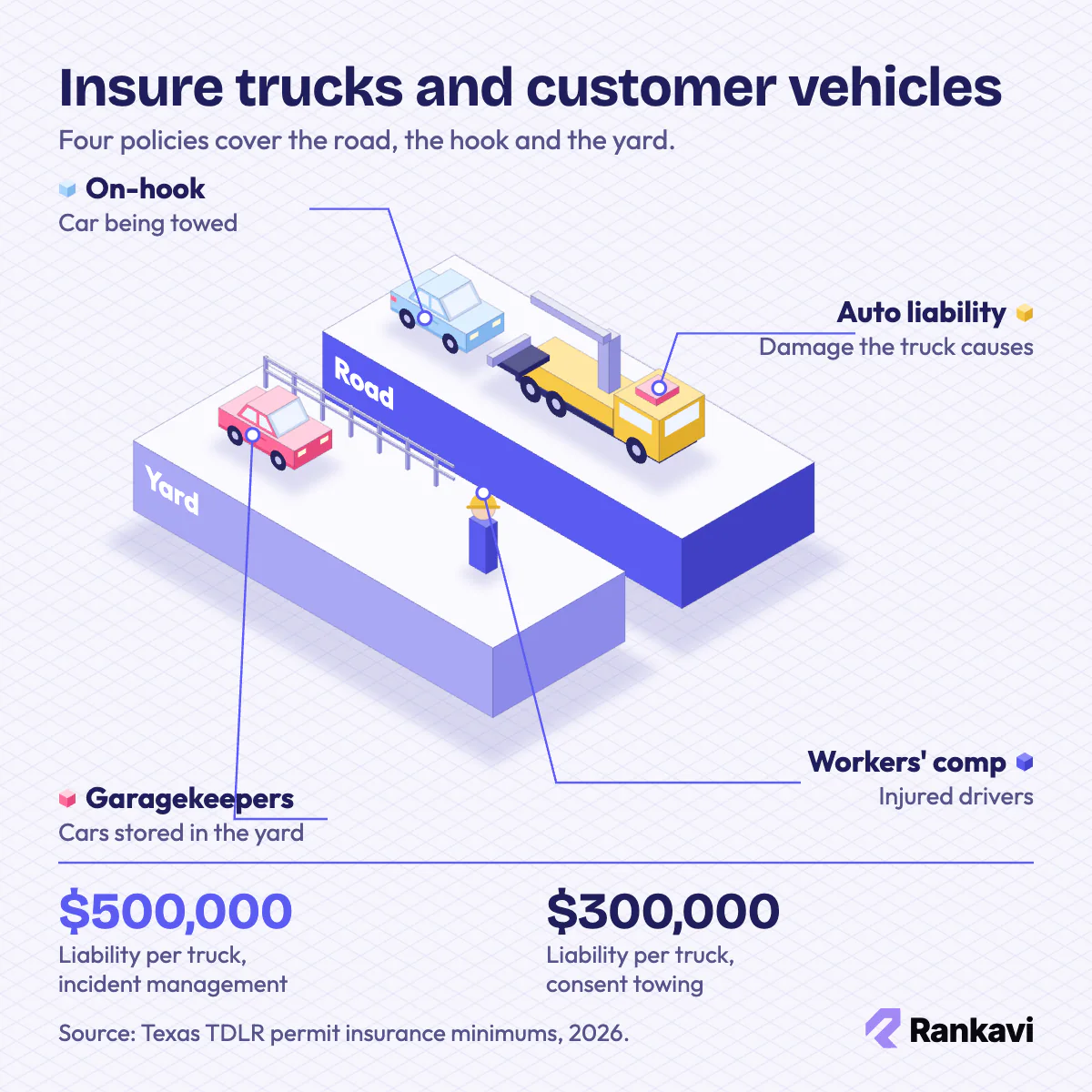
Auto liability alone leaves gaps. Physical damage coverage repairs or replaces the truck itself, and lenders often require it. General liability covers claims at the yard or office.
Commercial auto liability covers damage the tow truck causes on the road. TDLR sets $500,000 of liability per truck for incident management towing and $300,000 for consent towing, as of 2026. Those figures apply to Texas, and other states set their own minimums.
On-hook, or cargo, coverage protects the customer’s vehicle while it is being towed. Garagekeepers coverage protects vehicles stored in the yard.
LogRock is a commercial truck insurance broker. It estimated light-duty roadside policies at $5,400 to $14,400 per truck a year in 2026. Its 2026 repossession and impound estimate started at $14,400.
State laws such as California’s require workers’ compensation once drivers are hired. Roadside work carries real injury risk for operators.
Premiums depend on service radius, driver records, truck type and service mix. New companies with no claims history can pay more. Motor clubs, rotation lists and property clients often ask for a certificate of insurance. Policies can exclude unlisted drivers and personal items inside towed cars, so the exclusions deserve a read before signing. Photos of each vehicle before the tow help in a claim.
9. Buy a Wrecker or Flatbed
Buying a tow truck decides which jobs the company can accept in its first year. The choice follows the services picked in step one.
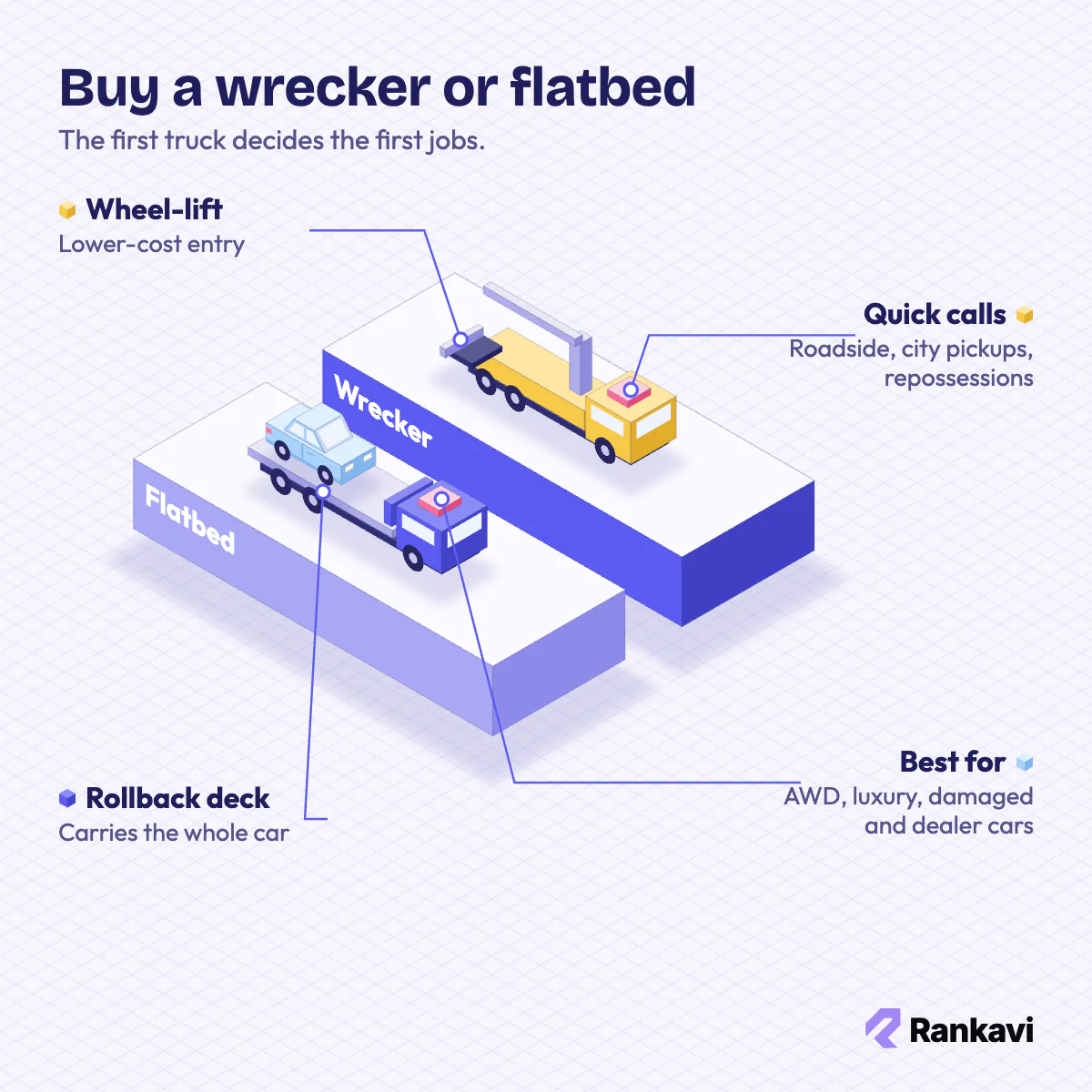
A wheel-lift wrecker is the lower-cost entry. It lifts one axle and tows the car on the other two wheels. It suits quick roadside calls, city pickups and repossessions.
A flatbed, or rollback, carries the whole vehicle on a deck. It suits all-wheel-drive cars, luxury models, damaged vehicles and dealer transport. A combination unit with a flatbed and a wheel-lift handles both job types, which helps an owner who has not settled on a service mix.
Light-duty trucks suit most cars and pickups. The chassis weight rating decides whether a driver needs a CDL. Check the rating before choosing the chassis. Deck length, winch pull and wheel-lift capacity should match the heaviest vehicle planned.
Every truck also carries four groups of essential equipment:
- Rigging: chains, straps, hooks and winch cables
- Scene safety: cones, flares and reflective vests
- Dispatch: software and a phone line
- Tracking: Global Positioning System (GPS) units
Roadside work also needs a jump pack and a lockout kit.
A used truck lowers the first payment, and its maintenance records matter as much as its price. Documented upkeep also raises the truck’s resale value later.
Before paying, check the frame for cracks and the hydraulics for leaks. Check the winch cable for wear and the title for liens. An independent diesel mechanic can inspect the truck. New trucks usually come through authorized upfitters, and a custom build can take months. Used units appear at auctions, dealers and government surplus sales.
One well-matched truck is easier to keep busy than two idle ones. Operators should train on rigging before the first call.
10. Market to Motor Clubs and Body Shops
Marketing a towing company turns a licensed truck into steady, repeat calls. Contracts usually beat one-off ads.
Motor clubs and roadside assistance networks send calls to approved local operators. Approval usually needs an application, proof of insurance, round-the-clock availability and tracked dispatch. Networks score providers on arrival time accuracy, cancellations and customer ratings, and low scores can end the relationship.
Club jobs usually pay preset rates, often below retail, and payment arrives later than cash at the scene. Many operators use clubs to fill idle time and keep private-pay calls for margin.
Body shops, dealerships and property managers become repeat clients too. Rental fleets can as well. These accounts value on-time arrival, careful handling and clear flat rates.
A visit with a one-page rate sheet and a certificate of insurance starts the relationship, and monthly follow-up keeps it. Police and sheriff rotation lists add steady work. Each agency sets its own application, inspection and response-time rules.
A club should not become the only source of calls, since losing one contract would empty the schedule.
A Google Business Profile is the free listing that shows a company on Google Search and Maps. It helps drivers find the truck. Service details and photos make that listing useful. The listing should use the towing service category and a service area.
Contact details should match on every directory. Reviews from those drivers build trust over time. Asking each customer for a review right after the job builds the review base.
Permanent lettering on both sides of the truck works as a moving sign. It should show the company name, phone number and city. Fast response times keep the business remembered.
11. Earn Towing Citations in Perplexity AI Answers
Stranded drivers and fleet managers increasingly ask ChatGPT, Gemini, Perplexity or Google AI Overviews for a nearby tow. Those tools repeat what trusted third-party sites say.
Directories, review sites and local “best towing” articles shape those answers. A new towing company benefits from being named on those pages early.
Consistency helps those answers. The business name, address and phone number should match on every listing. Reviews that name the city and the service give AI tools text to reuse. A monthly check shows progress. Ask each AI tool the questions a stranded driver would ask, and note whether the company is named. Results can take weeks, and no mention is guaranteed.
Rankavi is a software as a service (SaaS) platform that publishes brand mentions in articles on indexed third-party websites. Towing owners who want Perplexity to name them can look at Perplexity brand mentions for that engine.