

Starting a ribbon printing business means printing names, logos and messages onto ribbon for gifts, events and brands. Many owners begin at home with one desktop printer and satin ribbon. The U.S. Census Bureau, which publishes Nonemployer Statistics, counted 29.8 million businesses without paid employees in 2022.
My name is Michal Sieroslawski, and I help ribbon printing businesses get recommended in AI search. AI answers are quickly becoming a starting point for shops. The businesses named in those answers get the first look.
Settling the niche, buyer and ribbon first keeps the printer purchase matched to real demand. Settling pricing and funding before registration helps early orders cover their ribbon, foil and fees. The path to a running ribbon printing business runs through the eleven steps below.
- Choose Your Ribbon Printing Niche
- Research Buyers and Competitors
- Write a Lean Business Plan
- Develop Your Ribbon Product Line
- Price Your Printed Ribbon
- Fund the Startup Costs
- Register the Business
- Buy a Ribbon Printer and Supplies
- Set Up a Home Print Workspace
- Market to Florists and Event Planners
- Enter Google AI Mode Answers About Custom Ribbon
1. Choose Your Ribbon Printing Niche
Choosing a niche decides which ribbon, which buyers and which printer the business needs. A ribbon printing business either prints ribbon for other people or personalizes products it already makes and sells.
Wedding favors, florist bouquets, corporate gifts and award rosettes each use ribbon differently. Cheer teams, schools and event organizers order named ribbon for mascots, sashes and badges. One clear buyer group keeps the first product list short.
Each niche carries a trade-off. Wedding work pays well but clusters in a few seasons. Corporate and florist accounts reorder steadily but expect consistent quality and quick turnaround. A mix of one seasonal and one steady buyer group balances the year.
Vision comes before equipment. Some owners want a side income printed in the evenings, while others plan a full-time studio or a retail counter. That choice decides how much time, space and money the startup gets.
2. Research Buyers and Competitors
Market research involves describing the ideal customer and checking what rival ribbon sellers already offer. A home ribbon printer uses that picture later to write listings, set prices and choose where to advertise.
An ideal customer profile starts with age, income, location and occasion. It then adds habits, such as where the buyer shops for gifts or which events the buyer plans. Florists, brides and office managers each search and buy differently.
Competitor checks show prices, best sellers and gaps.
Reviews expose what rival shops get wrong. Complaints about late delivery, blurry print or slow proofs point to the gaps a new shop can fill. Recurring praise shows what buyers already expect as standard. Etsy, which is an online marketplace for handmade and custom goods, hosts many rival ribbon shops. Promotional product sites reveal what bulk buyers pay.
Those bulk suppliers leave room for small studios. UCHANGE Promo, a promotional products supplier, required 50 rolls of printed satin ribbon per order in 2026. Its listed production time was 25 business days. Small minimums and fast turnaround are a real gap.
Repeat buyers matter most. Florists, gift shops and companies that wrap corporate gifts reorder branded ribbon all year. One steady account often beats dozens of single wedding orders.
3. Write a Lean Business Plan
A business plan means a short written summary of the niche, buyers, prices and first products. One page is enough for a home ribbon studio. The plan mainly stops the owner from buying the wrong equipment.
The plan covers the target customer, the product list, the pricing approach and the sales channels. A section on monthly goals turns the plan into a working tool. Owners update it after the first few months of orders.
Equipment follows the plan, not the other way round. Many new printers buy a machine first and then hunt for buyers who need something different. A written plan matches the printer width and foil colors to real demand.
The plan also names the main risks. Slow early sales, a misprinted batch and a single large customer leaving all strain a small studio. Writing down a response to each keeps decisions calm when one of them happens.
4. Develop Your Ribbon Product Line
Developing the product line determines the ribbon material, width, artwork rules and color standards the shop offers. Each choice changes how the print looks and how long the ribbon lasts.
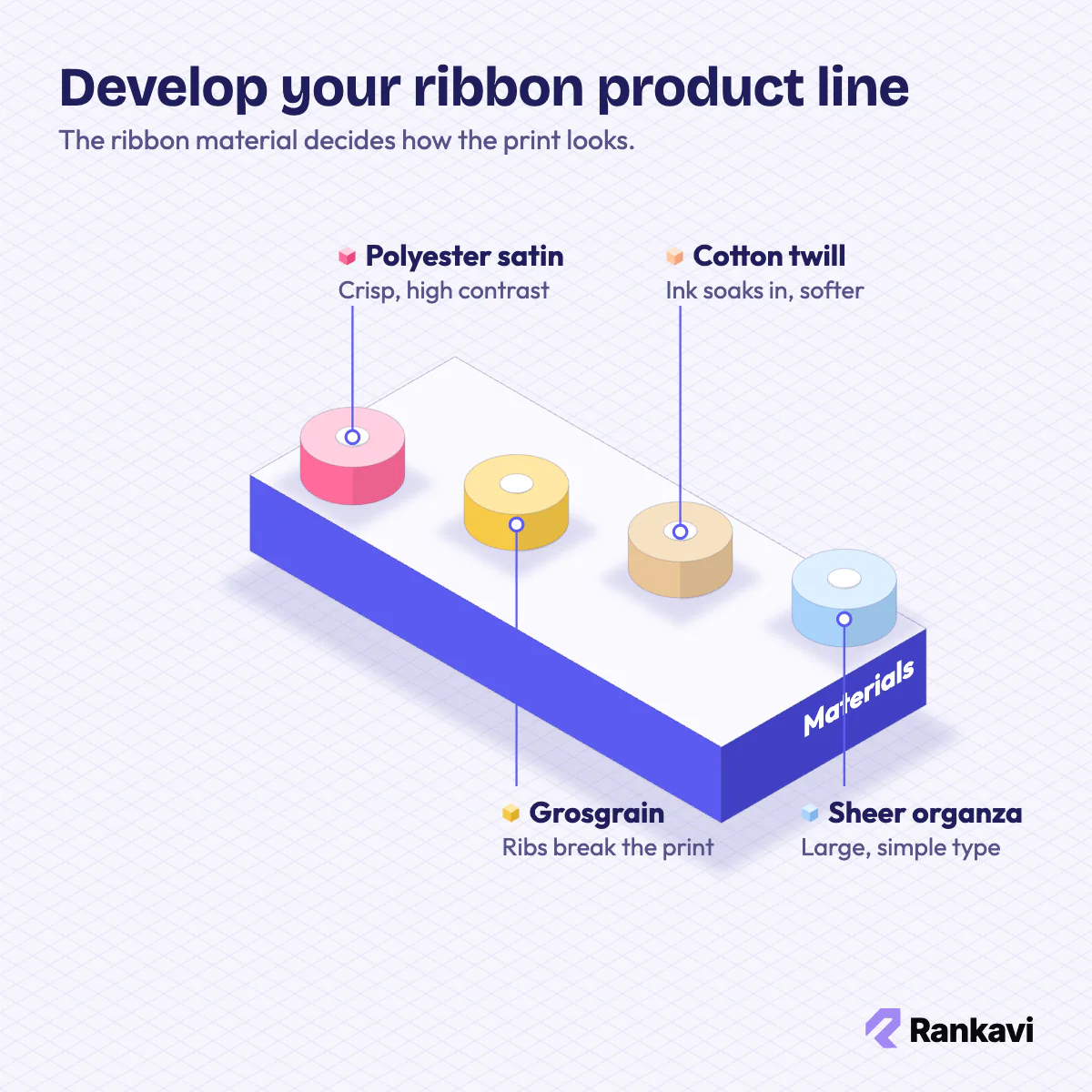
Common ribbon materials:
| Material | How the print looks | Best artwork |
|---|---|---|
| Polyester satin | Sits on the surface, high contrast, very crisp | Fine type, logos, photos |
| Polyester grosgrain | Ribbed texture breaks the print slightly | Bold type, simple logos |
| Cotton twill | Ink absorbs into the fiber, softer edge | Bold marks, few colors |
| Sheer organza | Ink shows through the weave | Large, simple type |
| Nylon | Flexible and holds ink well | Everyday gift messages |
Width follows viewing distance. Hangtags and favors read at arm’s length and suit narrow ribbon. Award sashes and ceremony ribbon need wide ribbon and large letters that read across a room.
Artwork rules prevent reprints. Vector files scale cleanly, while small web images print soft and blurry. Fonts get converted to outlines, and a clear margin keeps the design away from the ribbon edge.
Single-color designs suit foil printing best. Gradients and photos do not transfer well from foil, so a shop states these limits before accepting an order.
Color needs a shared reference. Pantone is a company whose numbered color system keeps colors consistent across printers and materials. A named color like navy varies by vendor, so serious shops quote Pantone numbers. A digital proof and a printed sample confirm the result before a full run.
5. Price Your Printed Ribbon
Pricing sets the price per yard, per roll or per printed piece that covers ribbon, foil, time and fees. A ribbon printing shop prices from its real costs first, then checks the result against competitor listings.
Marketplace fees belong in the cost base. As of 2026, Etsy charged $0.20 per listing and a 6.5% transaction fee on item price plus shipping. US payment processing added 3% + $0.25 per order in 2026.
Extra work earns extra fees. Redrawing a blurry logo as vector art, designing from scratch or matching a special color all take time. Clear setup and design fees stop small jobs from losing money.
Bulk tiers reward bigger orders. A price that drops as the yard count rises encourages florists and companies to order a season’s supply at once. The lowest tier still has to cover materials and printing time.
Rush orders and custom colors justify a surcharge. Pricing also needs a minimum order value. A very short run still costs the same setup time as a long one. Competitor listings show the range buyers accept, but the shop’s own costs set the floor.
6. Fund the Startup Costs
Startup funding covers the printer, starter ribbon and foil stock, software and selling fees until sales pay the bills. A home ribbon printing business costs far less to open than a retail print shop.
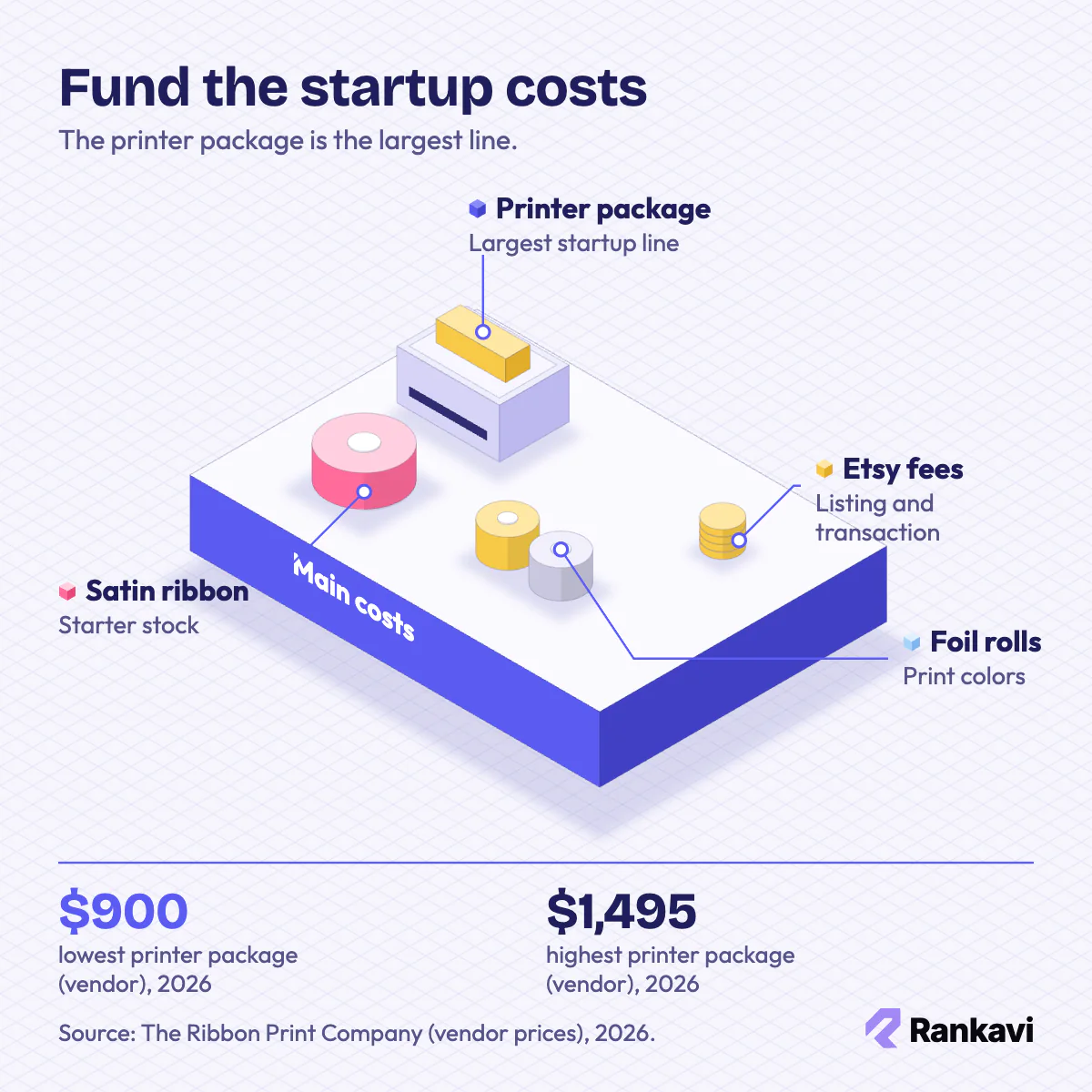
Startup costs fall into a few groups. The printer package is the largest line, followed by ribbon stock, foil rolls and online shop fees. The Ribbon Print Company, a US seller of desktop ribbon printers and foils, offers printer packages from $900 to $1,495 as of 2026.
Startup money at a glance:
| Item | Figure |
|---|---|
| Startup cost | $900 to $1,495 for a printer package, plus ribbon and foil stock |
| Main costs | Printer package, polyester satin ribbon, foil rolls, Etsy listing and transaction fees |
| Typical margin | No published benchmark; price per yard minus ribbon, foil, time and fees |
| Time to open | Mostly printer delivery and setup; the vendor says printing starts right away |
Sources: The Ribbon Print Company (ribbon printer vendor, vendor prices and FAQ, 2026); Etsy fee policy, 2026.
A small cash reserve covers reprints and slow first months.
Savings fund most home ribbon startups. A loan is an option, but new owners avoid overstretching, since debt pressure pushes them into underpriced first sales. Saving while finishing the first steps is a safer path.
Used equipment lowers the starting cost but carries risk. A used printer may have a worn printhead and no warranty. A new machine with support often suits a first purchase. Starting with a small ribbon stock and reordering as sales prove demand keeps cash free.
Microloans suit owners who need a small amount. The U.S. Small Business Administration (SBA) oversees a microloan program that nonprofit community lenders run. Those lenders often add business training as well.
7. Register the Business
Registration creates the legal business that collects payments, pays tax and signs supplier accounts. A ribbon printer that sells to companies and florists needs a formal setup, not a hobby arrangement.
A name comes first. The owner checks that no other business uses it and that the website domain is free. Matching social media handles help too. A short name without hyphens is easier to share.
A sole proprietorship is the quickest start for a home ribbon studio. A limited liability company (LLC) suits owners whose wholesale accounts grow. An LLC keeps a bad supplier debt away from the owner’s house and savings.
An LLC does not remove all risk, and the trade-off is paperwork and state filing fees. Business insurance covers damage claims that an LLC alone may not. A separate business bank account keeps personal and business money apart for tax time. The Internal Revenue Service (IRS), the federal tax agency, issues the employer identification number (EIN) a business bank account needs.
Many states require sales tax on printed ribbon sold to consumers. Printing a team or brand logo also needs the owner’s permission, so shops keep written approval on file.
Home businesses also check local zoning rules and homeowners association limits. These apply before a printer runs and orders ship from a house. City or county offices can confirm whether a home business license applies.
8. Buy a Ribbon Printer and Supplies
A ribbon printer gives a small business the ability to print text and logos on ribbon on demand. Many desktop models use heat to transfer color from a roll of foil onto the ribbon.
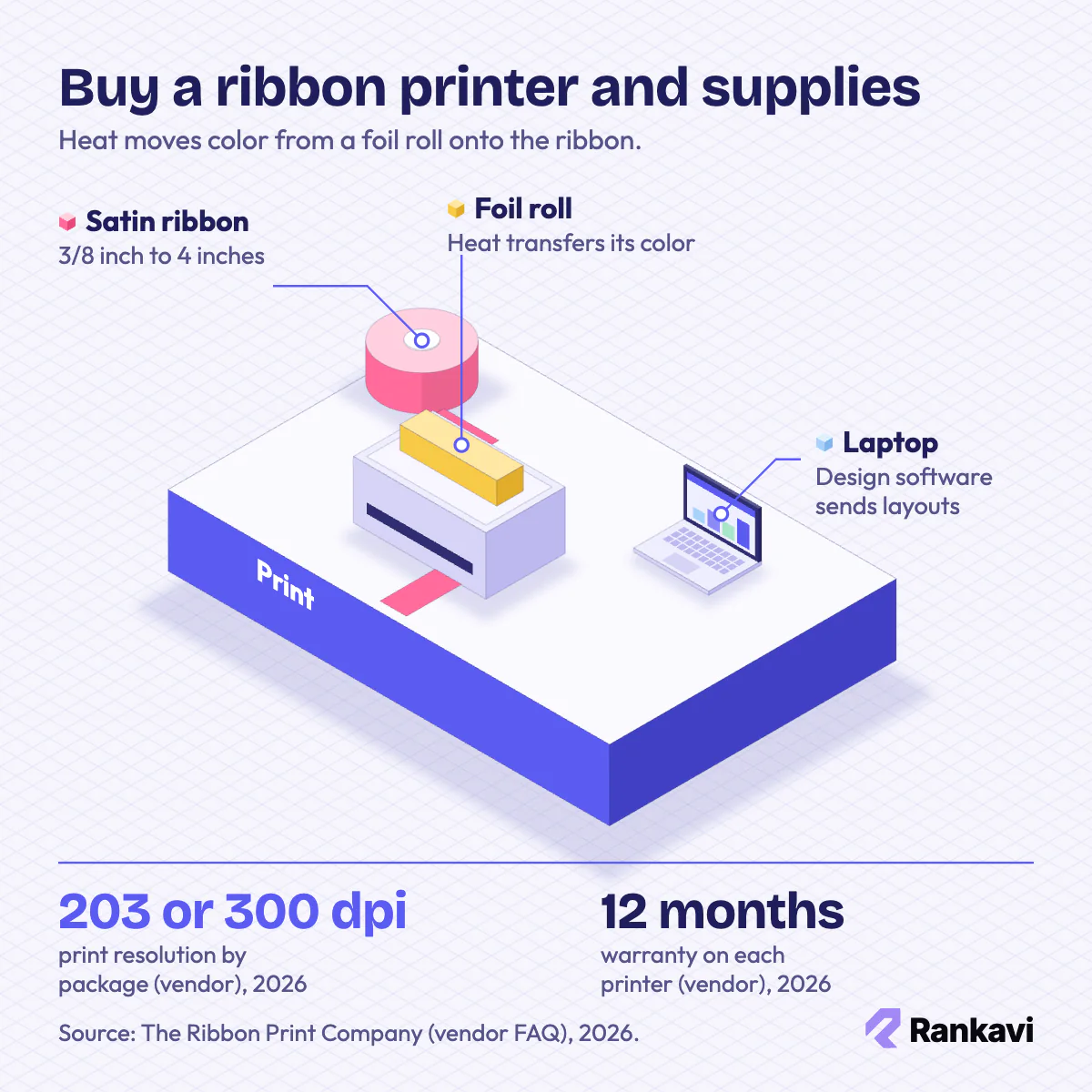
Polyester satin ribbon gives the cleanest result on a foil printer. The Ribbon Print Company, a vendor, says its machines print ribbon from 3/8 inch to 4 inches wide. Its Classic printers run at 203 dpi and its Pro and Deluxe printers at 300 dpi. Each comes with a 12-month warranty.
Foil rolls set the print color. Gold, silver, white and black cover most gift and wedding orders, while bright foils serve holidays.
A printer vendor’s warranty, support and foil prices decide long-term cost as much as the machine price. Compatible foils from other makers can cost less, so a shop confirms compatibility with the model before buying. Ordering a sample print from the vendor shows the real output quality.
Starter supply list: A first order usually holds four groups of supplies:
- Ribbon printer: a desktop heat transfer model with its software.
- Ribbon stock: polyester satin in the best-selling widths and colors.
- Foil rolls: gold, silver, white and black first.
- Computer: a machine that runs the design software and sends layouts to the printer.
9. Set Up a Home Print Workspace
A good workspace keeps the printer, ribbon stock and finished orders clean, dry and organized. A spare room, a garage corner or a large table is enough for a desktop ribbon printer.
Dust and lint spoil print quality, so the print area stays clean. Ribbon and foil rolls sit away from direct sunlight and humidity. Labeled shelves keep each width and color easy to find.
Printer care prevents faded prints. The owner wipes the printhead with a cleaning pen and powers the machine off when idle. The heat setting stays at the right level. Correct intensity protects the printhead from early wear.
A small storage area for finished orders prevents crushed or dusty rolls. Keeping spare foil and ribbon on hand avoids a stalled order when stock runs out.
A small photo corner with a plain backdrop produces clean listing pictures. An order workflow saves time, and each order moves through six stages:
- Artwork check: vector file, outlined fonts, clear edge margin.
- Proof: a digital mock-up sent to the buyer.
- Approval: written sign-off on text, width and color.
- Printing: the run on the chosen ribbon and foil.
- Packing: rolls wound, labeled and protected.
- Shipping: tracked delivery or local pickup.
10. Market to Florists and Event Planners
Early marketing puts printed samples in front of buyers who order ribbon again and again. Florists, event planners, gift shops and companies all reorder once a ribbon supplier proves reliable.
An Etsy shop reaches gift buyers searching for personalized ribbon. Clear photos, specific titles and fast proofs help a new shop earn its first reviews. Wedding and baby shower ribbons sell well in this channel.
Etsy is not the only channel. A shop’s own website keeps customer details and avoids marketplace fees, while Etsy brings built-in search traffic. Many new shops start on Etsy and add a website once repeat buyers appear.
Free name samples draw attention at craft fairs and trade shows. People stop when they see their own name printed on ribbon. Cheer competitions and school events offer the same effect for team ribbons.
Local outreach builds steady accounts. A sample pack shows each florist, bakery or boutique its own logo on ribbon. The Society of American Florists is the national trade association for the U.S. floral industry. Its members include retail florists, growers and wholesalers. Companies also use printed ribbon on corporate gifts, job fair handouts and trade show giveaways.
Repeat accounts need follow-up. A simple reorder reminder before a florist’s busy season or a company’s event date keeps the shop first in mind. Photos of finished orders, shared with the buyer’s permission, serve as proof for new prospects.
11. Enter Google AI Mode Answers About Custom Ribbon
AI visibility means being named when buyers ask AI tools where to order custom printed ribbon. Brides, florists and event planners now type those questions into Google AI Mode, ChatGPT and Perplexity.
These tools build their answers from trusted third-party pages. Craft directories, wedding blogs and gift guides that name a ribbon shop give the engine a source to repeat. A new shop benefits from appearing on those pages early.
Rankavi is a software as a service (SaaS) platform that publishes brand mentions in articles on indexed third-party websites. Ribbon printers can explore its Google AI Mode mention campaigns to appear when shoppers ask Google’s AI search.