

Starting a photo booth business means forming a company and renting a portable booth to weddings, parties and corporate events. Future Market Insights is a market research firm that estimates the global photo booth market at $639.1 million in 2026.
A bit about me: my name is Michal Sieroslawski, and I help photo booth businesses become easier to find online. Asking an AI assistant is becoming a normal way for event hosts to compare photo booth businesses. Showing up there helps a new photo booth business reach people it would otherwise miss.
Each decision feeds the next. The market shapes the plan, pricing sets the income each event brings, and that sets the budget. The funded company then registers, buys the booth and insures it before the first paid event. The following list shows how to start a photo booth business in eleven steps.
- Choose Your Photo Booth Market
- Write a Lean Business Plan
- Price Your Photo Booth Packages
- Budget and Fund Your Startup Costs
- Register Your Photo Booth Company
- Buy the Right Booth and Gear
- Insure Your Equipment and Events
- Set Up Software and Event Workflows
- Market Your Booth to First Clients
- Grow With Attendants and New Booths
- Land Bookings Through AI Recommendations
1. Choose Your Photo Booth Market
Choosing a market means deciding which events the photo booth company serves first. That choice drives the booth style, the brand and the price level of a new rental business.
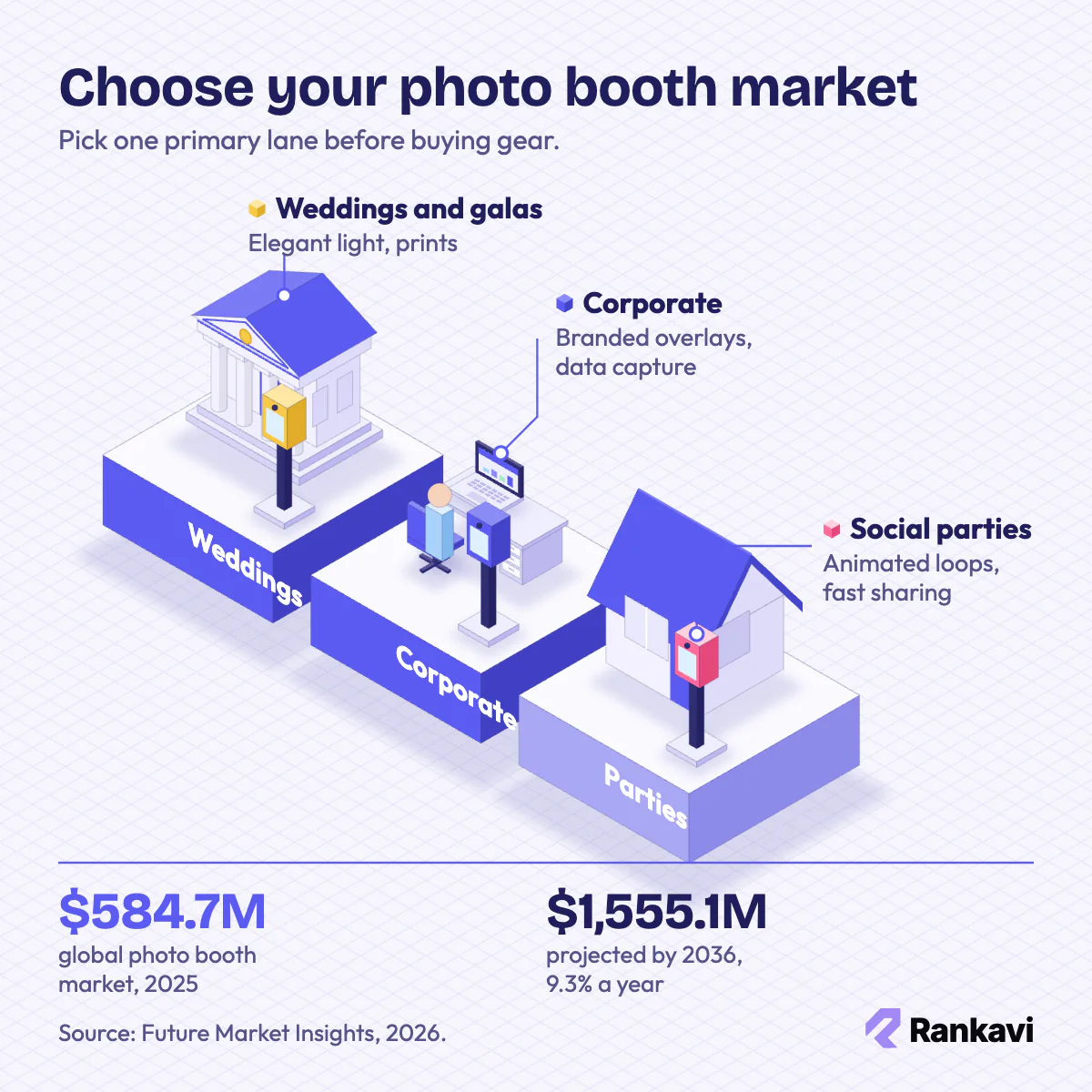
A booth company that chases every event dilutes its brand. A website built for a corporate marketing director confuses a parent planning a birthday party. One primary market keeps the message sharp, even though other bookings arrive later.
Demand is growing across all three lanes. Future Market Insights valued the global photo booth market at $584.7 million in 2025 and projected $1,555.1 million by 2036, a 9.3% annual growth rate.
Main photo booth markets:
| Market | Typical clients | What they expect |
|---|---|---|
| Luxury weddings and galas | Engaged couples, wedding planners | Elegant backdrops, flattering light, prints |
| Corporate events and brand activations | Marketing directors, agencies, conference organizers | Branded overlays, data capture, sharing reports |
| Social parties | Parents, schools, private hosts | Animated loops, boomerangs, fast text sharing |
Price levels differ by lane too. Check Cherry is booking software for event vendors, and it publishes rental prices from about 118,000 bookings made through its own platform since January 2024. In its 2026 guide, corporate events had a median of $899, weddings $886 and private parties $606.
A local competitor scan reveals the gap. If rivals crowd the budget party segment, the opening sits in upscale weddings. If every local booth chases weddings, corporate activations are the open lane.
The medians show that price alone does not separate the lanes. Corporate and wedding rentals cost about the same. The real differences are how far ahead clients book, how many dates exist and what they demand from the vendor.
Booking habits differ by lane. Wedding clients book long before the date and decide as a couple, often with a planner. Corporate buyers go through marketing teams or agencies and may pay by invoice. Party hosts decide alone and book close to the date. A wedding-only company can sit idle through winter, which makes a second lane worth planning early.
A scorecard keeps the choice honest. Each lane gets a rating for local competition, seasonality, profit per event and equipment budget. Access to clients through the owner’s network counts too. A founder with no corporate contacts usually starts with parties or mid-range weddings. Corporate work follows once a portfolio exists.
The chosen market then becomes the unique selling proposition (USP). It answers why a client should hire this booth over the next one. It also rules out poor equipment buys, such as a heavy spinning booth for small, intimate venues.
2. Write a Lean Business Plan
A business plan turns the photo booth idea into a set of written decisions. For a one-booth operator it works as a private roadmap, not a long document for a bank.
Its key assumption is event volume: how many bookings a month, at what average package price. Everything else, from payback to hiring, follows from that pair of numbers.
Bookings are seasonal. Wedding season and the winter holiday party rush bring peaks, while January and February run slow. A sound plan marks those months and shows how spring income carries the quiet stretch.
Then comes the operating goal. Some owners run one booth on weekends and staff every event themselves. Others aim for a fleet run by trained attendants, which changes transport, storage and late-night staffing.
A lean plan fits on one to two pages. It holds the target customer and the packages. It adds a short list of local competitors and a monthly booking forecast. Last come the cost of one event and goals for the first 90 days. A spreadsheet handles the math.
Cost per event comes before profit. Attendant pay, fuel, parking, prints, props and wear on the gear are subtracted from the average package price. The remainder, divided into the startup cost, shows how many events the booth needs to pay for itself.
One booth with one operator usually serves one event a day, so weekend availability caps the forecast, not demand. Three scenarios show the risk: a low, an expected and a high month. If the low case cannot cover fixed costs, price or costs change before any equipment is bought.
Cash flow differs from profit. Deposits arrive months ahead of an event, while repairs arrive without warning. A reserve for the slow winter months protects the owner’s pay.
3. Price Your Photo Booth Packages
Pricing decides which clients a photo booth business attracts and how much profit each event leaves. New operators often undercut rivals, and that low rate is hard to raise later.
Check Cherry’s 2026 figures give a clear benchmark: half of all rentals fell between $452 and $1,022. Length matters too: in 2026, three-hour attended rentals had a median of $699 and four-hour ones $800.
Underpriced packages attract the most price-sensitive clients, who are often the hardest to please. A safer approach prices the standard package at or slightly above the local market, with reliability justifying the difference.
Three tiers let clients choose by budget. A premium top tier anchors the comparison, so the middle package looks like strong value and most clients settle there.
Add-ons lift each booking, yet only 26% of 2026 rentals in Check Cherry’s data included one, at a median of $147. Popular upgrades include glam filters, slow-motion video, live photo mosaics and premium backdrops.
Branding offers one more lever. Standard packages carry a small company logo on each photo. Corporate clients often pay extra to remove it.
Price should start from cost, not from rivals. Each event takes far more time than its booked hours, because setup, teardown and travel all count. A low package price can turn into a low hourly wage once that time is added.
Packages usually beat hourly rates because clients compare them easily. Each tier states the hours, whether an attendant is present, print or digital delivery, the backdrop and the online gallery. A minimum booking length protects against short, unprofitable jobs.
Extra fees keep long trips and hard venues profitable. Common ones are a travel fee beyond a set radius, a charge for stairs and an overtime rate. Sales tax on rentals depends on the state.
A deposit and a written contract make the price binding. Discounts work best as extras, such as a longer session, so the base rate stays intact. A calendar that fills early signals room for a price increase.
4. Budget and Fund Your Startup Costs
A startup budget sets how much cash the photo booth business needs before its first booking. Here the booth itself is the largest line, since no storefront or employees are required.
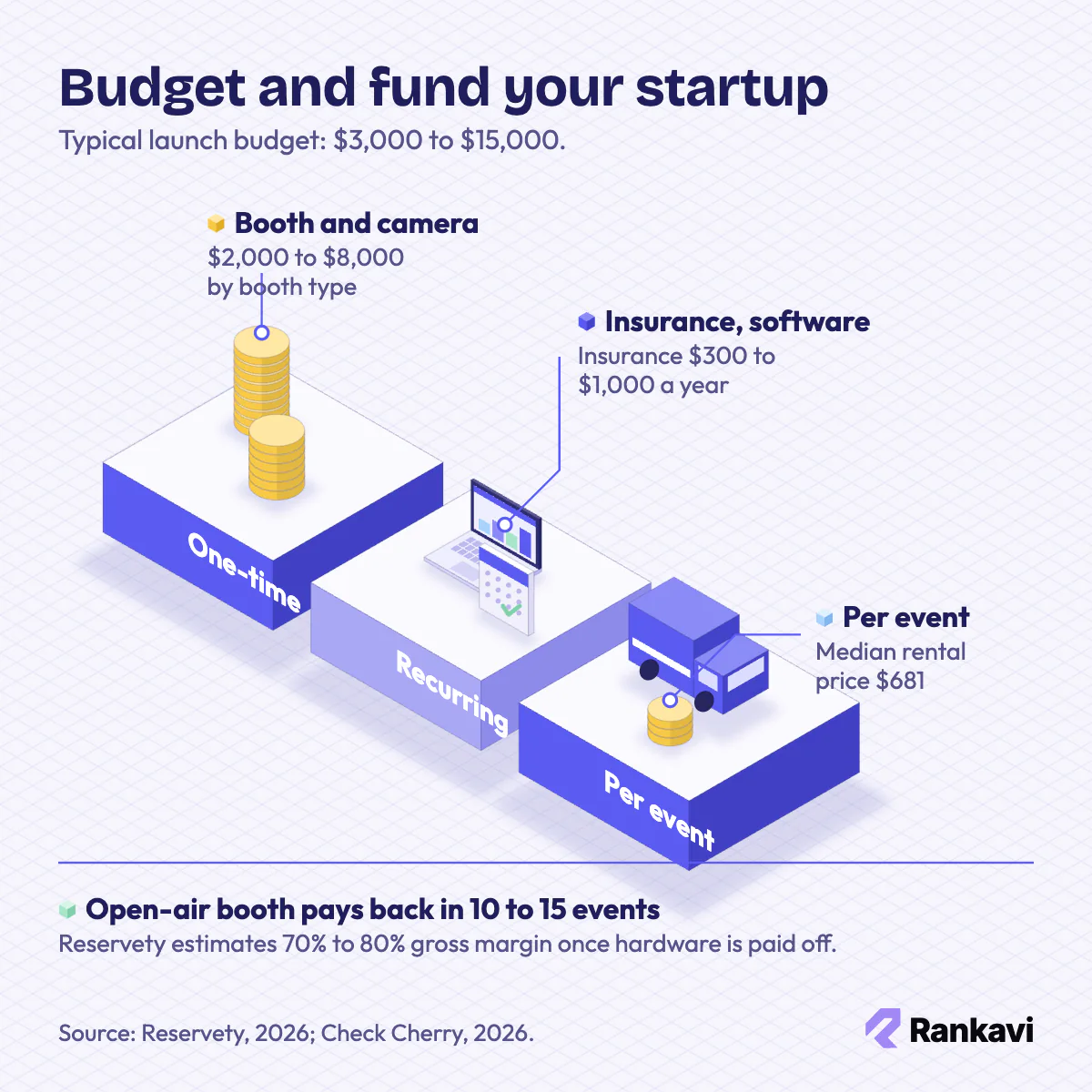
Reservety is a rental booking software maker that publishes cost guides for booth owners. Its figures below are vendor estimates, not survey data.
Startup money at a glance:
| Item | Figure |
|---|---|
| Startup cost | $3,000 to $15,000, depending on booth type, gear and transport |
| Main costs | Booth with camera ($2,000 to $4,000 open-air, $3,000 to $5,000 for a 360, $5,000 to $8,000 for a mirror booth), printer and print media, booth software subscription, liability insurance ($300 to $1,000 a year) |
| Typical margin | 70% to 80% gross margin per event once the hardware is paid off (vendor estimate) |
| Time to open | About 60 to 120 days from first marketing to first bookings |
Sources: Reservety, 2026; Check Cherry, 2026.
Its 2026 guide estimates that an open-air booth pays for itself in 10 to 15 events. A 360 booth takes 6 to 10 because it commands higher rates. Events per month times package price is the number to watch. Check Cherry’s 2026 median of $681 per rental is a realistic starting figure.
Most owners fund a single booth from savings or an equipment financing plan from the booth maker. A Small Business Administration (SBA) microloan suits founders who need a vehicle as well.
Worked example: Take an illustrative open-air booth with printer, bought for $5,000, booked at $681 per event. An attendant for five hours at $16 an hour costs $80, and prints, fuel and parking add roughly $60. That leaves about $541, so the booth pays back in about 10 events, under three months at four a month. The figures leave out insurance, software, taxes and the owner’s own pay.
Cash flow follows the event calendar. A reserve for spare cables, printer media and the slow winter stretch keeps surprises off the bank balance.
Funding choices carry trade-offs. Savings cost nothing in interest but put personal money at risk. Equipment financing spreads the cost, though payments continue through slow months. A loan makes sense only when forecast bookings cover the payment with room to spare.
One-time costs differ from recurring ones. The booth, printer and backdrop are bought once. Software, insurance, storage and print media repeat every month or year and belong in the break-even math.
5. Register Your Photo Booth Company
Registering the company gives the photo booth business a legal identity separate from its owner. It comes before the booth purchase, so the company owns the gear.
Most photo booth operators form a limited liability company (LLC). A guest tripping over a power cord then becomes a claim against the company, not the owner’s home.
A trademark clearance search on the name comes before any logo goes onto the booth or print templates. The matching domain and Instagram handle should be free as well.
The Internal Revenue Service (IRS) issues a free employer identification number online. That number opens the business bank account. Keeping booth income in that account preserves the liability shield.
Cities and counties usually require a general business license. Selling physical prints can also require a state sales tax permit. States differ on whether booth rentals and digital-only photos are taxable, so the state revenue department’s rules decide it.
6. Buy the Right Booth and Gear
Booth choice determines the events a photo booth company can serve and the rates it can charge. Most new operators start with one booth type and add others once revenue supports them.
Common booth types:
| Booth type | How it works | Best fit |
|---|---|---|
| Open-air (freestanding) | Camera kiosk and backdrop without walls | Large groups, corporate events, most new owners |
| Enclosed | Classic curtain or hard-shell booth | Nostalgic themes, smaller groups |
| 360 booth | Camera on a rotating arm films slow-motion video | High-energy parties, brand activations |
| Mirror booth | Full-length mirror with a touchscreen and hidden camera | Luxury weddings and galas |
| Roaming booth | Attendant carries a tablet and ring light | Dance floor add-on |
Check Cherry’s 2026 data shows why the type matters: open-air rentals had a median of $615, mirror booths $866 and glam booths $950.
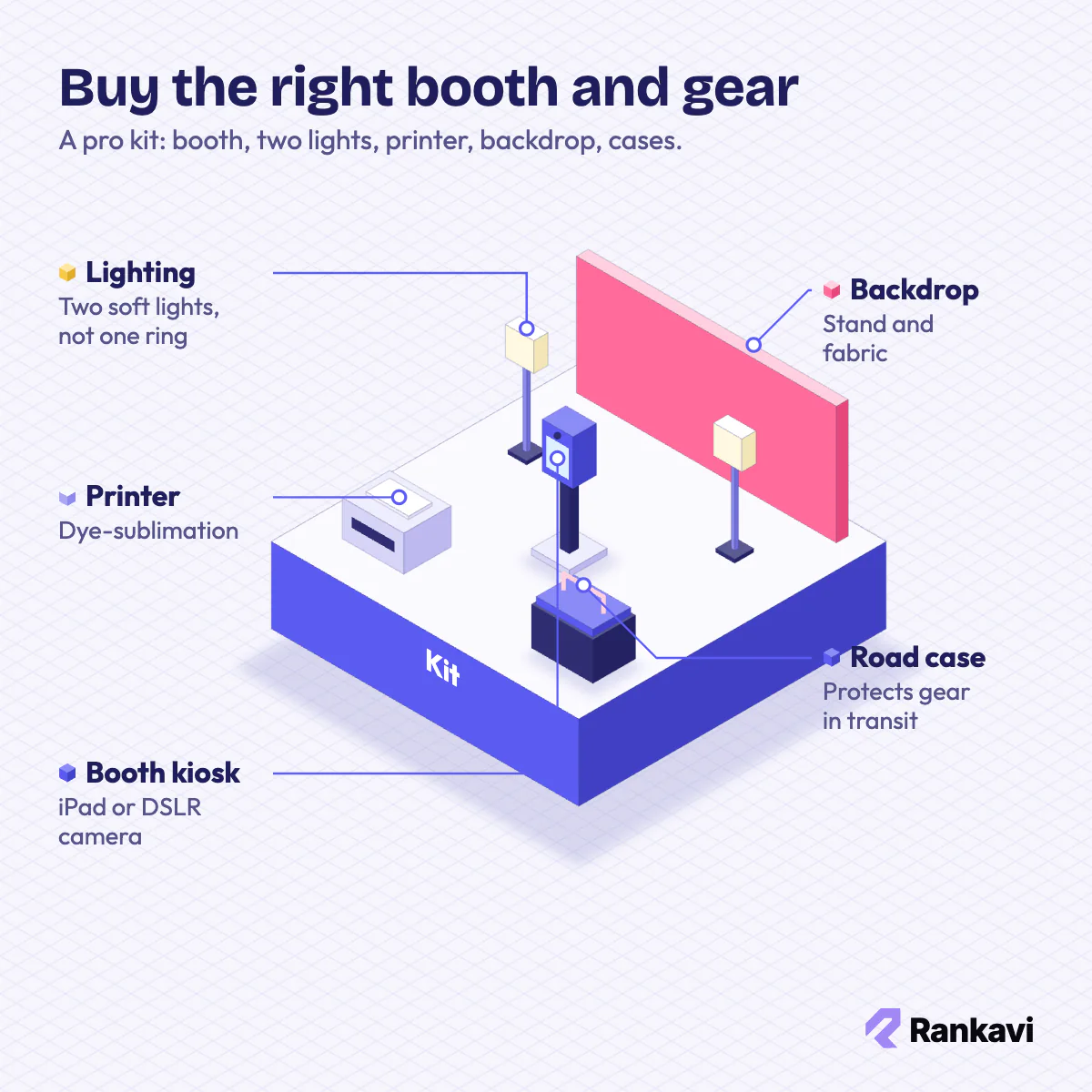
Next is the camera. An iPad has few failure points and suits new owners. A digital single-lens reflex (DSLR) camera gives sharper images but adds cables, power management and troubleshooting.
Lighting separates professional photos from amateur snapshots. A single ring light leaves harsh shadows on faces. Two soft, continuous lights give even skin tones and still suit video.
A dye-sublimation printer produces dry, smudge-proof prints in seconds, and weddings still expect them. A tight budget can launch digital-only and add the printer later.
Backdrops, props, wheeled road cases and gaffer tape complete the kit. Road cases protect the camera and printer in transit, while gaffer tape keeps cords flat so guests don’t trip.
New and used gear carry different risks. A used booth costs less up front but may lack a warranty or support. A new one usually comes with software, setup help and a clear return policy. Compatibility between the booth, software and printer should be confirmed before any purchase.
Venue limits also shape the choice. Footprint, ceiling height, power outlets and wireless coverage vary by location. A booth that does not fit the room cannot be booked. The target market decides which booth earns its cost.
7. Insure Your Equipment and Events
Insurance protects the booth owner from the cost of accidents, theft and damage at events. Venues treat it as a condition of entry, so the policy must be active before the first booking.
General liability covers a guest who trips over a cable or a drink spilled on a venue’s carpet. Reservety’s 2026 guide puts event liability cover at $300 to $1,000 a year.
Hotels and high-end venues ask for a certificate of insurance (COI) before load-in. Many want to be named as an additional insured. Owners keep a template ready, because each venue wants its own certificate.
Equipment cover, often called inland marine, protects the booth, camera and printer against theft and transport damage. That gear moves in and out of vehicles every weekend, so a dedicated van may also need commercial auto insurance.
Corporate clients often ask for a certificate of insurance and a tax form before signing. Keeping both ready speeds up approval. Policy terms vary by insurer. An agent should confirm that the policy covers event work away from home and attendants.
8. Set Up Software and Event Workflows
Workflows keep every booking running the same way from inquiry to final gallery. Software, contracts and checklists replace memory when weekends get busy.
Booth software is the engine of the setup. Owners check that it supports their hardware, text and email sharing, branded templates and their printer model. Reliability under heavy use matters most, and most platforms offer free trials.
Back-office tools handle the rest. Check Cherry and Booth Book both let clients reserve dates and pay a deposit online. QuickBooks, Xero or FreshBooks then tracks expenses and sends invoices.
Every booking needs a written contract listing the date, location, deliverables, payment terms and a non-refundable deposit. In Check Cherry’s 2026 data, 44% of deposits were a percentage of the price, most often 50%.
Event day checklist:
- Confirm venue details and arrival time with the client
- Test the camera, software, printer and lights at home
- Pack spare paper, chargers, props and a mobile hotspot
- Arrive early and run test shots on site
- Send the digital gallery and a review link after the event
Guest photos are personal data. Clients give written consent for promotional use of the images. Hosts also tell guests that the booth shares photos.
9. Market Your Booth to First Clients
Marketing puts the photo booth in front of couples, planners and companies before their event dates fill. Early bookings depend on proof, visibility and referrals.
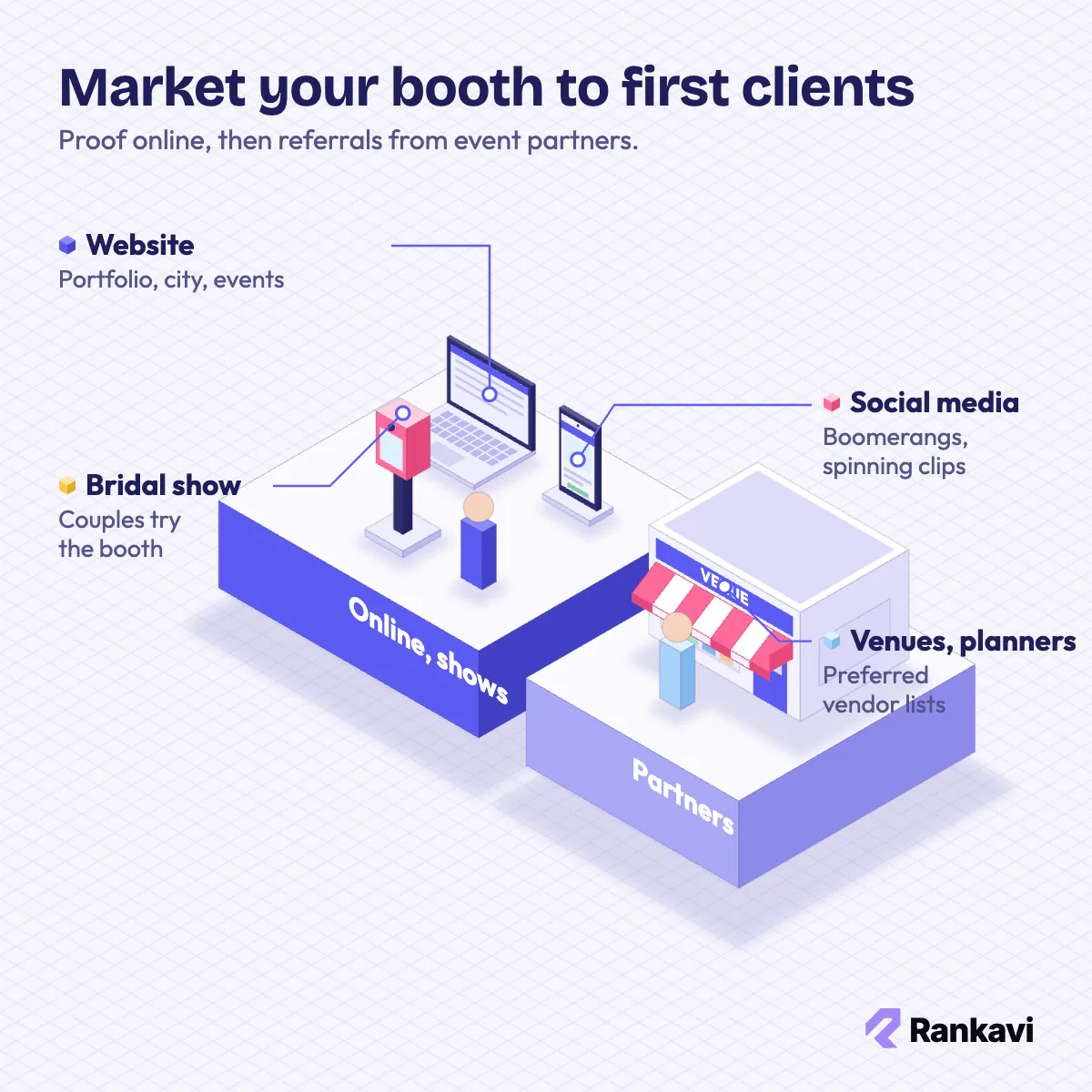
A mobile-friendly website with a strong photo portfolio is the main sales tool. It names the city, the event types served and the booth experiences on offer.
Booth searches are local. Google Business Profile is a free listing that shows the booth when hosts search “photo booth rental near me”. The Knot is a wedding planning marketplace, and WeddingWire is its sister vendor directory. Engaged couples browse both.
Vendor partnerships build steady referrals. Wedding planners, venues and disc jockeys (DJs) book far more events than any single couple. A free booth at a planner’s networking mixer often earns a spot on a venue’s preferred vendor list.
Reviews and real photos prove quality to a client who has never met the owner. Each finished event is a chance to ask for a review and permission to post photos. Early reviews carry the most weight, since a new company has no track record.
Booth photos are shareable by nature, which suits Instagram and TikTok boomerangs. Bridal shows let couples try the booth in person and book on the spot.
A donated booth at a charity gala tests the full workflow and produces real portfolio photos. Free events alone rarely bring leads, though, as one new owner admitted:
“Just did 2 free events but no leads. Still figuring out social media… and marketing. But we have gotten asked about prints… but we only have digital!”
— A new photo booth owner in a YouTube comment
10. Grow With Attendants and New Booths
Growth builds the photo booth company beyond one owner working one event at a time. Owners expand once bookings arrive consistently each month.
Trained attendants let the business run several events on the same night. Salary.com is a pay data company, and it put average photo booth attendant pay at $16 an hour in 2026, with most earning $15 to $17. Training covers setup, guest interaction and clearing printer jams calmly.
A second booth type raises the value of each booking. An owner who started with an open-air booth can add a 360 or mirror booth on the same software.
Corporate clients balance the seasonal wedding calendar, since product launches, conferences and holiday parties run all year. Satisfied companies often rebook the same booth annually.
Drop-off rentals need no staff on site. Check Cherry’s 2026 median was $450 for a drop-off booth versus $656 attended, a trade of lower price for no labor cost.
Hiring brings trade-offs. Attendants add capacity but also reliability risk, so a backup person and a written event checklist matter. Worker classification affects labor cost and legal duties. A tax professional can confirm whether helpers count as employees or contractors.
A second booth makes sense when the calendar repeatedly forces the owner to turn down bookings on busy dates. Adding gear before that point leaves equipment idle and cash tied up.
11. Land Bookings Through AI Recommendations
AI visibility means a photo booth company is named when a host asks an assistant who to book. A planner might ask ChatGPT, Gemini or Microsoft Copilot for “best photo booth rental for a corporate party in Austin”. The reply is a short list, not ten blue links. Microsoft Copilot is the assistant built into Windows and Bing.
That list comes from sources the assistant can find and trust. Wedding directories, review pages, venue vendor lists and local vendor roundups all feed it. A booth with recent reviews and a mention in those places is easy to name. One with only an Instagram feed is easy to skip.
Copilot leans on Bing’s index, so articles on indexed event, wedding and lifestyle sites carry weight there.
Rankavi is a software as a service (SaaS) platform that publishes brand mentions in articles on indexed third-party websites. Booth companies pay from $12 per placement, and articles usually go live in under 24 hours. Mentions on event sites can support Copilot recommendations when a planner asks for a booth nearby.