

Starting a passenger transportation business means moving people for pay with licensed drivers, insured vehicles and the right permits. The U.S. Bureau of Labor Statistics (BLS), which publishes federal job data, counted 455,700 taxi driver, shuttle driver and chauffeur jobs in 2025.
Quick introduction: I’m Michal Sieroslawski, and I help passenger transportation companies show up in Google and AI search. AI search is a growing way for riders to find passenger transportation companies, and recommended names start ahead.
Fares and funding come first, so permits and insurance fit a fleet the owner can afford. Vehicles and drivers follow once the paperwork is in place. The eleven steps below take a passenger transportation business from plan to launch.
- Choose a Passenger Service Model
- Write a Fleet and Route Plan
- Set Fares for Meters, Hours and Flat Trips
- Finance Vehicles and Working Capital
- Form an LLC for the Ride Company
- Obtain Operating Authority and Local Permits
- Insure the Fleet and Its Riders
- Lease or Buy Sedans, Vans and Buses
- Hire and Vet Professional Drivers
- Market to Hotels, Airports and Event Planners
- Reach Riders Through Google AI Overviews
1. Choose a Passenger Service Model
A passenger service model decides which riders the company carries, in which vehicles and under which rules. Taxi, limousine, airport shuttle and charter bus firms all move people, yet each runs differently.
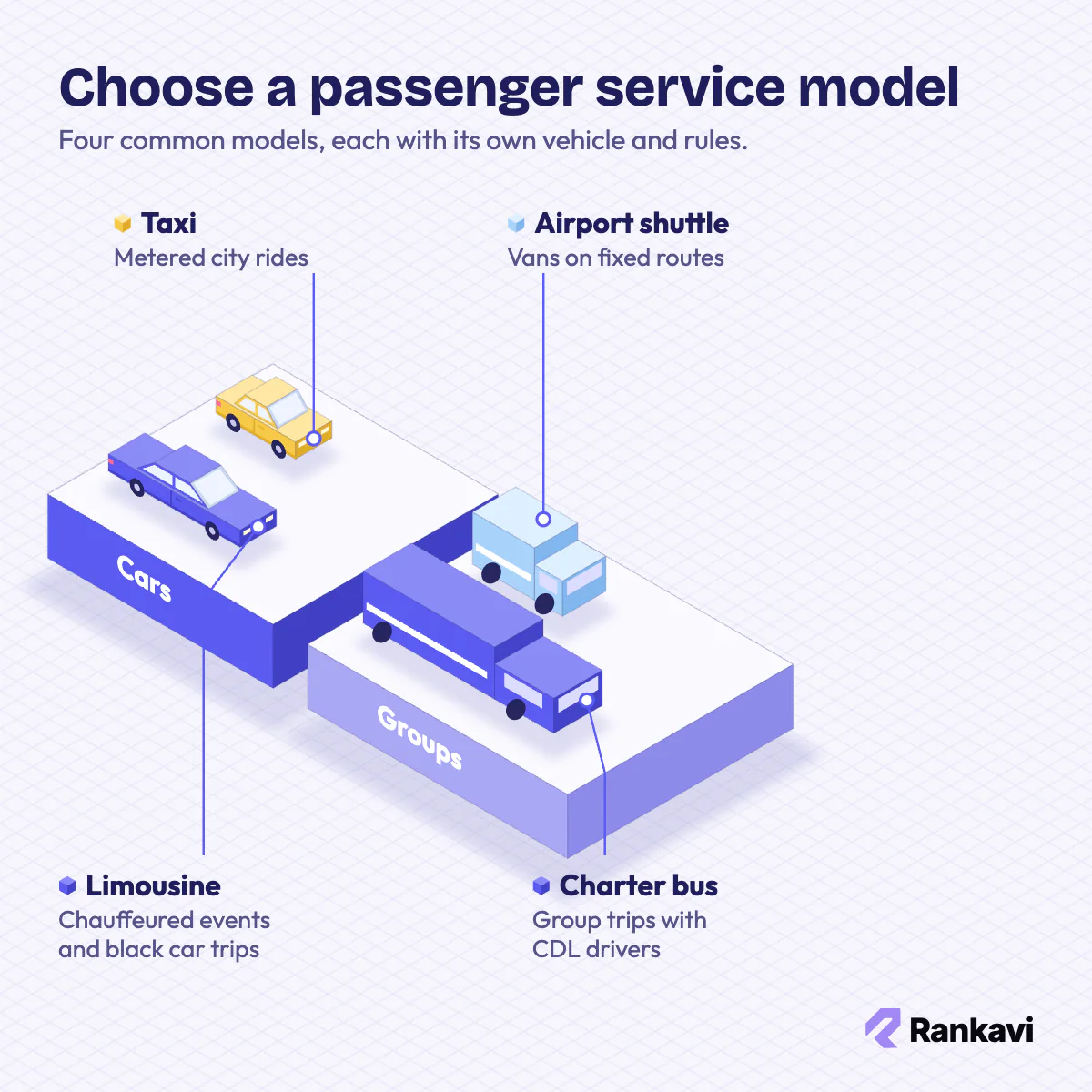
Common models include metered taxis, chauffeured limousines and black cars, hotel and airport shuttles, and charter buses for groups. Senior rides and church or school transport form smaller niches.
Demand is growing. The Bureau of Labor Statistics projects 9% job growth for taxi drivers, shuttle drivers and chauffeurs from 2025 to 2035. That figure counts jobs in the three occupations combined, not company revenue.
Each model carries different rules and costs. A sedan-based car service needs far less capital than a charter bus company. Charter firms buy large coaches and hire specially licensed drivers.
Seat count draws the main regulatory line. The Code of Federal Regulations (CFR) sets that line in 49 CFR 390.5. A vehicle used to carry more than 8 passengers for pay, driver included, counts as a commercial motor vehicle. A sedan stays below it, while a 15-passenger van and a coach cross it.
The customer type is a second choice. Consumers book taxis and airport rides one trip at a time. Hotels, companies and event planners buy limousine and shuttle service on account, which gives steadier work.
Driving for a ride app such as Uber or Lyft is a different path. It needs no fleet, but the driver works under the app’s terms instead of building a company brand.
Local demand settles the choice. A town with a busy airport but few car services has a gap. A crowded taxi market rewards a niche such as wheelchair-accessible rides. Small fleets are common, and the BLS counted 86% of taxi drivers as self-employed in 2025. That points to low entry barriers and many independent rivals.
Starting with one model keeps the first fleet, license and insurance needs simple. A second model can be added later.
2. Write a Fleet and Route Plan
A transportation business plan shapes the fleet, the routes and the money behind them before any vehicle is bought. Lenders read it before they finance a van.
The plan has five core sections, and each one covers a different part of the business:
| Section | What it covers |
|---|---|
| Executive summary | Services, riders and goals |
| Company overview | Model, service area and edge over rivals |
| Marketing plan | How riders and accounts find the company |
| Operations plan | Routes, hours, dispatch and staffing |
| Financial plan | Startup costs, fares and revenue forecast |
These sections answer the practical questions about running the business. The first questions are how many vehicles will run and whether the company will lease or buy them. Fleet size comes first because routes, service hours and the number of drivers follow from it.
Fleet size starts with the busiest hour. Multiply peak trips per hour by the average round-trip time in hours. The result is the number of vehicles on the road at once. The round trip includes loading and the empty return, not only the ride.
That number leaves no vehicle free when one needs repairs. A spare vehicle covers those repairs, so a breakdown does not cancel a booking.
Once the fleet size is known, the company also knows how many vehicles it must house. A garage or parking base therefore belongs in the operations plan too. Vehicles need secure overnight parking, cleaning space and a spot for routine maintenance.
How much of this detail goes on paper depends on the format of the plan. The U.S. Small Business Administration (SBA), which backs small business loans and publishes plan templates, describes two formats. A traditional plan is detailed, and lenders and investors commonly request it. A lean startup plan is much shorter. It can take as little as one hour and is usually one page.
3. Set Fares for Meters, Hours and Flat Trips
Fare setting sets the price per mile, per hour or per trip that covers every cost and leaves a profit. How that price is charged changes with the service. Taxi meters, hourly limo rates and flat airport fares are the main formats.
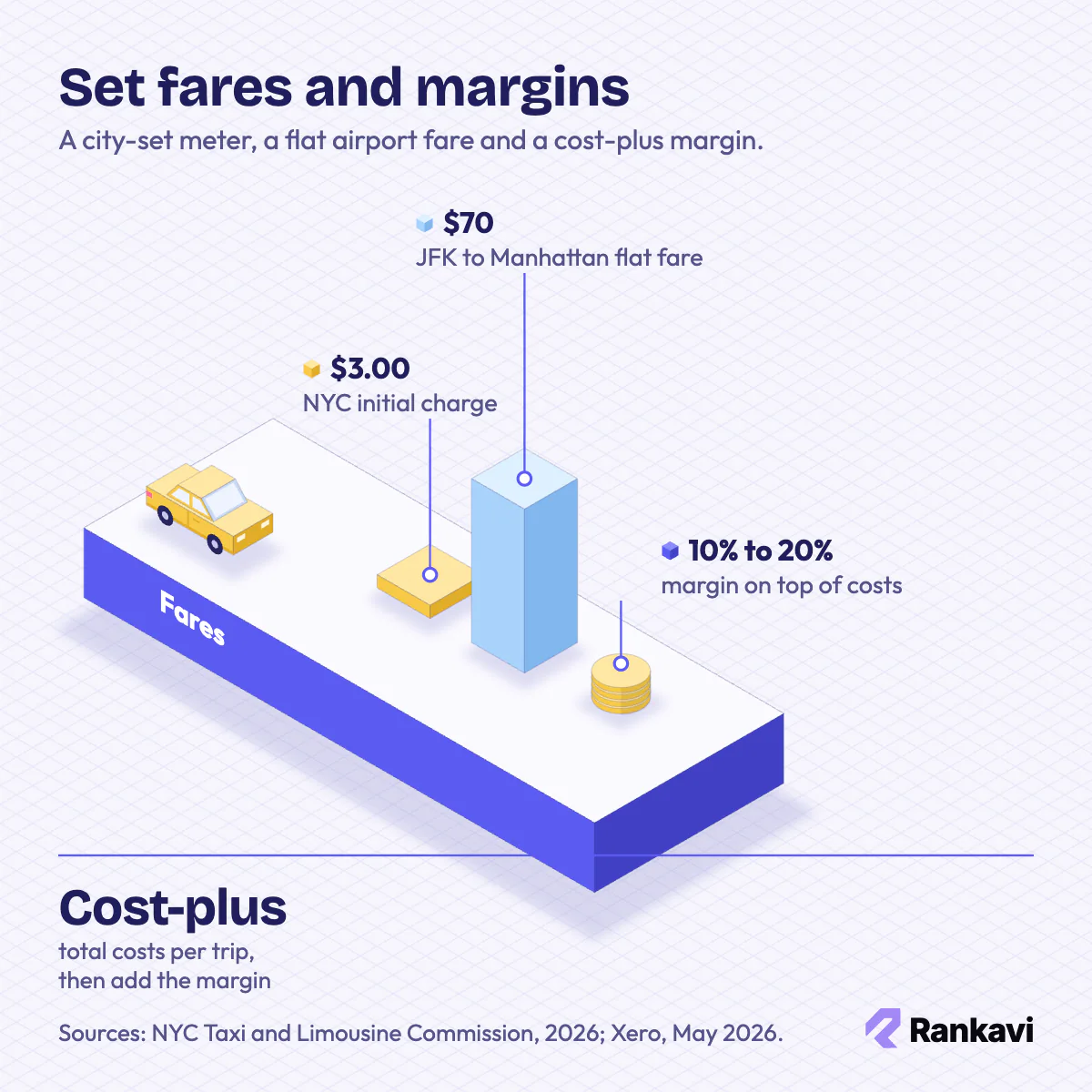
Each format suits a different kind of trip. The table below shows four common fare models and their typical use:
| Model | Typical use |
|---|---|
| Metered fare | Taxis charging by distance and waiting time |
| Hourly rate | Limousines and chauffeured cars for events |
| Flat fare | Airport runs and fixed shuttle routes |
| Per-trip contract | Corporate, hotel and school accounts |
A taxi owner may not get to choose the price, because many cities fix taxi fares by law. In New York, the NYC Taxi and Limousine Commission licenses taxis and sets their fares. It lists a $3.00 initial charge as of 2026.
That initial charge is only the start of a metered fare. A meter adds more than the initial charge:
- Distance: The meter adds 70 cents per fifth of a mile above 12 mph.
- Slow traffic or a stop: The meter adds 70 cents per 60 seconds.
- Overnight surcharge: A $1.00 surcharge runs from 8pm to 6am in 2026.
- Weekday rush hour surcharge: A $2.50 surcharge runs from 4pm to 8pm in 2026.
Tips and tolls come on top of these charges.
Not every regulated fare runs on the meter. The NYC Taxi and Limousine Commission also listed a $70 flat fare between Manhattan and JFK Airport in 2026.
Limousine and black car firms work differently. They usually set their own rates and add a minimum booking time.
Fares the law does not fix come from the owner’s own numbers, so cost-plus pricing works for the rest. This method starts with costs and then adds profit.
The owner totals fuel, vehicle payments, insurance, maintenance, permits and driver pay. Dividing that total by expected trips, then adding a margin, gives the fare. Xero, an accounting software vendor, suggested in May 2026 adding a 10% to 20% profit margin on top of operating costs.
The size of that margin needs care, because Xero’s May 2026 range works as a markup on cost. A markup is a percentage of cost, while a true margin is a percentage of the fare. For that reason, a true 20% margin in 2026 needs the cost divided by 0.80.
4. Finance Vehicles and Working Capital
Funding a ride company covers vehicles, permits, insurance deposits, software and several months of running costs. Vehicles take the largest share of the budget.
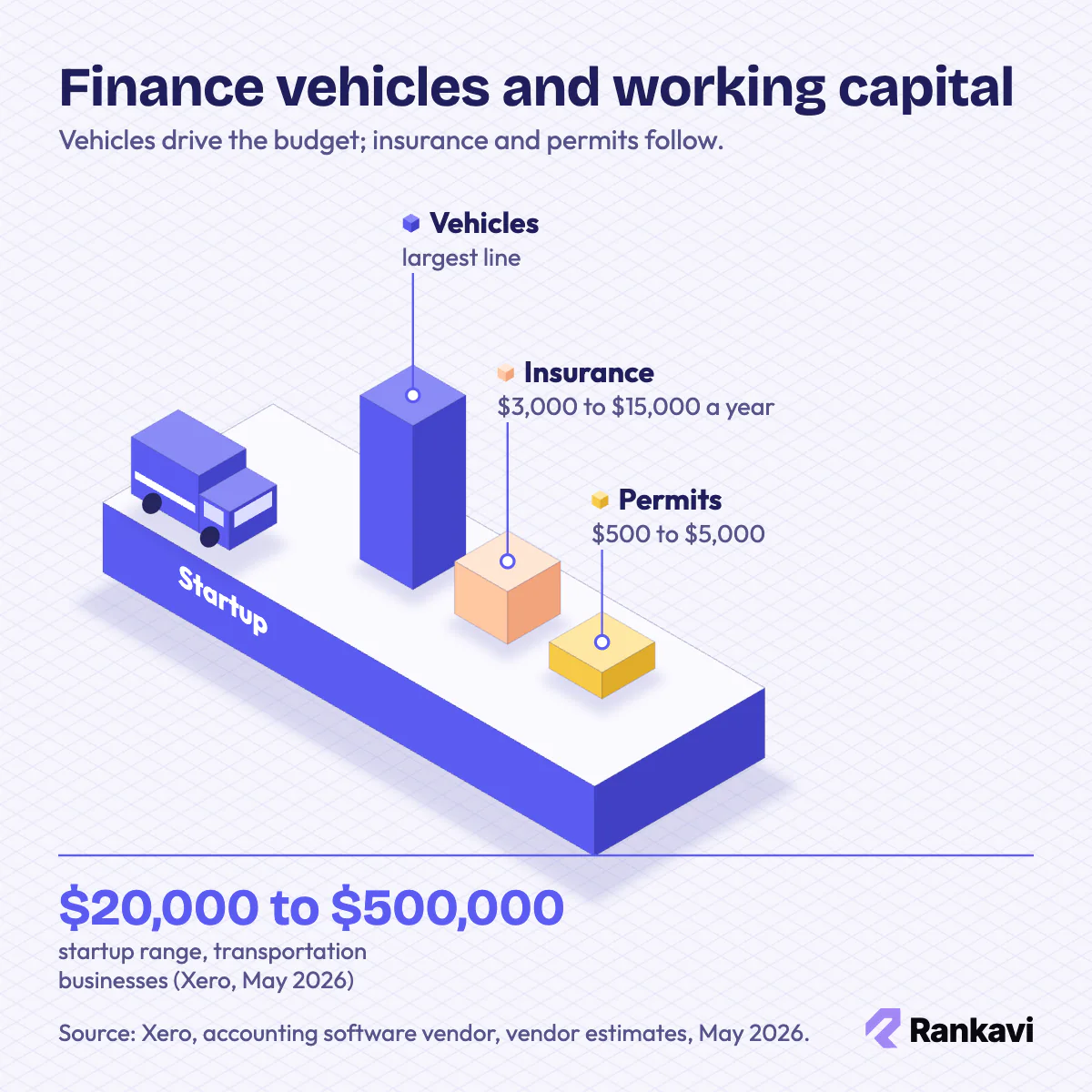
Much of this money goes out before the first ride. Startup spending covers vehicle down payments, permits and the first insurance premium, which is the first payment for coverage. Dispatch, booking and global positioning system (GPS) tracking tools add a monthly bill, so software costs continue after launch.
The total depends on the size of the operation. Xero, an accounting software vendor, put transportation startup costs at $20,000 to $500,000 in May 2026.
Vehicles take the largest share of the budget. Equipment financing is a loan for buying equipment, and it suits a fleet because the vehicle secures the loan. That means the vehicle serves as the lender’s protection if the loan is not repaid.
Lenders include the SBA, which offers loan guarantees to small firms. A loan guarantee is a promise to cover part of a loan if the borrower fails to repay. The SBA’s microloans, which are small loans, reached up to $50,000 as of 2026.
The table below brings the main startup figures together in one place.
Startup money at a glance:
| Item | Figure |
|---|---|
| Startup cost | $20,000 to $500,000 for transportation businesses, set by vehicle type and fleet size |
| Main costs | Vehicles, insurance at $3,000 to $15,000 a year, licensing and permits at $500 to $5,000, software at $100 to $500 a month, working capital |
| Typical margin | 10% to 20% profit margin added on top of operating costs (a pricing target, net or gross not stated) |
| Time to open | Four to eight weeks to become legally operational, after one to three months of planning |
Sources: Xero, an accounting software vendor, vendor estimates for transportation businesses of all types, May 2026.
Once the business opens, its monthly income must pay these running costs and still leave money for the owner. A simple example shows how quickly those costs use up revenue.
Worked example: In this illustrative case, an owner drives one sedan on $70 flat airport runs. Four runs a day for 22 days make 88 runs and $6,160 a month. Insurance at $15,000 a year costs $1,250 a month, and software adds $500. The remaining $4,410 must cover fuel, the car payment and the owner’s pay.
Income on paper does not always arrive when the bills do. Corporate and hotel accounts often pay on invoice, which means they receive a bill and pay later. Fuel and driver pay keep flowing while those payments arrive. This gap is why working capital matters. Working capital is the cash a business keeps on hand to pay its running costs.
5. Form an LLC for the Ride Company
Forming a limited liability company (LLC) gives the ride company a legal identity separate from the owner’s home and savings. An accident claim then targets the company.
An LLC is the most common choice for small ride firms. One crash claim can exceed the policy limits. Sole proprietors skip the paperwork but carry every claim personally.
The name gets checked with the Secretary of State before filing. The Internal Revenue Service (IRS), which runs federal taxes, then issues an employer identification number (EIN) for payroll and taxes.
A separate business bank account keeps fares, fuel cards and vehicle payments apart from personal money. Insurers and lenders also ask for the registered company name.
6. Obtain Operating Authority and Local Permits
Licensing a passenger carrier means getting federal, state and city approval to carry people for pay. The rules depend on the vehicle size and whether trips cross state lines.
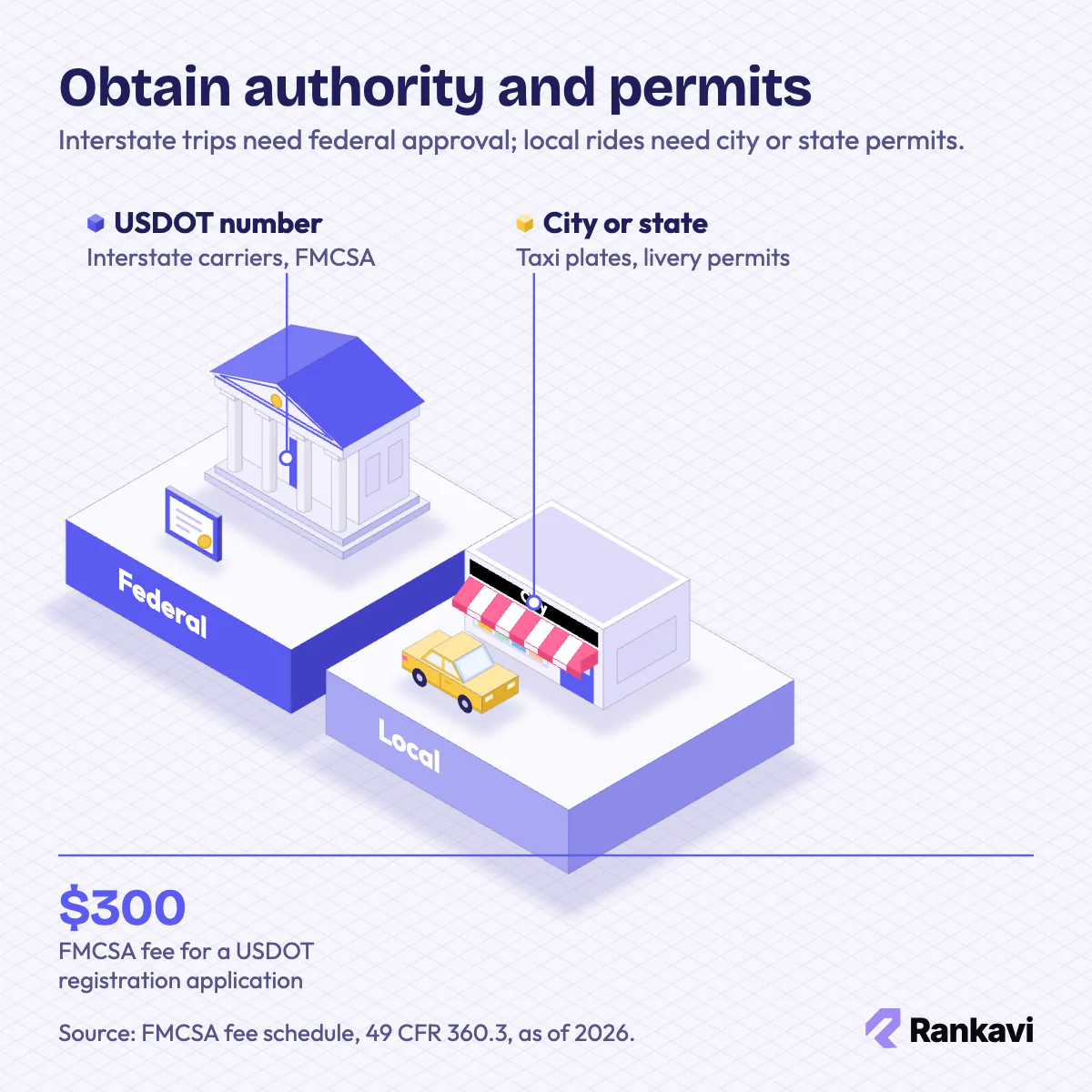
Where the trips go decides which agencies a carrier answers to.
An interstate carrier needs a U.S. Department of Transportation (USDOT) number and operating authority. The Federal Motor Carrier Safety Administration (FMCSA) regulates interstate carriers, so it issues both. Its fee for a USDOT registration application was $300 as of 2026.
A purely local firm answers to the state and city instead, so its approval comes as local permits. A taxi often needs special plates or a medallion, which is a license to run a taxi. A limousine needs a livery or for-hire permit from the state or city.
A permit does not settle every local question, because pickup rules vary too. Some cities only let ground transportation firms collect riders at taxi stands or set airport zones.
7. Insure the Fleet and Its Riders
Insurance for a passenger carrier protects the business against crash, injury and property claims while riders are aboard. Personal auto policies exclude driving for pay.
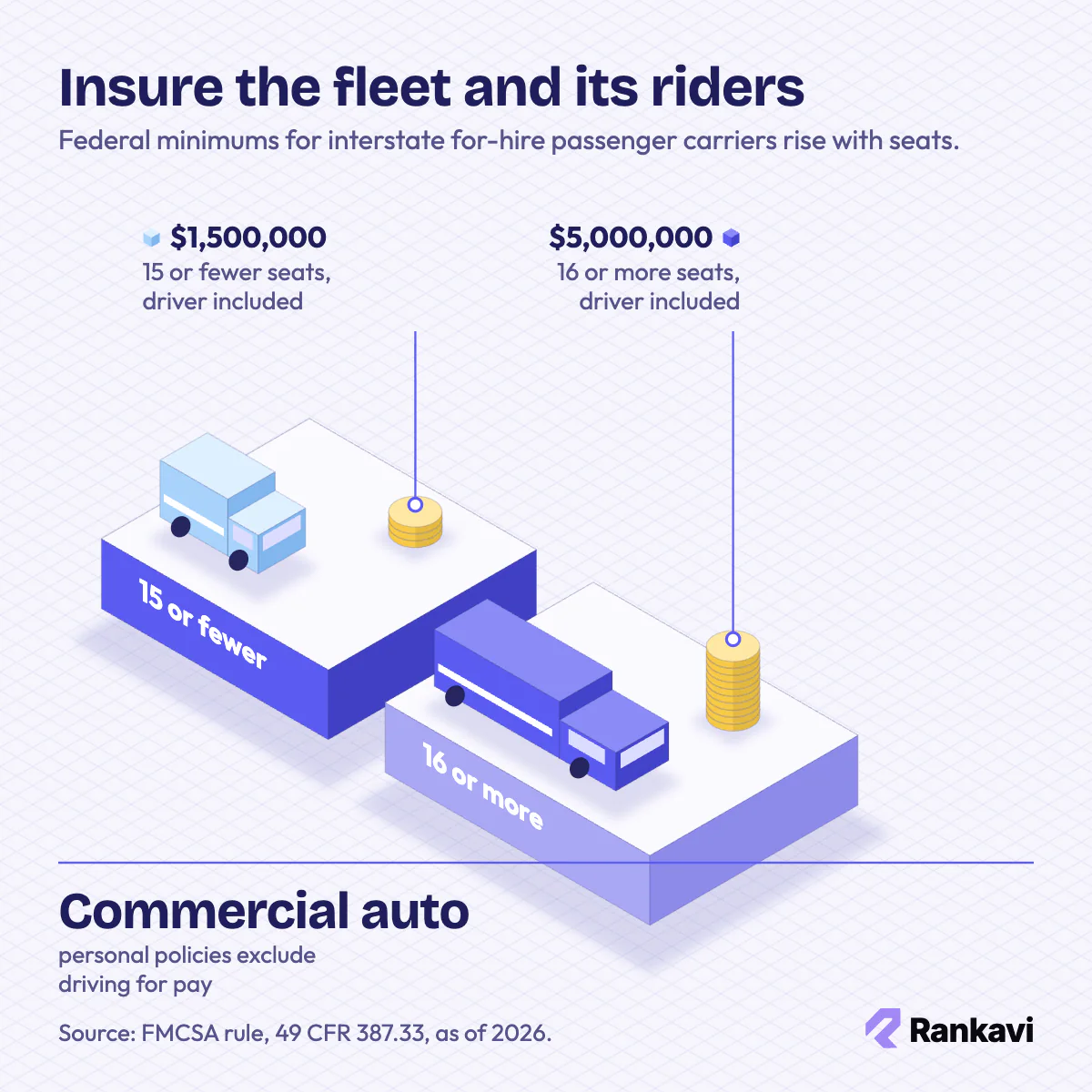
Commercial auto liability for for-hire livery work is the core policy. Federal rules set minimum limits for interstate passenger carriers, and those limits rise with seating capacity. As of 2026, an FMCSA rule required $1,500,000 for vehicles seating 15 or fewer, including the driver.
Larger vehicles need far more. The same 2026 federal rule required $5,000,000 for vehicles seating 16 or more passengers, driver included.
Other policies fill the gaps:
- General liability: covers a rider who slips while boarding.
- Physical damage: pays for collision, theft and vandalism losses.
- Workers’ compensation: covers employee injuries in most states.
- Umbrella liability: adds protection above the base limits.
Brokers who know livery and taxi risks quote more accurately. Older vehicles and new drivers usually raise the premium.
8. Lease or Buy Sedans, Vans and Buses
The service model determines the vehicle, from a sedan for a car service to a coach for charters. A shuttle firm usually runs passenger vans or small buses.
Kelley Blue Book listed the 2026 Ford Transit 350 Passenger Van from $61,075, so a single shuttle van already costs more than many sedan startups.
Accessible vans with lifts and securement systems serve senior and medical riders. Luxury sport utility vehicles (SUVs) and stretch limousines serve weddings, proms and corporate events.
Leasing spreads payments over time and limits repair risk. The downside is a mileage cap, which hurts busy airport or long-distance routes. Buying used vehicles lowers the upfront cost.
Software runs the fleet day to day. Dispatch, online booking, GPS tracking and digital vehicle inspections cut paperwork and missed pickups.
9. Hire and Vet Professional Drivers
Driver screening keeps riders safe and keeps the company inside state and federal rules. Drivers represent the brand on every trip.
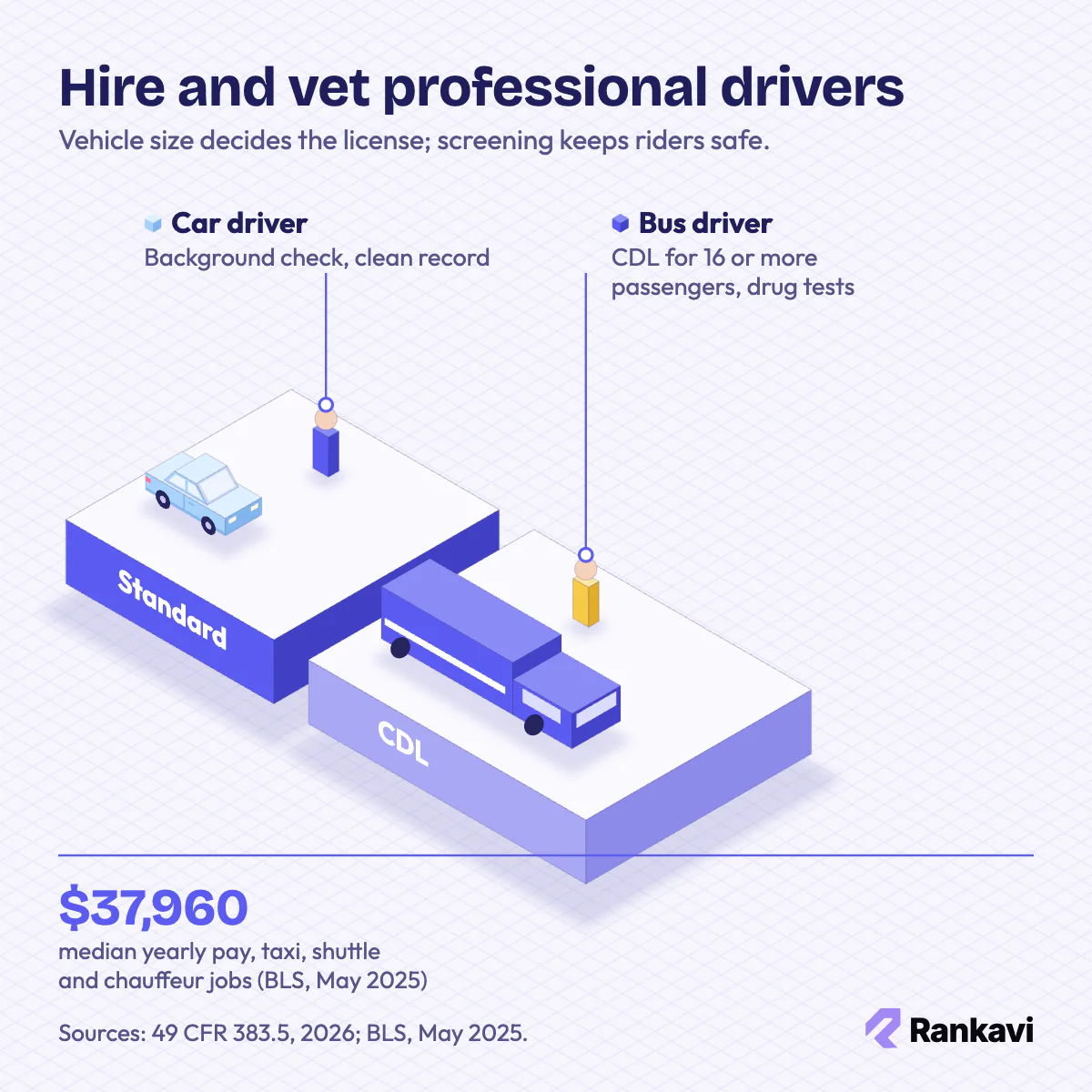
Larger vehicles need a commercial driver’s license (CDL). The federal rule covers vehicles designed to carry 16 or more passengers, including the driver. Some states set lower thresholds for vans.
Drivers who need a CDL also fall under federal drug and alcohol testing. Many states and cities add background checks and clean driving records for taxi and livery drivers.
Pay sets the hiring budget. The BLS reported median pay of $37,960 a year across the taxi, shuttle and chauffeur occupation in May 2025.
Training covers defensive driving, passenger assistance and emergency steps. Chauffeurs also learn customer service, because polite, punctual drivers win repeat bookings.
10. Market to Hotels, Airports and Event Planners
Marketing a ride company builds steady bookings by reaching the places where trips start. Hotels, airports, venues and offices send repeat riders.
Google Business Profile, which is Google’s free business listing for Search and Maps, joins Yelp and local directories. Together they put the company on maps for “taxi near me” searches. Reviews from early riders build trust fast.
Partnerships bring volume. Travel agencies, restaurants, wedding planners and hotel concierges refer guests, and corporate accounts book regular airport runs.
Trade groups add credibility and contacts. The National Limousine Association, a nonprofit founded in 1985, represents chauffeured transportation operators. The Transportation Alliance is a nonprofit trade association for taxi, limousine, shuttle and paratransit companies.
Members of the National Limousine Association also meet suppliers and other operators at its events. Loyalty rewards and easy online booking then turn first-time riders into regulars.
11. Reach Riders Through Google AI Overviews
AI visibility for a ride company places it in the answers riders get from AI tools about car services. Travelers now ask ChatGPT, Gemini and Google AI Overviews for airport rides and limo picks.
Those answers lean on review sites, city guides and “best car service” lists. A new transportation company benefits when those pages name it early.
Rankavi is a software as a service (SaaS) platform that publishes brand mentions in articles on indexed third-party websites. Taxi and limo firms that want to get brand mentions in Google AI Overviews can begin there. In 2026, articles on the platform start at $12.