

Starting a home remodeling business takes trade experience, a state contractor license where required, insurance and margin-based pricing. The U.S. Bureau of Labor Statistics counted 889,700 carpenter jobs across the United States in 2025.
I’m Michal Sieroslawski, and I help remodeling companies get recommended in AI search. Homeowners now ask AI chats the same questions they once typed into Google. Showing up there helps a new remodeling company reach people it would otherwise miss.
This order settles prices and cash before any license or bond fee is paid. Crew and marketing follow once the company can legally sign a contract. The path to a running home remodeling business runs through the twelve steps below.
- Choose Your Remodeling Niche
- Write a Remodeling Business Plan
- Price Jobs With Markup and Margin
- Fund Tools, a Truck and Working Capital
- Register the Remodeling Company
- Get a Contractor License and Permits
- Insure and Bond the Business
- Equip a Work Truck and Job Software
- Hire Carpenters and Vet Subcontractors
- Market With Project Photos and Local Listings
- Grow Through Referrals and Credentials
- Appear in Homeowners’ AI Remodeler Picks
1. Choose Your Remodeling Niche
A remodeling niche decides which rooms, homes and clients the company targets. Kitchens, bathrooms, basements and whole-home renovations each need different skills and subcontractors.
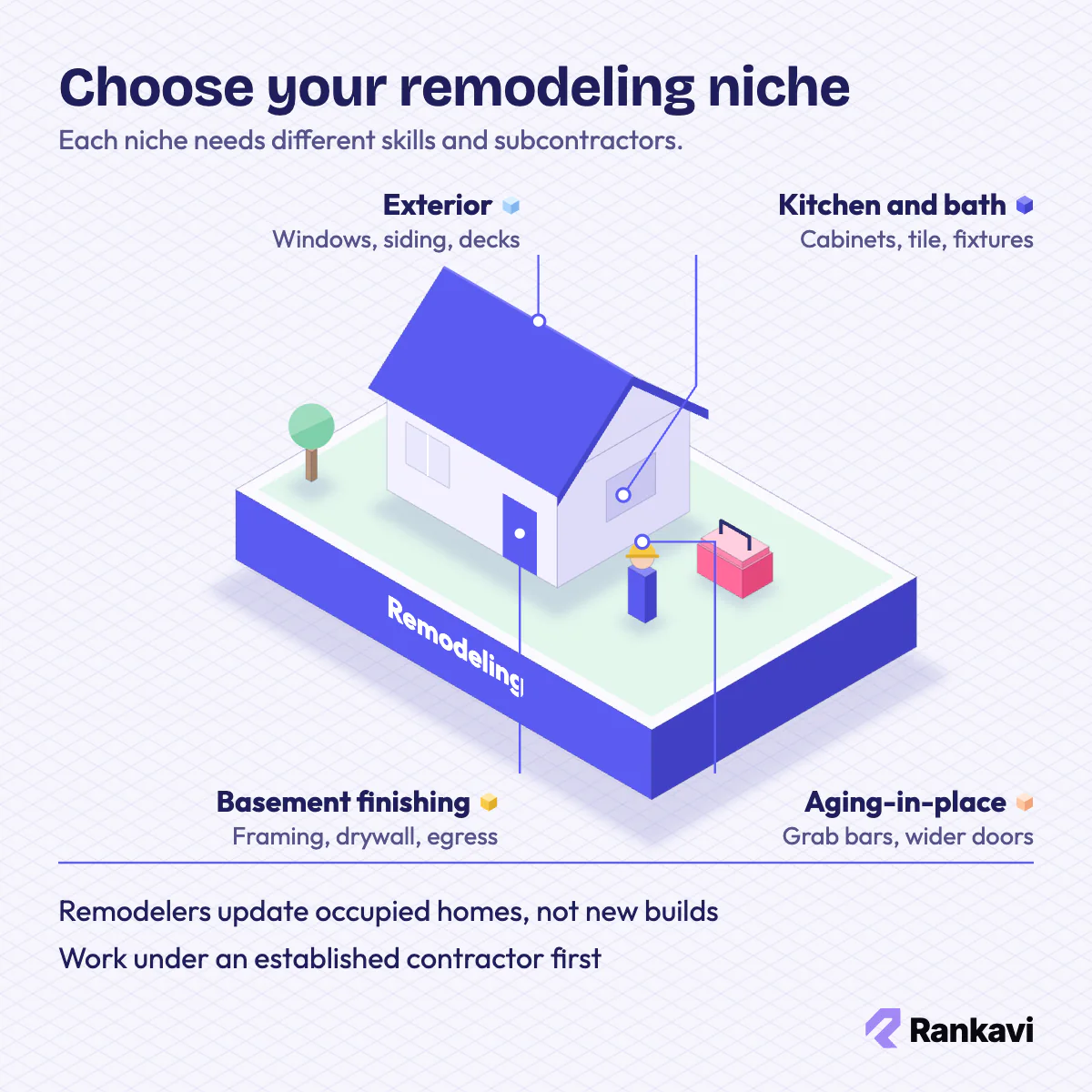
A remodeling contractor updates existing homes rather than building new ones. That focus on occupied houses means dust control, tight schedules and homeowners living around the work.
A remodeler differs from a handyman, who handles small repairs, and from a home builder, who works on new construction.
Common remodeling niches:
| Niche | Typical work |
|---|---|
| Kitchen and bath | Cabinets, counters, tile, fixtures and layout changes |
| Whole-home renovation | Several rooms, walls moved and systems updated |
| Basement finishing | Framing, drywall, flooring and egress upgrades |
| Aging-in-place | Grab bars, wider doors and curbless showers |
| Exterior | Windows, doors, siding and decks |
Experience comes before the company. Most successful remodelers first work under an established contractor. Trade school and apprenticeships add carpentry, plumbing and electrical basics.
A quick local check shows where the niche fits. Older housing stock means steady kitchen and bath demand. A crowded field of kitchen specialists points toward a gap elsewhere.
The main choice is specialist or generalist. A narrow niche builds referrals and pricing power. It also ties the company to one kind of demand, so a slow kitchen market hurts more.
Season and housing age matter too. Exterior work slows in cold weather, while basements and bathrooms hold steadier. Older homes bring outdated wiring, plumbing and lead paint, which make some jobs harder to price.
Clients differ by niche. Homeowners live in the house during work, while landlords and property managers care about turnaround and cost. Each type needs a different sales approach.
2. Write a Remodeling Business Plan
A remodeling business plan turns the chosen niche into numbers a lender or partner can test. It stays short and practical.
A lean remodeling plan covers five parts:
- Services: project types, service area and target homeowners.
- Competition: nearby remodelers and the gap the company fills.
- Pricing and marketing: how jobs are priced and how leads arrive.
- Crew: the owner, early hires and subcontractor trades.
- Forecast: first-year revenue, overhead and key risks.
Its key assumption is the sales pipeline. Jobber is a field service software company for home service firms. Its August 2026 guide put the average general contracting close rate at 20%. At that rate, five estimates win one job, so the plan counts estimates, not just jobs.
The plan also sets the owner’s role. Early on, one person sells, supervises sites and keeps the books. The plan shows when an office helper or lead carpenter takes part of that load.
The plan also states whether the company offers design or builds from the client’s drawings. Offering design adds a service to sell. Building from drawings keeps the scope narrower. Competitor research starts with Google Maps listings and Houzz profiles, which show project types, photos and review counts.
3. Price Jobs With Markup and Margin
Pricing a remodeling job sets a contract price that covers materials, labor, subcontractors, overhead and profit. Many new remodelers lose money because they confuse markup with margin.

Markup is added to the job cost. Margin is the share of the final price left after job costs. A markup on cost always gives a smaller margin on the price.
Markup is profit divided by cost, and margin is profit divided by price. A markup equal to the target margin falls short of that margin. A target margin sets the price: cost divided by one minus the margin.
Overhead belongs in every price. The National Association of Home Builders (NAHB) is a trade federation for builders and remodelers. It measured operating expenses at 23.6% of remodelers’ revenue in fiscal 2024.
NAHB published those fiscal 2024 results in April 2026. In fiscal 2024, remodelers averaged a 29.9% gross profit margin and 6.3% net margin on $2.7 million revenue.
Startup money at a glance:
| Item | Figure |
|---|---|
| Startup cost | As low as $5,000 with owned tools and a vehicle; $50,000 to $70,000 when buying both |
| Main costs | Tools $1,500 to $8,000, insurance $1,800 to $5,000 a year, licensing and bonding $300 to $2,500 |
| Typical margin | 29.9% gross and 6.3% net, remodeler averages for fiscal 2024 |
| Time to open | Varies with state license exams and bond filing; no national figure published |
Sources: Houzz Pro, which runs Houzz software for remodelers, June 2023 (vendor estimate for startup cost). Jobber, a field service software vendor, August 2026 (vendor estimates for main costs). National Association of Home Builders, Remodelers’ Cost of Doing Business Study, fiscal 2024, published April 2026 (margins).
Worked example: An illustrative kitchen remodel has job costs of $40,000: $16,000 materials, $14,000 crew labor and $10,000 subcontractors. A 50% markup sets the price at $60,000. That leaves $20,000 of gross profit, a 33% gross margin. Overhead at 23.6% of the price takes $14,160. The job clears $5,840 before taxes, close to a 10% net margin.
That beats the NAHB average because an illustrative job has no waste, callbacks or warranty work.
Old houses hide rot and outdated wiring. Estimates carry a contingency line for surprises and allowances for items the client picks, such as tile and fixtures. The owner’s own pay belongs in overhead. A small company with low revenue has a higher overhead share than the NAHB average.
Three contract types are common. A fixed price gives the client certainty but leaves cost risk with the remodeler. Cost-plus bills actual cost plus a fee. Time and materials suits small or uncertain jobs.
A written estimate lists scope, materials, price and payment terms. Homeowners compare these documents, so a clear one wins trust before work starts.
Payments follow milestones. A modest deposit, then progress payments at demolition, rough-in and completion keep cash moving. Signed change orders handle every added task. State rules on deposits vary, so the state contractor board sets the limit.
4. Fund Tools, a Truck and Working Capital
Funding a remodeling startup covers tools, a work vehicle, licensing, insurance and the cash gap before clients pay. Many owners already own tools, which keeps the first budget modest.
Jobber, the software vendor, estimated $10,000 to $50,000 for a lean remodeling operator in August 2026. Tools and a truck lead the list, followed by license and bond fees, insurance, software and early marketing.
Working capital matters most. Jobber’s 2026 vendor estimate put it at $5,000 to $30,000. Materials and subcontractors get paid before the next progress payment, so that reserve keeps jobs moving.
Personal savings fund most launches. Family money, small business loans, equipment financing and business lines of credit fill gaps. Lenders ask for the business plan first.
Each source carries a trade-off. Equipment financing uses the truck or tools as security, so a lender claims those items first. A personally guaranteed loan puts personal assets at risk. Used trucks cost less than new ones but can bring repair bills.
Several steps cut the cash needed. Supplier credit accounts at lumberyards delay the materials bill. Renting specialty tools avoids buying them. Client deposits and progress payments also fund materials, within state limits.
5. Register the Remodeling Company
Registering a remodeling company gives it a legal identity that signs contracts, pulls permits and carries insurance. Many state license boards require the company name on the license to match its registration.
Most new remodelers choose a limited liability company (LLC). A burst pipe or failed tile job can bring a large claim. The LLC keeps that claim away from personal assets.
A sole proprietorship is the cheapest start, but the owner is personally liable. An LLC adds a state filing fee. It does not replace insurance, which pays the claims.
A name search on the Secretary of State website and a trademark check confirm the name is free. A broad name leaves room to add services later.
The Internal Revenue Service (IRS) runs federal taxes and issues an employer identification number (EIN) at no charge. A business bank account opened with the EIN receives client deposits, apart from household money. The same company name should appear on the contract, license and insurance.
6. Get a Contractor License and Permits
Licensing a remodeling business means meeting the state rules for contractors who work on homes for pay. Requirements vary widely by state and often by city.
Because the rules differ, states handle licensing in two main ways. Many states require a contractor license once a job passes a set dollar value. Others do not license this work the same way. Instead, they register home improvement contractors through a consumer protection agency.
The state licensing board website lists the exact rules for each state. The city or county office then adds its own local rules on top.
Finding these rules matters because skipping the license has costs. In some states, unlicensed work brings fines and stop-work orders. A stop-work order is an official demand to halt the job. The contractor may also be unable to enforce the contract. That means the contractor may not be able to use the courts to hold the client to the deal.
California offers one example of licensing fees. The Contractors State License Board (CSLB) licenses California contractors. As of 2026, it charges a $200 initial fee for a sole owner. A sole owner is one person who owns the business alone. For other owner types, the fee was $350 in 2026.
The fee depends on who owns the business, and the license depends on the kind of work. License classes split general building work from single trades. A general building license covers projects that involve several trades. Plumbing and electrical work need their own trade licenses.
Once the owner knows which license fits, the next task is to qualify for it. Most states test applicants. The process commonly includes four steps:
- Law and business exam: This exam tests knowledge of the laws and business rules for contractors.
- Trade exam: This exam tests knowledge of the type of work the license covers.
- Proof of experience: The applicant shows past work in the field.
- Background check: The board reviews the applicant’s record.
The experience step often rests on one person. Many boards tie the license to a qualifying individual, such as the owner. This person must hold the required experience.
Passing these steps does not end the process, because licenses expire. Licenses renew on a cycle the state sets. Some states also require continuing education, which means taking classes to keep the license active.
A license allows the business to do the work, but each job also needs its own approval. Building permits come project by project, from the local building department. A permit is official permission to do a specific job. The licensed contractor usually pulls the permit.
A permit then leads to inspections, where an official checks the work. Inspections follow at set stages such as rough-in and final. Rough-in is the stage when pipes and wires are in place but walls are still open. Final is the check when the job is done. Many common jobs fall under these rules. Moving walls, adding outlets or replacing a water heater usually needs a permit and an inspection.
Older homes add a federal rule on top of local permits. The U.S. Environmental Protection Agency (EPA) enforces lead paint rules. It requires certified firms for paid work that disturbs paint in pre-1978 homes.
7. Insure and Bond the Business
Insuring a remodeling company protects it from claims for damaged homes, injured workers and unfinished jobs. Homeowners and license boards often ask for proof before work starts.

Each of those risks needs its own kind of protection. Remodelers usually carry four core policies:
- General liability: Pays for damage to a client’s home and for injuries to visitors.
- Workers’ compensation: Covers employee injuries. It is required in most states once the company hires.
- Commercial auto: Covers the work truck. Personal policies often exclude business use.
- Contractor license bond: Pays homeowners when a contractor breaks license law. Some states require it.
The bond works differently from the other three. Insurance protects the contractor from claims. A bond protects the homeowner instead. When a bond pays a claim, the contractor must repay the bond company.
Since a bond ties to license law, a state can make it a condition of getting a license. California is one example. The CSLB, the state’s contractor licensing board, requires a $25,000 contractor’s bond before it issues a license, as of 2026.
Clients and boards ask for a certificate of insurance, a document that shows proof of coverage.
Tool and equipment coverage replaces gear stolen from trucks and job sites. Remodelers who also design spaces may add professional liability.
Coverage needs shift with state and crew size. Remodelers can contact an insurance agent who works with contractors. That agent can quote all the policies together.
8. Equip a Work Truck and Job Software
The chosen niche decides the tool list. A kitchen and bath remodeler needs tile saws and plumbing tools. A basement specialist leans on framing and drywall gear.
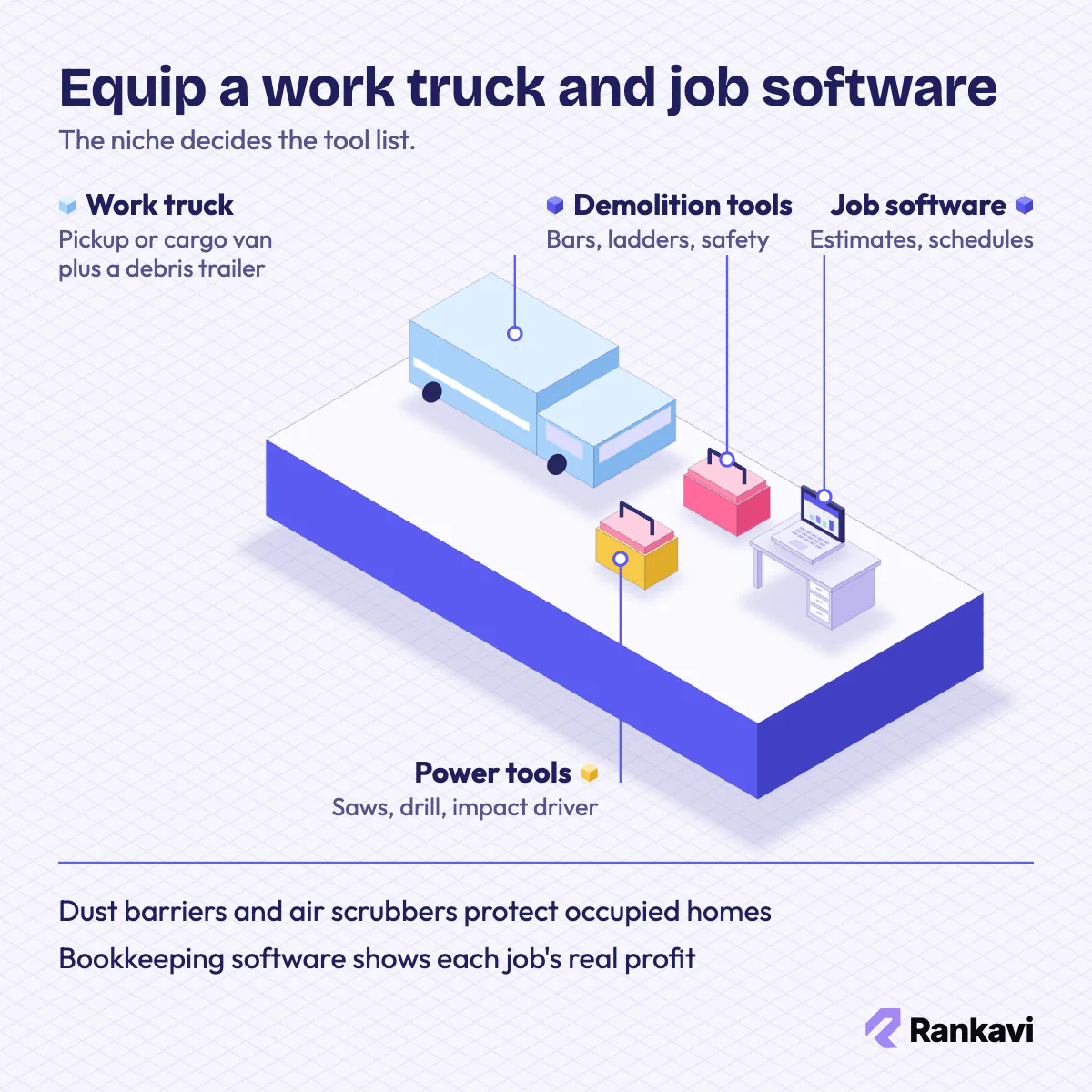
Every remodeler needs a set of core power tools, whatever the niche. These include a circular saw, miter saw, drill, impact driver, oscillating tool and shop vacuum. An oscillating tool is a handheld tool with a vibrating blade. Demolition bars, ladders and safety gear round out the kit.
All of this gear has to get to the job site, along with the materials for each project. A pickup or cargo van carries both. Remodels also create a lot of demolition debris, and it piles up fast. A trailer or rented dumpster handles that debris.
Remodels can take place in occupied homes. Dust control protects these occupied homes. Plastic barriers and floor protection keep the work area separate from the rest of the house. Air scrubbers are machines that filter dust out of the air. These steps keep clients happy. They also help with lead-safe work, which means working around old lead paint without spreading its dust.
A full kit can get large and costly, so a new remodeler can keep it in check in three ways:
- One battery system: Using one cordless battery system for all tools keeps the kit simple.
- Used tools: Buying used tools costs less than buying new.
- Rental: Renting covers tools needed only for rare jobs.
Tools handle the physical work, but each job also creates paperwork. Job software handles estimates, schedules, change orders and client updates. A change order is a written record of a change to the agreed work. Bookkeeping software tracks job costs. This way, each project shows its real profit.
9. Hire Carpenters and Vet Subcontractors
Most remodelers start with a small crew and a bench of subcontractors. Plumbers, electricians, roofers, drywall finishers and countertop fabricators cover work outside the owner’s trade.
A bad subcontractor’s work is always blamed on the remodeler. Owners check licenses, insurance certificates and online reviews before hiring any partner. The license lookup on the state board site shows complaints or discipline. The insurance certificate should come from the insurer or agent, not the subcontractor. Past clients and a finished job give a view of the work.
A written subcontract states scope, price, schedule, warranty and cleanup. Lien waivers collected at each payment protect the client’s home if a subcontractor leaves a supplier unpaid. A Form W-9 is collected before the first payment.
Trade partners are a large cost line. NAHB found trade contractor costs fell from 36% of remodelers’ revenue in 2021 to 30% in 2024.
First hires are usually carpenters who can work alone on a site. The U.S. Bureau of Labor Statistics (BLS), which tracks wages, reported $60,580 median annual pay for carpenters in May 2025. A lead carpenter who runs jobs frees the owner to sell and estimate.
Pay type matters. A carpenter who follows the owner’s schedule, tools and direction is usually an employee, not a subcontractor. The IRS weighs behavioral control, financial control and the relationship of the parties. Paying such a worker as a contractor risks back taxes and penalties.
Good carpenters come from referrals by lumberyard staff, trade schools and local remodeling association chapters. A small paid trial job tests a new subcontractor before a large scope.
Training builds a reliable crew. Many owners teach their own methods for dust control, client updates and cleanup. Shared methods keep quality even on every job.
10. Market With Project Photos and Local Listings
Homeowners hire remodelers they trust, so visible proof of past work brings the first calls. Photos and reviews do most of the selling.
A website with before-and-after photos, client testimonials and a simple contact form works as the main sales tool. Each page names the service area and project types. Some states require the license number on websites and ads.
Google Business Profile is Google’s free listing that puts the company on Maps with photos, services and reviews. Houzz is a home design platform, which runs Houzz Pro, where homeowners browse project photos and find remodelers.
A review request after every finished job keeps the profile fresh. A reply to each review shows prospects how the company handles feedback. A Houzz profile shows project photos next to reviews.
Lead generation sites sell homeowner requests to several contractors at once. Owners track what each lead costs against the jobs it wins.
A marketing budget set as a share of revenue keeps spending steady. Yard signs and branded trucks add free local exposure on every job.
11. Grow Through Referrals and Credentials
Referrals drive steady growth for remodelers. Past clients who loved their kitchen tell friends, and those leads close faster than strangers.
A follow-up call, a review request and a handwritten note after each job turn clients into referral sources. Repeat clients return for the next room.
Industry credentials signal skill to homeowners. The National Association of the Remodeling Industry (NARI) is a trade association for professional remodelers. Its Certified Remodeler designation asks for about five years of remodeling experience.
Aging-in-place work has its own credential. The Certified Aging-in-Place Specialist (CAPS) is an NAHB designation for pros who adapt homes for older residents. Earning the Certified Aging-in-Place Specialist title requires three courses. Credentials cost course time and fees, and they help most with clients who check them.
Community ties add goodwill. Chamber of commerce membership, local sponsorships and volunteer projects keep the company’s name in front of neighbors.
Larger projects come with a proven record. Whole-home renovations and additions follow once the crew, cash reserve and reviews support them.
12. Appear in Homeowners’ AI Remodeler Picks
AI visibility for a remodeling company involves being named when homeowners ask chat tools which remodelers to trust nearby. Questions about kitchen remodelers, basement finishers and bath specialists now land in ChatGPT, Gemini and Perplexity.
Those tools repeat what trusted pages say: review sites, local directories and “best remodelers” roundups. A new remodeling company gains from appearing there before its own reviews pile up.
Rankavi is a software as a service (SaaS) platform that publishes brand mentions in articles on indexed third-party websites. A ChatGPT brand mention service places a remodeler’s name in articles that renovation answers draw on.