

Starting a flooring business takes installation skill, a tool kit, a work van, licences and liability insurance. The U.S. Bureau of Labor Statistics (BLS), which publishes federal job data, counted 23,640 employed floor layers outside carpet, wood and tile in May 2025.
My name is Michal Sieroslawski, and I’m an entrepreneur. I help flooring companies get found by homeowners on Google and in AI chats. Homeowners increasingly ask AI apps about flooring companies, and the ones mentioned gain an edge.
This order checks the numbers before money goes into tools. Licences and insurance land before the first install. Below are the twelve steps, in the order most flooring founders take them.
- Choose Your Flooring Specialty
- Research Local Flooring Demand
- Write a Flooring Business Plan
- Price Installs by the Square Foot
- Fund Tools, a Van and Working Capital
- Register the Flooring Company
- Get a Flooring Contractor License
- Insure Every Job Site
- Buy Installation Tools and Open Supplier Accounts
- Market With Job Photos and Builder Referrals
- Hire Installers and Add Services
- Surface in Gemini AI Answers on Flooring
1. Choose Your Flooring Specialty
A flooring company first decides which floors it installs and for whom. Hardwood, laminate, luxury vinyl plank, carpet and tile each need different skills, tools and suppliers.
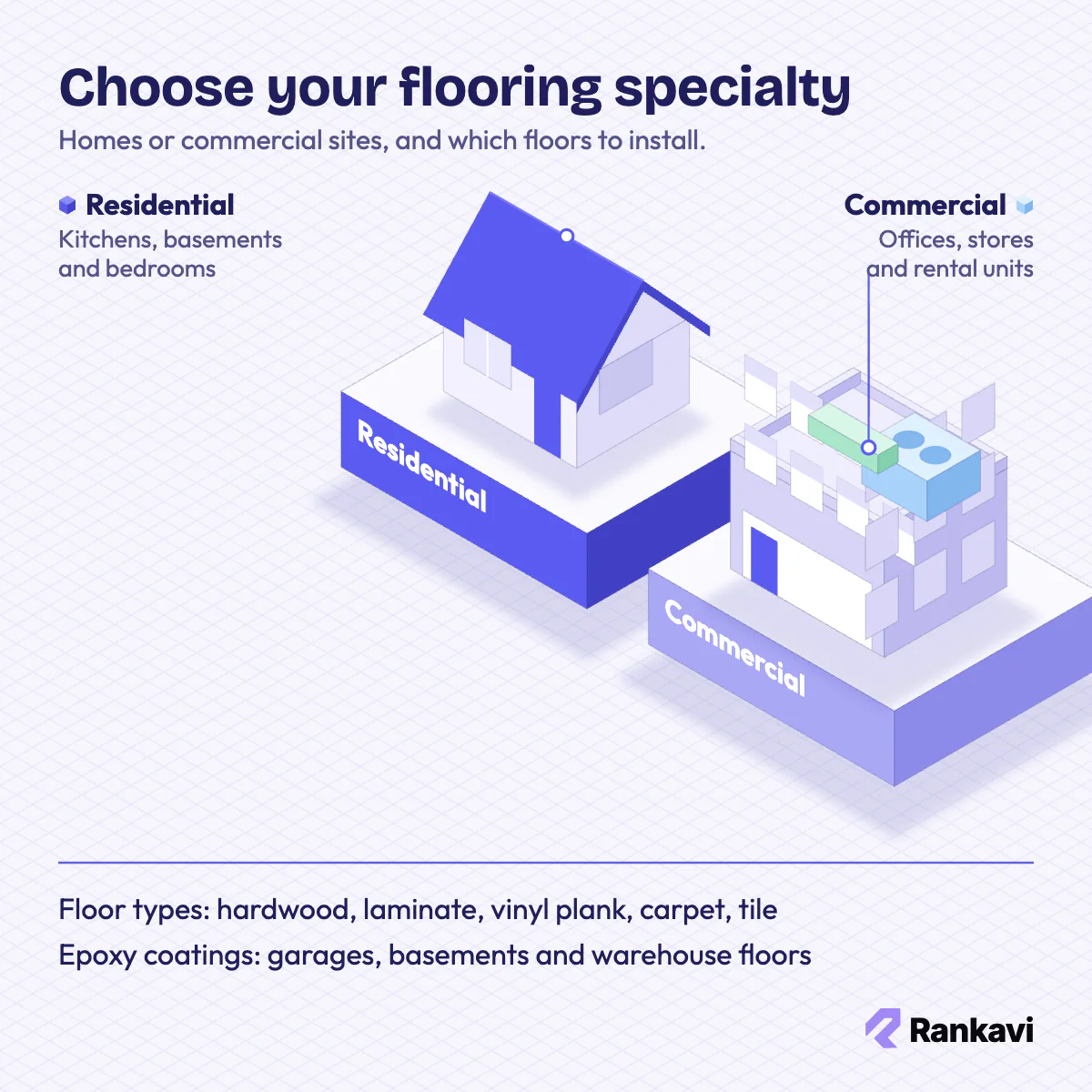
Residential work means homeowners renovating kitchens, basements and bedrooms. Commercial work covers offices, stores and rental units, often through general contractors and property managers. Commercial jobs bring bigger orders but slower payment.
Floor type sets the learning curve. Floating luxury vinyl plank and laminate click together and suit beginners. Nail-down hardwood and tile need more training and more tools. Sanding and refinishing is a separate service from installation.
New-build work for builders runs on volume and tight schedules. Remodels for homeowners bring more subfloor surprises and more decisions from the client. Each type of work needs a different way of scheduling crews.
Epoxy flooring is a separate specialty inside the trade. Epoxy, polyaspartic and polished concrete coatings go on garages, basements and warehouse floors. Coating crews need grinders and chemical training rather than saws and nailers.
Selling terms matter as much as floor type. Installation-only work, supply-and-install work and customer-supplied material split margin, risk and warranty in different ways. Selling the material adds markup and also adds product warranty questions.
Most founders begin as installation-only contractors working from home. A retail showroom with samples comes later, once steady jobs pay for the lease.
Local climate and housing stock point toward a specialty. Older homes suggest hardwood repair and refinishing, while rental turnover favors quick vinyl plank jobs. A sound plan picks one core specialty and one nearby add-on, then expands later.
Each specialty also sets the safety load. Tile and concrete work release silica dust, epoxy gives off fumes, and every kind of install strains knees and backs. Gear and training costs follow the choice.
2. Research Local Flooring Demand
A demand check reveals which floors local customers buy and who already sells them. Remodeling activity, new home building and rental turnover all drive flooring jobs.
The ideal customer gets defined early. Homeowners in older houses replace carpet with hardwood or vinyl plank. Landlords want durable, cheap floors between tenants. Builders need crews that meet tight schedules.
Public data shows where flooring jobs come from. Building permit counts, home sales and rental turnover in the service area all point to coming demand. A short list of target customers ties that demand back to step 1. Each customer gets the job it needs.
Competitor reviews on Google Maps and Yelp reveal gaps. Complaints about missed dates, uneven seams or poor cleanup point to an opening for a reliable installer.
Competitor websites show prices, specialties and lead times. A crowded niche with long waits for quotes signals room for a faster installer. Seasonality also matters, because demand often swings with the weather, so cash planning needs a buffer for slow months.
Referral sources matter as much as end customers. Kitchen remodelers, interior designers, real estate agents and flooring stores without installers all pass on work.
Big-box stores and local flooring stores compete for the same homeowners. Some of them also subcontract installs, which makes them a possible customer as well as a rival.
3. Write a Flooring Business Plan
A flooring business plan sets out the services, customers and money targets the company works toward. Lenders often ask for one before approving a loan.
Plans come in two sizes. A one-page lean plan suits a solo installer who only needs a clear direction. A longer plan with full financials suits a lender or investor. The plan needs updating when a service or a crew member is added.
Core plan sections:
| Section | What it covers |
|---|---|
| Executive summary | The company, its specialty and its goals |
| Market analysis | Local demand and competing installers |
| Services | Floor types installed, removal and repairs |
| Marketing plan | The channels that bring first leads |
| Financial plan | Startup costs, prices and projected profit |
The service list keeps the plan focused. Installation, old floor removal, subfloor repair and refinishing each get their own line and price. The key assumption is how many square feet a crew installs each week.
An operations section explains how the company runs. It covers crew setup, job scheduling, material ordering and delivery, subcontractor use and warranty callbacks.
A risks section names what can go wrong and the response. Material delays, moisture and subfloor problems, installation defects, seasonality and slow-paying builders each get a plan. Milestones such as the first job and the first hire give the plan a timeline.
The financial plan needs more than one line. A startup budget, a 12-month cash flow forecast and a break-even point show whether the numbers hold. Revenue assumptions state whether the company sells labor only or labor plus material markup.
4. Price Installs by the Square Foot
Pricing a flooring job involves turning measured square footage into a quote that covers labor, materials, overhead and profit. Most installers quote per square foot, then add extras.
Square foot prices differ by floor type. Tile and hardwood need more labor than click-together vinyl, so one flat rate misprices them. A minimum job charge covers small rooms, where setup and travel cost the same as a large job.
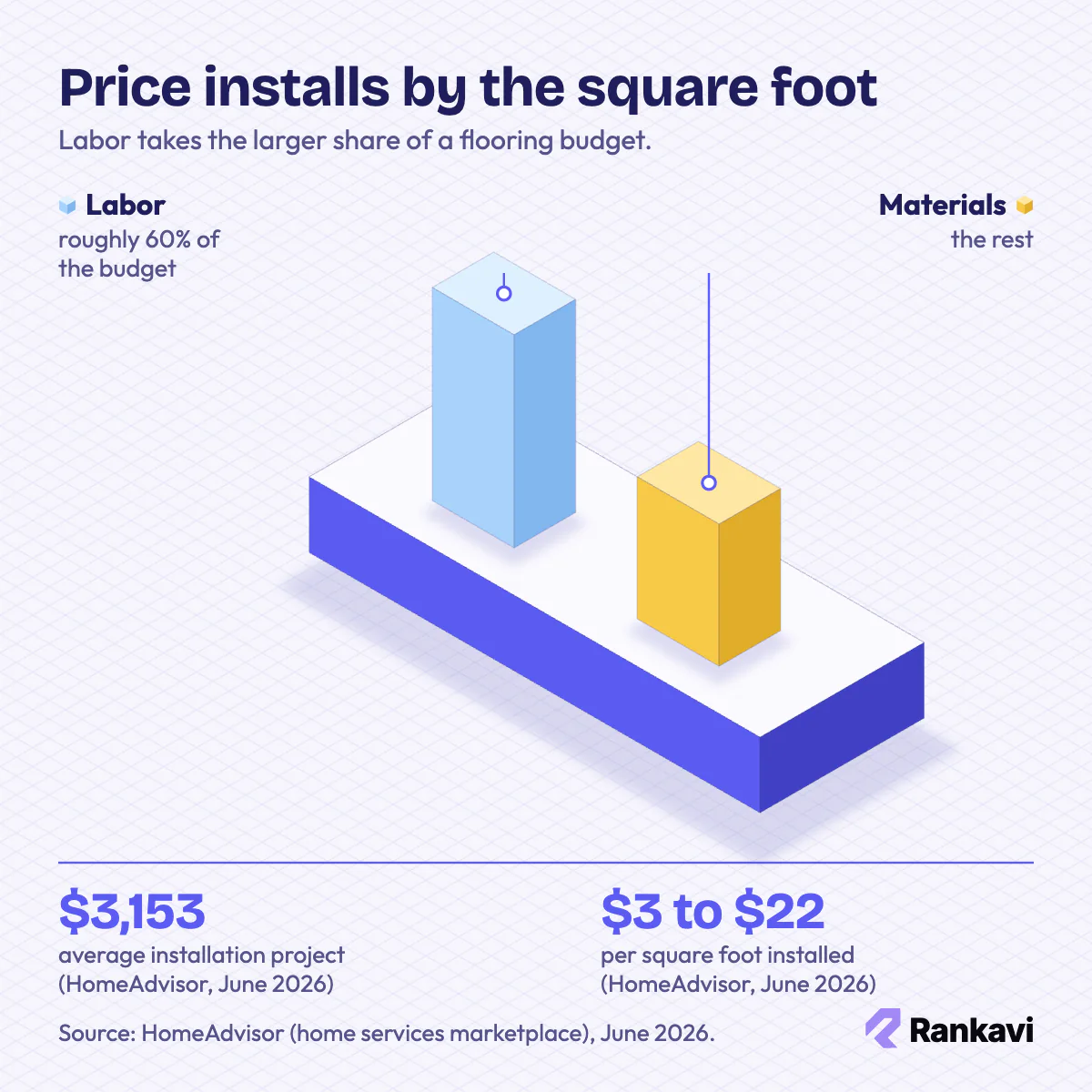
HomeAdvisor is a home services marketplace that publishes cost guides. Its June 2026 guide put the average installation project at $3,153. Its 2026 normal range ran from $1,528 to $4,850, at $3 to $22 per square foot installed.
Labor is the number flooring owners watch first. HomeAdvisor’s June 2026 guide said labor takes roughly 60% of a flooring budget and materials the rest. Many installers let homeowners buy flooring elsewhere and charge only for installation.
Installation-only pricing keeps risk low, because the homeowner owns the product. Supply-and-install pricing adds a material markup but ties up cash and adds warranty duties. Material orders also need a waste allowance for cuts and mistakes.
Extras raise the ticket on most jobs. Removal of old flooring, furniture moving, subfloor leveling, stairs and trim each get their own line on the estimate.
Subfloor prep and moisture testing get priced apart from the floor itself. Hidden problems often show once the old floor comes up. The estimate states what is included and what changes the quote.
Startup money at a glance:
| Item | Figure |
|---|---|
| Startup cost | $15,000 to $50,000 for an installation company |
| Main costs | Saws, nailers and a moisture meter; a cargo van; licence fees; general liability ($63 a month); marketing |
| Typical margin | 20% to 45% profit margin (vendor estimate; gross or net not stated) |
| Time to open | Weeks where only a local licence applies; longer where a state exam needs four years of experience |
Sources: ZenBusiness, which is a business formation service, June 2025 (vendor estimates for startup cost and margin). Insureon, which is an online insurance marketplace, 2026 (general liability). Contractors State License Board, which licenses California contractors, 2026 (experience rule).
The same ZenBusiness vendor estimate from June 2025 put break-even at 6 to 12 months. Free in-home estimates win most residential jobs, and a deposit before ordering material protects against cancellations.
Worked example: In this illustrative case, a solo installer finishes three average jobs a month at $3,153 each. Labor at 60% leaves about $1,892 per job, or $5,676 a month. General liability at $63 brings that to $5,613 before fuel, supplies and owner pay. At that pace, a $15,000 starter budget pays back in under three months.
5. Fund Tools, a Van and Working Capital
Funding a flooring startup covers tools, a van, licences, insurance and early marketing until the first invoices clear. An installer needs far less money than a showroom.
Funding sources trade off cost, speed and risk. Savings carry no interest but drain the owner’s cushion. Equipment financing spreads the cost of tools and a van over time. A business credit card suits small supply purchases but costs more if balances carry over.
Startup costs fall into five groups: tools, a vehicle, licensing, insurance and marketing. A showroom adds rent, sample displays and inventory on top.
A van can be bought or leased. Buying builds ownership, while leasing lowers the upfront cost. Used tools cut the starting budget, though worn nailers and saws can fail mid-job.
Flooring founders often buy the first saws and nailers from savings. The U.S. Small Business Administration (SBA) is the federal agency behind most small business lending programs. Its microloans reached $50,000 through nonprofit intermediaries as of 2026, averaging about $13,000 in 2026.
Working capital bridges the wait between buying material and getting paid. Builders and commercial clients often pay weeks after the job ends. Flooring-specific grants are rare, so general small business programs fill the gap.
Supplier credit terms also help. A distributor that offers trade credit lets the company order material before paying. A deposit before ordering material shrinks the cash gap further.
6. Register the Flooring Company
Registering a flooring company gives it a legal identity that signs contracts and opens accounts. General contractors often ask for one before hiring a subcontractor.
Many installers form a limited liability company (LLC) because flooring work carries damage risk. A scratched cabinet or a flooded subfloor can lead to claims. The LLC keeps those claims away from personal savings.
A sole proprietorship needs the least paperwork but leaves the owner personally liable for business debts. An LLC separates the two for most claims. It does not replace insurance, and it does not shield an owner from the owner’s own negligence.
Flooring names often carry a town or floor type, so a state business-name lookup comes before signs and van wraps. Installers request an employer identification number (EIN) from the Internal Revenue Service (IRS), which issues it free. Flooring companies need it for a business bank account.
A separate business bank account keeps job income and expenses apart from personal money. A state registered agent receives legal papers for the company. Sales tax rules on flooring material differ by state, so the state tax agency or an accountant confirms them. General contractors often ask a subcontractor for a W-9 tax form and an insurance certificate before paying.
7. Get a Flooring Contractor License
Licensing a flooring company means meeting state, county and city rules before the first paid install. Rules differ widely from state to state.
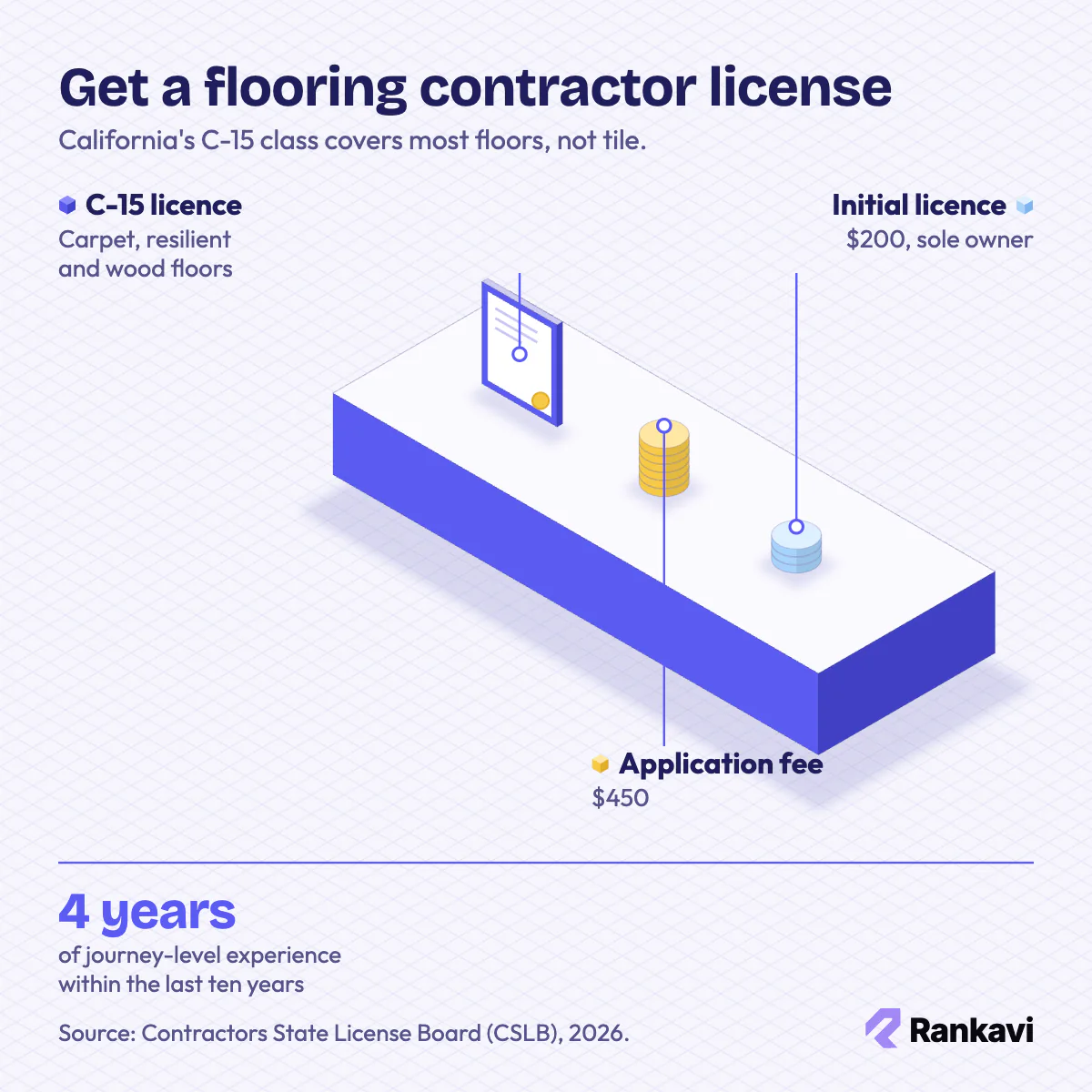
California’s Contractors State License Board (CSLB), which licenses the state’s contractors, runs a C-15 Flooring and Floor Covering classification. C-15 covers carpet, resilient flooring and wood floors, but not ceramic tile. Applicants need four years of journey-level experience within the last ten years.
The CSLB charged a $450 application fee and a $200 initial licence fee for sole owners as of 2026. Other states only require a general business licence from the city or county.
Licensing works in layers. A state board may license the trade, while a county or city adds its own business licence. A state may license flooring only above a certain job value or only for some floor types. The state licensing board confirms which rules apply before the first job.
Building permits apply to some jobs, mostly structural subfloor work and commercial projects. Work without a needed permit risks fines and delays.
Working without a required licence can bring fines and trouble collecting payment in some states. A contractor bond, where one is required, protects clients if the company fails to finish or pay for a job.
8. Insure Every Job Site
Insurance protects a flooring company from the cost of damaged homes, injured workers and stolen tools. Builders and property managers ask for proof before any job starts.
That proof usually comes as a certificate of insurance. Property managers and general contractors request one before a crew enters a site. The policy needs to be in force early.
A flooring installer usually carries four policies:
- General liability: damage to client property and injuries to others.
- Workers’ compensation: injuries to employees, required in most states after the first hire.
- Commercial auto: the work van and its driver.
- Tools and equipment coverage: stolen or broken saws and nailers.
General liability does not cover the company’s own tools, vehicles or employee injuries. Each of those needs its own policy, which is why the list above has four items instead of one.
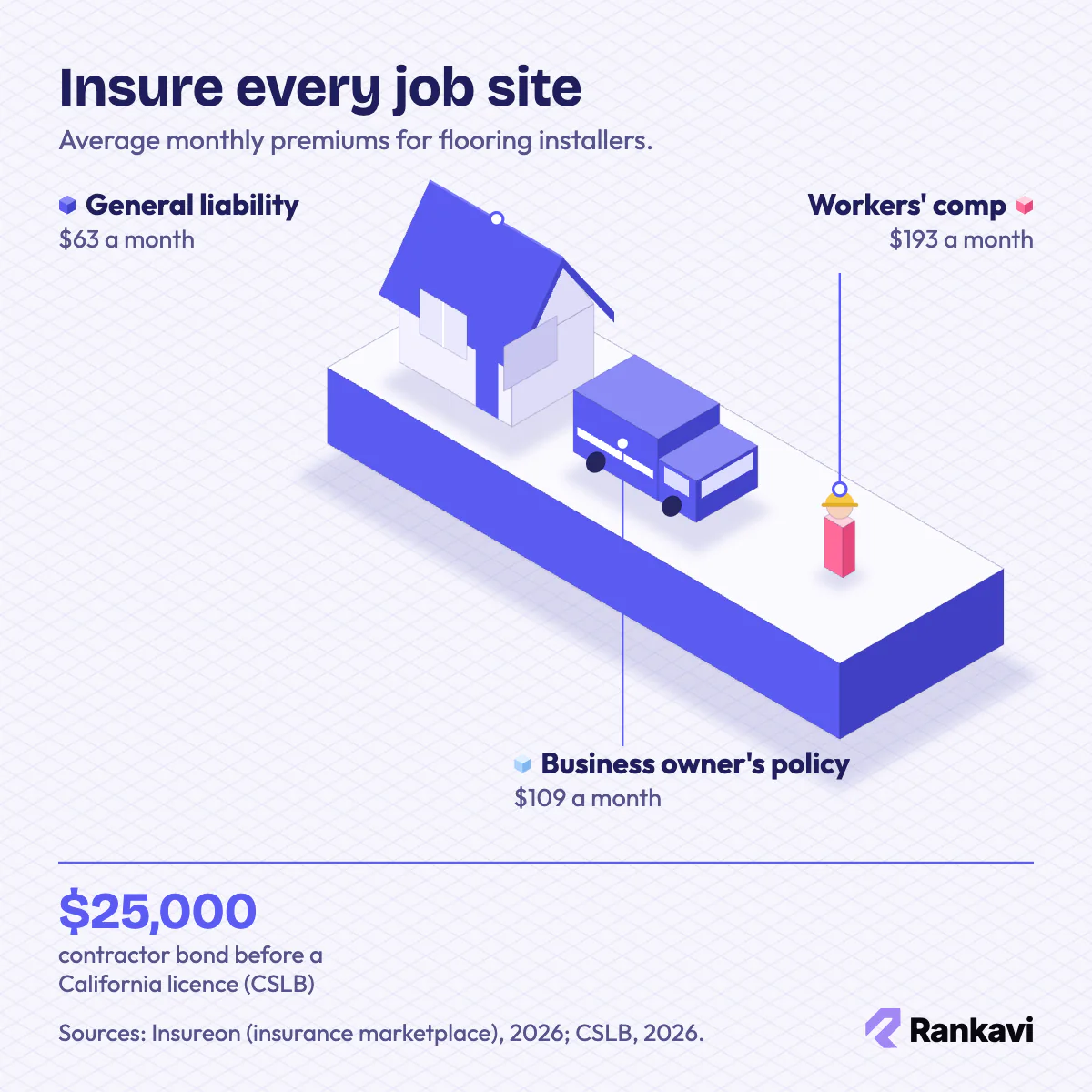
Insureon, an online insurance marketplace, reported 2026 averages of $63 a month ($759 a year) for flooring installers’ general liability. Its 2026 data put a business owner’s policy at $109 a month and workers’ compensation at $193 a month.
Moisture failures can surface long after an install, so completed-work coverage matters. California also required a $25,000 contractor bond before licensing as of 2026.
Subcontractors without their own coverage can leave the hiring company exposed to their injuries in many states. Asking each sub for proof of insurance before the first day closes that gap.
9. Buy Installation Tools and Open Supplier Accounts
The tool kit follows the specialty chosen in the first step. Hardwood crews need nailers and sanders, while tile setters need wet saws and trowels.
Rental can cover specialized machines such as floor sanders and concrete grinders until steady jobs justify buying them.
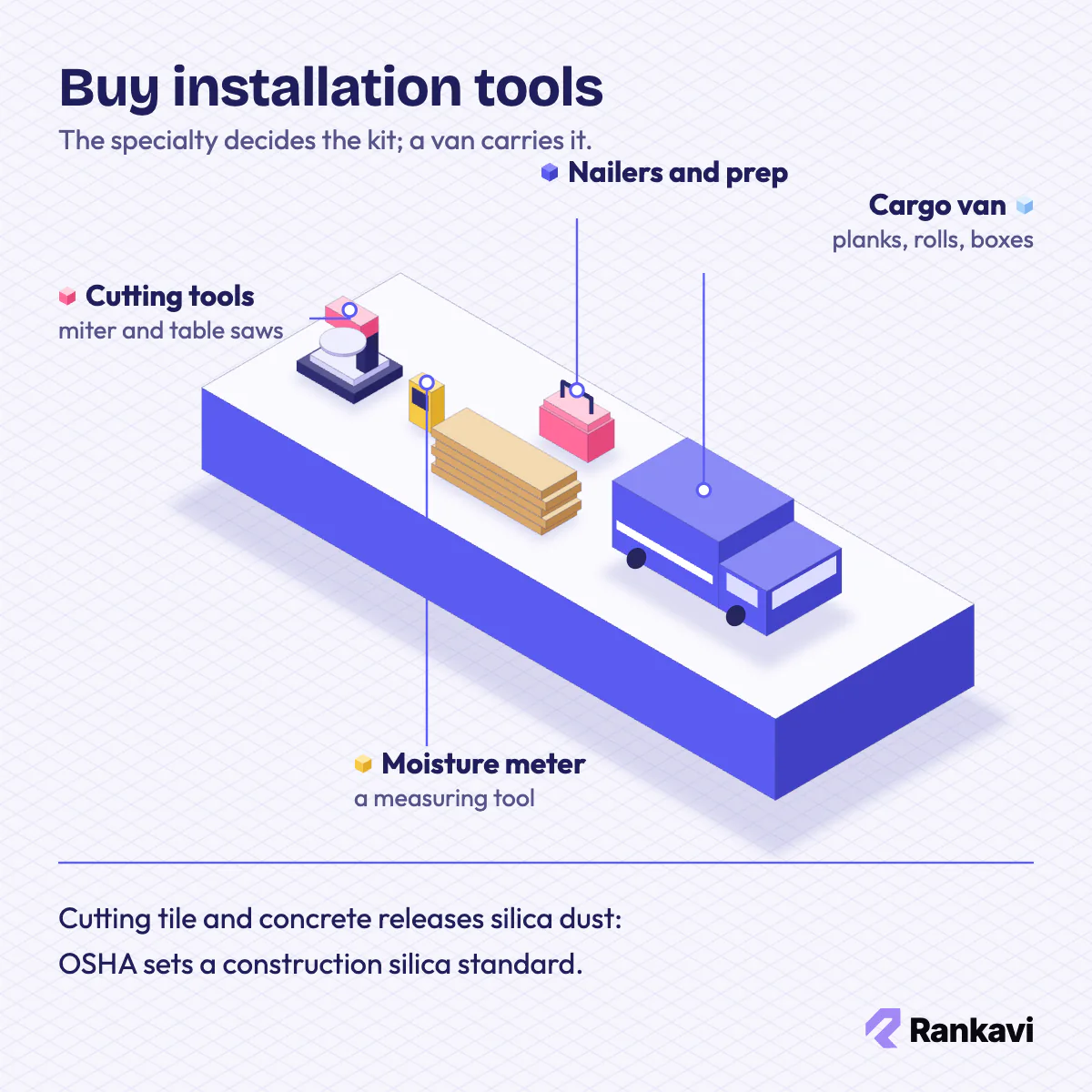
A starter flooring kit holds five core items:
- Cutting tools: a miter saw, a table saw and a flooring cutter.
- Fastening tools: a flooring nailer, a stapler and a compressor.
- Measuring tools: a laser measure, levels and a moisture meter.
- Prep tools: a floor scraper, a sander and leveling compound.
- Safety gear: knee pads, dust masks and eye protection.
Cutting tile and grinding concrete release silica dust. The Occupational Safety and Health Administration (OSHA), which enforces workplace safety rules, sets a construction silica standard. Water on the saw blade cuts that dust sharply.
A moisture meter reads the subfloor before any plank goes down. Moisture trapped under an install is a common cause of later failures, so the reading goes in the job file.
A cargo van or pickup with a rack carries planks, rolls and boxes. Local flooring distributors give trade pricing and credit terms to contractors, often with manufacturer training.
Opening a supplier account usually needs a business licence and tax details, since distributors sell at trade prices to businesses. Material delivered to the job site needs time to adjust to room conditions. The van needs shelving so tools stay organized.
10. Market With Job Photos and Builder Referrals
Marketing starts where homeowners look first: Google Maps and local search. Google Business Profile is a free Google listing that shows a flooring company on Maps with photos and reviews.
Before-and-after photos sell flooring better than any description. Each finished job adds new images to the listing, the website and social media.
Photo permission from the homeowner comes first. A short review request right after the job adds fresh reviews to the Google Business Profile.
Low-cost local channels:
| Channel | Why it works |
|---|---|
| Builder referrals | Steady repeat jobs from one relationship |
| Designer partners | Higher-end clients who trust the designer |
| Yard and van signs | Neighbors see the finished project |
| Home shows | Face-to-face leads from renovators |
A simple website holds the gallery, service list and quote form. Reviews from the first clients build trust while the company is new.
Quick replies to quote requests also win jobs. Homeowners often contact several installers, and the first clear answer tends to get the visit. Builder referrals need a different approach: a short call, a reference list and a clear way to book crews.
11. Hire Installers and Add Services
Growth starts when the owner turns down jobs for weeks at a time. Subcontract installers fill the gap before the first employee joins.
The choice between a subcontractor and an employee has tax and insurance effects. The IRS has rules on who counts as an employee, and misclassifying one brings penalties. Installers are often paid per square foot rather than per hour, which ties pay to output.
Wages set the hiring budget. The BLS reported a $56,460 median annual wage for floor layers outside carpet, wood and tile in May 2025. Carpet installers earned a $50,340 median that same May 2025 survey.
A new hire usually starts as a helper on prep and removal work before cutting or setting floors. Quality checks and callbacks need an owner, because a failed install by a new installer costs the company’s reputation.
The National Wood Flooring Association (NWFA) is a trade association for the wood flooring industry. It runs a Certified Professional program, hands-on training and an apprenticeship program. The World Floor Covering Association (WFCA) represents flooring dealers and installers and offers installer certification.
Add-on services raise the value of each client. Refinishing, stair work, epoxy garage floors and commercial maintenance fit the same customers. A showroom with samples then turns the installer into a full flooring retailer.
Add-ons come one at a time, each tied to the existing customers and tools. Stair work and refinishing reuse tools and clients, while epoxy needs new equipment and training.
12. Surface in Gemini AI Answers on Flooring
Homeowners now ask AI assistants which flooring company to call. Gemini, ChatGPT and Google AI Overviews answer those questions with named local businesses.
Those answers repeat what trusted third-party sites say. Review sites, local directories and “best flooring installers” lists shape which names appear. A new installer gains from being mentioned on those pages early.
Consistent facts help those answers. The company name, address, phone number and services need to match on the website and every directory. Complete listings with recent reviews give AI tools clear details to repeat.
Rankavi is a software as a service (SaaS) platform that publishes brand mentions in articles on indexed third-party websites. Flooring companies that want more brand citations in Gemini can start with those mentions.