

Starting a daycare business takes a state child care license, an inspected space, insurance and qualified caregivers. The U.S. Bureau of Labor Statistics (BLS), which publishes federal labor data, counted 1,010,300 childcare worker jobs in 2025.
Quick introduction: I’m Michal Sieroslawski, and I help daycares get found by parents on Google and in AI chats. ChatGPT and Google’s AI Overviews now suggest daycares by name, and that list matters.
The order below settles tuition and funding before any lease or license fee. Licensing, insurance and hiring then come before the first family enrolls. The thirteen steps below show how to start a daycare business, in order.
- Choose Your Daycare Model
- Research Local Childcare Demand
- Write a Daycare Business Plan
- Set Tuition Rates and Fees
- Fund the Startup and First Months
- Register the Daycare as a Business
- Find a Licensable Space
- Apply for a Child Care License
- Insure Your Daycare
- Hire Qualified Caregivers
- Market to Local Parents
- Expand Through Accreditation and Food Programs
- Gain Daycare Mentions in Perplexity AI Answers
1. Choose Your Daycare Model
Choosing a model decides where the children stay, how many the program may enroll and which license applies. Most founders pick between a home-based family child care program and a commercial center.
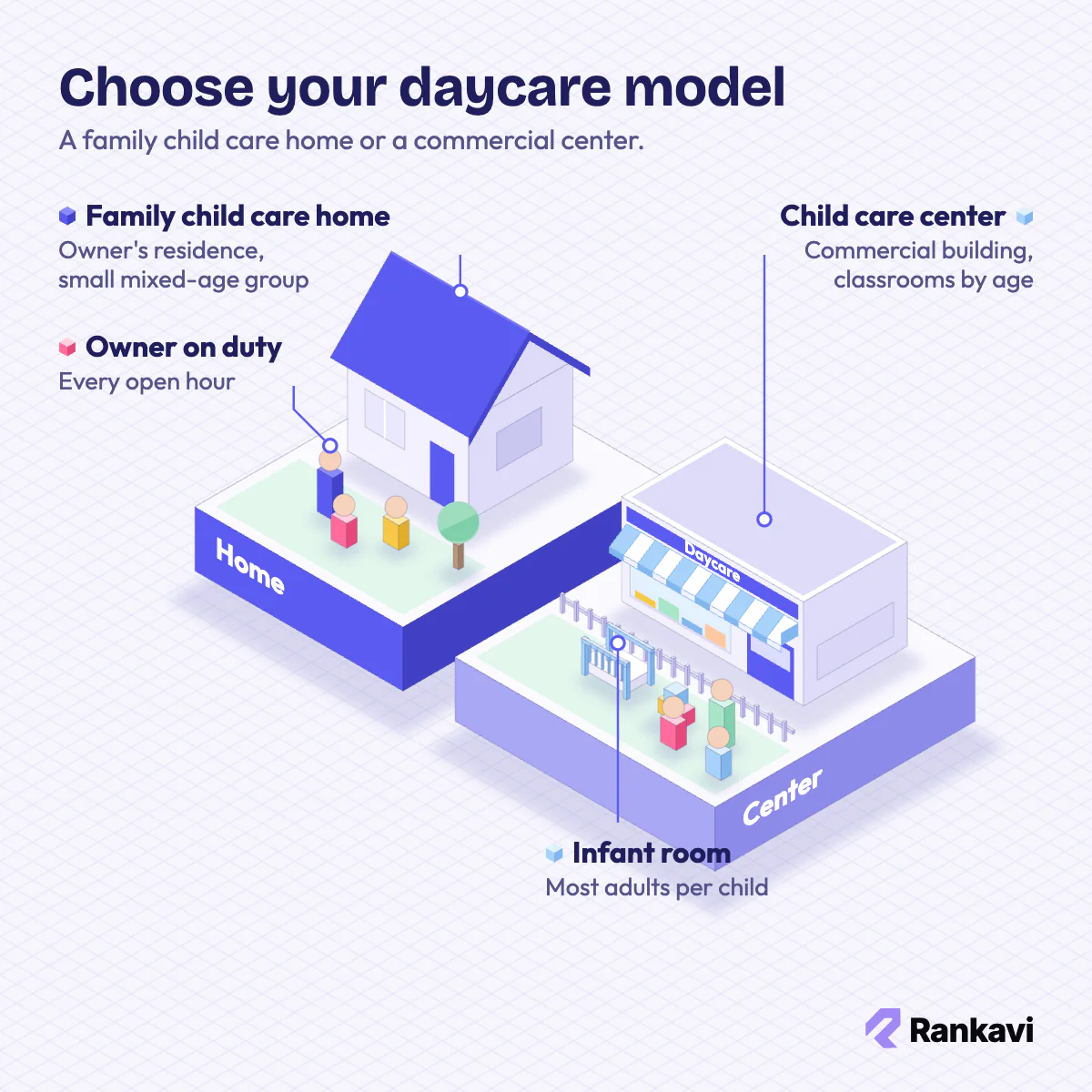
A family child care home runs inside the owner’s residence. Startup spending stays low, but capacity is small and the owner usually works every hour the doors are open.
A child care center operates in a commercial building with classrooms by age. Centers enroll far more children, yet they carry rent, payroll and stricter building rules.
Age range shapes everything else. Infant rooms need the most adults per child and the most equipment. Preschool rooms run larger groups and lean toward early learning goals.
Capacity follows the model. Many states split home care into a small tier and a larger tier. The larger tier usually needs an assistant. Centers have no fixed small cap, because floor space and staffing limit enrollment.
Common daycare program types:
| Program type | Typical setting |
|---|---|
| Family child care home | Owner’s residence, small mixed-age group |
| Child care center | Commercial building, separate rooms by age |
| Preschool | Center or school, structured kindergarten readiness |
| Nature-based program | Outdoor classroom, forest school model |
Philosophy sets the program apart. Montessori, Reggio Emilia, Waldorf and play-based approaches each attract a different group of parents.
A center can also start as a franchise or as an independent program. A franchise brings a ready curriculum and brand in exchange for fees and royalties. An independent program keeps control of pricing and philosophy but builds trust alone.
Zoning rules, homeowner association covenants and lease terms can block a home program. Checking them first prevents choosing a model that cannot open at the chosen address.
Rules for license-exempt care differ by state, so the state licensing agency confirms what applies. Many founders open a home program first and move to a center once demand is proven.
The choice rests on budget, owner credentials, tolerance for debt and whether the home qualifies. The weekly hours the owner wants also matter.
2. Research Local Childcare Demand
Local demand decides whether new seats fill fast or sit empty. A daycare owner can measure it from public licensing data, phone calls and tours before signing anything.
Each state keeps a searchable list of licensed providers. Mapped by address, that list gives a real competitor count inside a short drive of the planned site.
A dated audit asks every nearby provider the same questions. Ages served, hours, current openings, tuition and waitlist rules reveal where families still struggle to find care.
Waitlists rarely spread evenly across ages. Infant spots are scarce in many areas, while preschool rooms in the same town may have empty chairs.
“…waitlists of 2 or more years is not unheard of (even in my very rural area)”
— A family child care provider in Minnesota on the Daycare.com forum
Demographics complete the picture. Working families with young children, commute patterns and new housing all point to future enrollment.
The search area needs a clear edge. A drive of 10 to 15 minutes from the site suits most cities. Parents choose care near home or on the commute. Rural areas need a wider circle.
Licensed capacity is not the same as real capacity. A provider may hold a license for more children than it enrolls because of staffing gaps. Asking how many rooms are open shows the true supply.
Free public pre-K and similar programs can remove a whole age group from the market. Finding them early shows which ages to serve first. Recent closures also matter, since they hint at weak economics, while a crowd of new openings hints at saturation.
Waitlists overstate demand because families join several at once. Asking each provider how many waitlisted children later enroll gives a better signal. Calls to competitors should state plainly that the caller is researching the local market.
A go or no-go rule works best when set before any lease is signed. Three signals make a strong case. They are waitlists in the target age group, few seats per young child and enough interest to fill rooms. If those are missing, changing the age mix or the location is cheaper than a lease broken later.
3. Write a Daycare Business Plan
A daycare business plan sets the program type, licensed capacity, enrollment ramp and funding request on paper. Lenders read it, and the owner uses it to test whether the numbers survive a slow first year.
A lender-ready plan follows five standard sections:
- Executive summary: program type, ages, capacity and the funding request.
- Company description: legal entity, service area, hours and mission.
- Market analysis: competitor audit, waitlists and tuition evidence.
- Organization and management: director role, staffing plan and credentials.
- Financial projections: enrollment, payroll, rent and cash flow.
Revenue in a daycare plan starts with billable seats, not a growth percentage. Licensed capacity, staffing coverage and tuition must agree on every page.
A sample daily schedule belongs in the plan too. Drop-off, meals, outdoor play, nap time and pickup show a lender that the owner has planned a real day.
Two more sections help. An operations section covers enrollment policy, health and safety routines, curriculum approach and parent communication. A risk section covers slow enrollment, staff turnover, a licensing delay and a director’s absence.
Staffing tables come from the state’s ratios for each age group. A room of infants needs far more caregivers per child than a room of preschoolers. The same capacity can therefore produce very different payroll.
Break-even occupancy is the share of licensed seats that must be filled to cover all costs. Lenders tend to check it first. A conservative, an expected and an optimistic enrollment ramp show how much cash remains in a slow case.
The funding request should state the amount, how the money will be spent and where repayment comes from. Landlords, licensing staff and partners may also ask for the plan. A review after the first months compares actual enrollment with the projections.
4. Set Tuition Rates and Fees
Tuition pricing determines whether enrolled seats cover payroll, rent and supplies with something left over. Local rates act as guardrails, while costs set the floor.
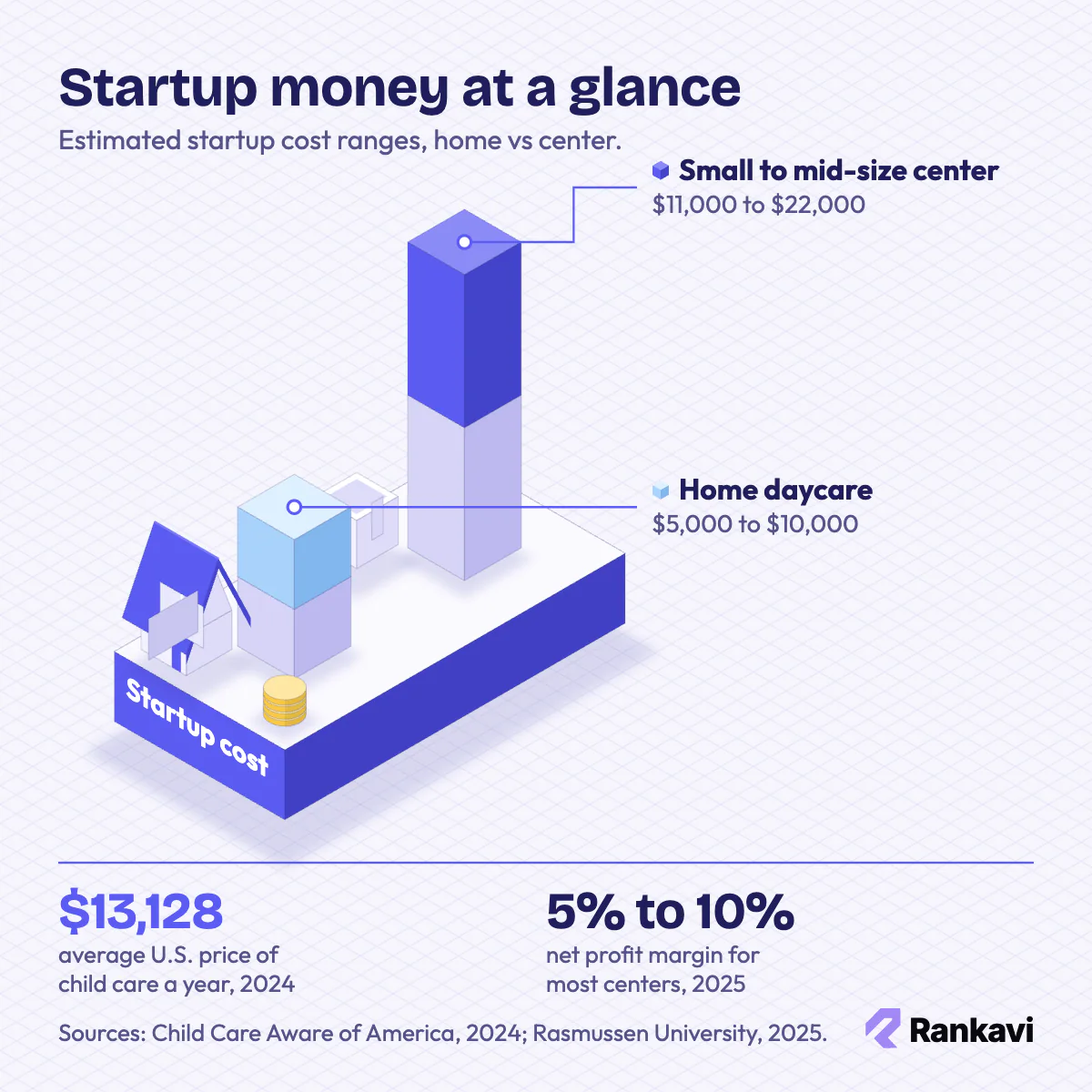
Child Care Aware of America, which runs a national child care support network, put average U.S. care prices at $13,128 a year in 2024. That works out to about $1,094 a month per child in 2024.
Rates differ by age group. Infant care costs the most because each caregiver looks after fewer babies. Infant tuition therefore sits well above preschool tuition.
Cost sets the floor and the market sets the ceiling. Monthly fixed costs, wages with payroll taxes and food are added together with a target margin. Owners then divide the total by licensed capacity times a realistic occupancy rate, one that leaves room for empty seats.
That cost-based price is then compared with nearby providers. Calling several of them as a prospective parent and recording weekly rates by age group shows the local range. If the cost-based price sits far above it, the model needs adjusting, not only the price.
Fee policies protect cash flow. A registration fee, a deposit that holds the seat and a clear late pickup charge keep enrollment and payments predictable.
The enrollment agreement usually covers these fee types:
- Registration or annual supply fee: a one-time or yearly charge at enrollment.
- Seat deposit: money that holds the place until the first day.
- Late pickup fee: a charge per block of minutes after closing time.
- Late and returned payment fees: a penalty for missed or failed payments.
Most providers bill for the reserved seat, not for days attended, so holidays and sick days are still charged. Sibling and staff discounts help enrollment but cut margin, and part-time seats are harder to fill than full-time ones.
Subsidy seats need a decision before opening. Reimbursement is set by the state and may sit below private tuition, with a parent co-payment. Families who pay with a dependent care account or a tax credit will ask for the provider’s taxpayer details.
Billing software with automatic bank payments lowers late payments. Rate increases work best with written notice and a clause in the enrollment agreement.
Startup money at a glance:
| Item | Daycare figure |
|---|---|
| Startup cost | $5,000 to $10,000 for a home daycare; $11,000 to $22,000 for a small to mid-size center |
| Main costs | Staff wages, rent, insurance, licensing and safety equipment |
| Typical margin | 5% to 10% net profit for most centers |
| Time to open | Several months; Wisconsin issues a license within 60 working days of a complete application |
Sources: Rasmussen University, a career college, estimates (2025); Wisconsin Department of Children and Families licensing manual (accessed 2026).
Break-even enrollment is the benchmark owners check first. Fixed monthly costs divided by tuition minus variable cost per child gives the number of seats that must stay filled.
Worked example: An illustrative home daycare enrolls 8 children at $1,094 a month each, bringing in $8,752. One full-time assistant at $16.82 an hour costs about $2,915 a month, and insurance adds $116. That leaves about $5,721 a month for food, supplies, utilities and the owner’s own pay.
5. Fund the Startup and First Months
Funding a daycare covers the space, the safety upgrades, the furniture and the payroll that runs before tuition catches up. A home program needs a modest budget, while a center needs far more.
Startup costs fall into a few groups. Licensing fees, insurance, cribs, cots, toys, safety gear and any renovation come first.
One-time costs and recurring costs behave differently. Renovation, fire and safety equipment, furniture and playground gear are paid once. Rent, wages, insurance, food and software repeat every month, and they drain the reserve until seats fill.
Most new owners combine savings with a loan. The U.S. Small Business Administration (SBA) is the federal agency that backs small business lending. Its microloan program names not-for-profit childcare centers among eligible borrowers.
Grants for child care exist at state and local levels. Many require a license or proof of legal compliance before money is released.
Lenders usually ask for a business plan with projections, personal credit history and tax returns. They also want details of the lease or property. Collateral and a personal guarantee are common. Free small business advisors can review the numbers before an application goes in.
Government subsidies are revenue, not startup money. Payments arrive only after enrolled families qualify, and they can lag. Many grants also reimburse costs after the money is spent, so cash is needed up front.
Common mistakes include budgeting only for opening day and mixing personal and business money. Paying anyone upfront for a promised grant is another. Underestimating renovation also drains the reserve early.
A cash reserve carries the program through the first months. Seats fill gradually, but staff wages start on the first day.
6. Register the Daycare as a Business
Registering a daycare gives the program a legal identity that signs leases, holds insurance and opens accounts. Many owners form a limited liability company (LLC) to separate personal assets from business risk.
A home daycare may also run as a sole proprietorship. That choice is simpler, but the owner’s personal assets stay exposed to claims.
A daycare with staff also needs an employer identification number (EIN) from the Internal Revenue Service (IRS). That number covers payroll, tax filings and the business bank account.
Some programs register as nonprofits instead. Churches and community groups often choose that route, and it can open doors to certain grants.
An LLC does not replace insurance. It limits some personal exposure, yet an injury claim can still reach the business itself. A separate business bank account keeps daycare money apart from personal money and makes the books clearer.
The legal structure should be settled before the license application. Many states issue the license to a named owner or entity, and changing it later can mean a new application. The state licensing agency says what it expects.
7. Find a Licensable Space
A licensable space means a building that meets zoning, square footage, fire and safety rules for the ages served. Licensing staff inspect a specific address, so the site comes before the application.
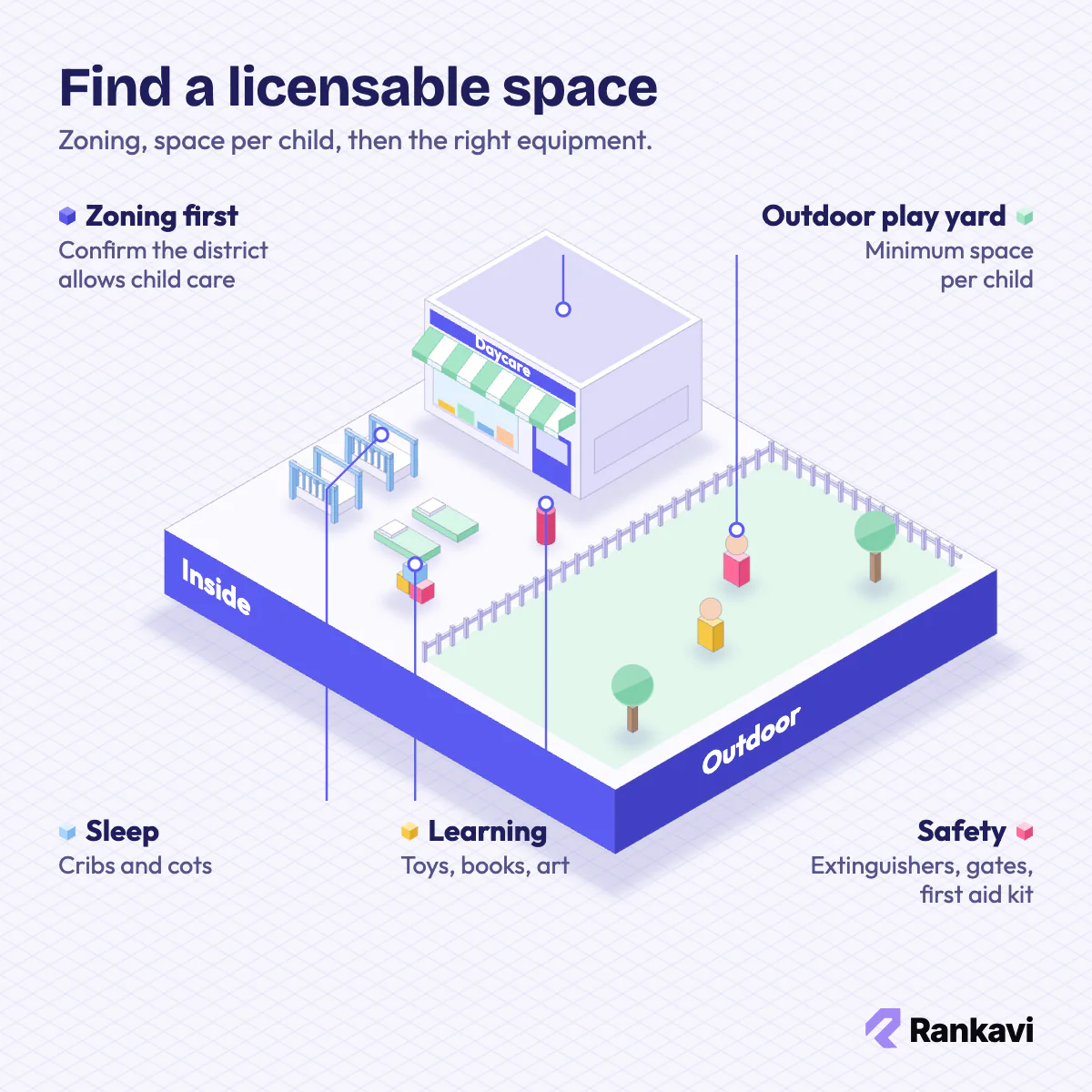
Zoning is the first filter. Some cities allow child care in certain districts only with a special permit. A call to the zoning office prevents a wasted lease.
“…the first thing the licensing agency requires you to do is to find a location”
— A prospective center owner in New Jersey on the Daycare.com forum
States set a minimum amount of indoor and outdoor space per child. Room size therefore caps enrollment as firmly as staffing does.
Home programs face their own checks. The home may need to pass fire and safety inspections, and the yard needs safe fencing. A lease or homeowner association rule can still forbid child care, even when the state allows it.
A smart lease includes a licensing contingency. The landlord agrees that the deal depends on the state approving the space.
A new daycare buys four groups of equipment:
- Sleep: cribs for infants and cots or mats for older children.
- Safety: outlet covers, gates, fire extinguishers and a first aid kit.
- Learning: age-appropriate toys, books and art supplies.
- Meals: child-sized tables, high chairs and food storage.
8. Apply for a Child Care License
Child care licensing involves meeting the state’s minimum health and safety rules before any child may enroll. ChildCare.gov, the federal child care site run by the Office of Child Care, explains that each state sets those rules.
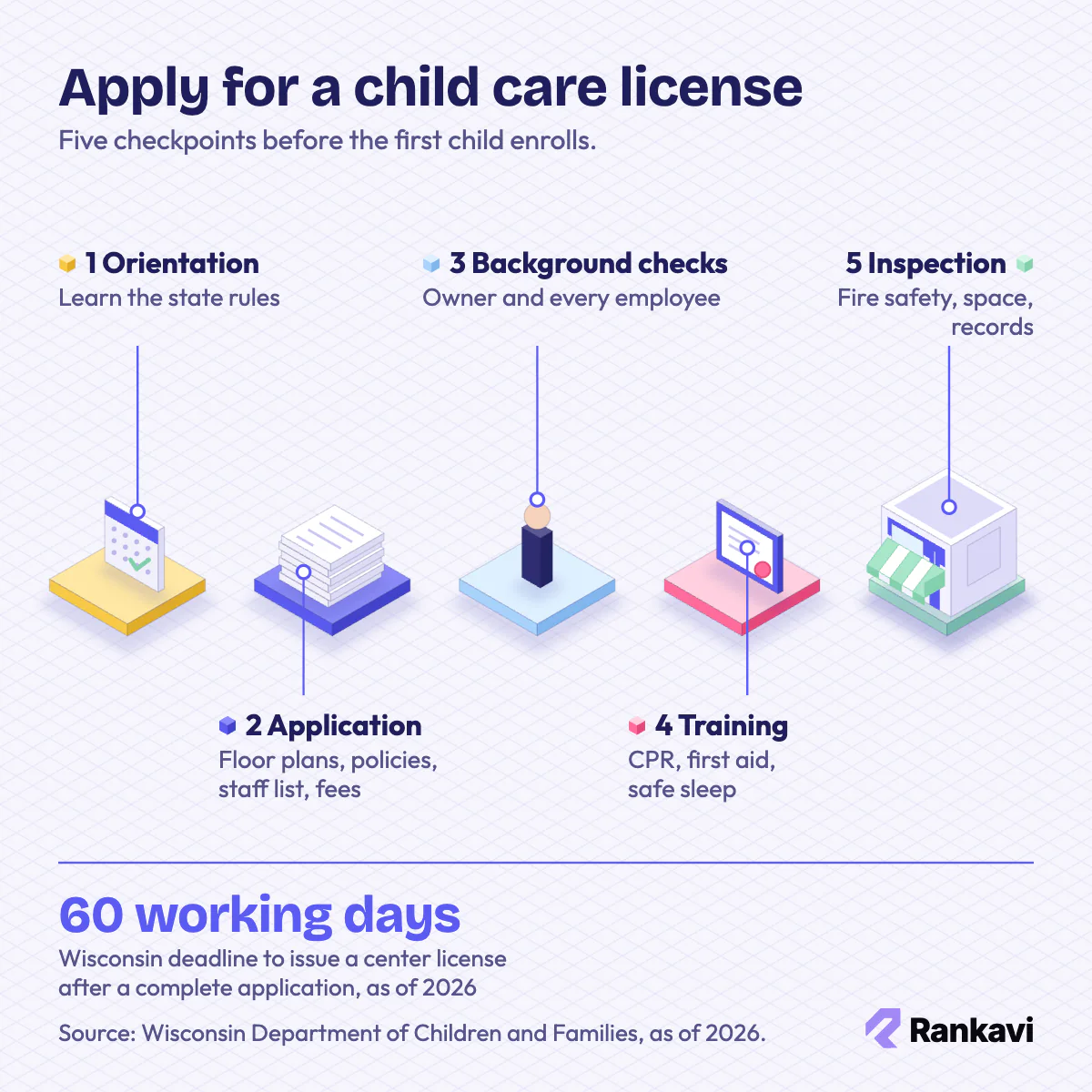
Most states start with a licensing orientation. The application package follows, with floor plans, policies, staff lists and fees.
Terms differ by state, since a program may be called licensed, registered or certified. Operating without a required license can bring fines and closure, so the state agency confirms which category fits the model. Centers also need a qualified director named on the application.
Processing takes time. In Wisconsin, the state child care agency must issue a center license within 60 working days of a complete application, as of 2026.
Background checks cover the owner, every employee and often adults living in a home daycare. Fingerprint checks and child abuse registry searches are standard.
Training requirements arrive before opening. Cardiopulmonary resuscitation (CPR), first aid, safe sleep and health and safety courses are the usual set.
An inspector visits once the paperwork clears. The visit checks fire safety, space, equipment and records, and any problems must be fixed before the license is issued.
9. Insure Your Daycare
Daycare insurance protects the owner against injury claims, abuse allegations and property loss. Many state licensing agencies require proof of coverage.
MoneyGeek, which publishes insurance cost comparisons, put daycare insurance at an average of $116 a month, or $1,386 a year, for small operations in 2026.
General liability covers injuries to children and visitors. Abuse and molestation coverage matters because many standard liability policies exclude those claims.
Workers’ compensation applies once the program hires employees. Most states require it, and it pays for staff injuries on the job.
A home daycare needs separate business coverage. A standard homeowners policy rarely covers a paid child care program.
The policy should match what the program really does. Licensed capacity, ages served and any transport of children affect what coverage is needed. Landlords and licensing staff often ask for a certificate of insurance, so coverage is best arranged before the inspection.
10. Hire Qualified Caregivers
Staffing rules shape the payroll, the daily schedule and the number of children each room may hold. States set staff-to-child ratios and group sizes for every age.
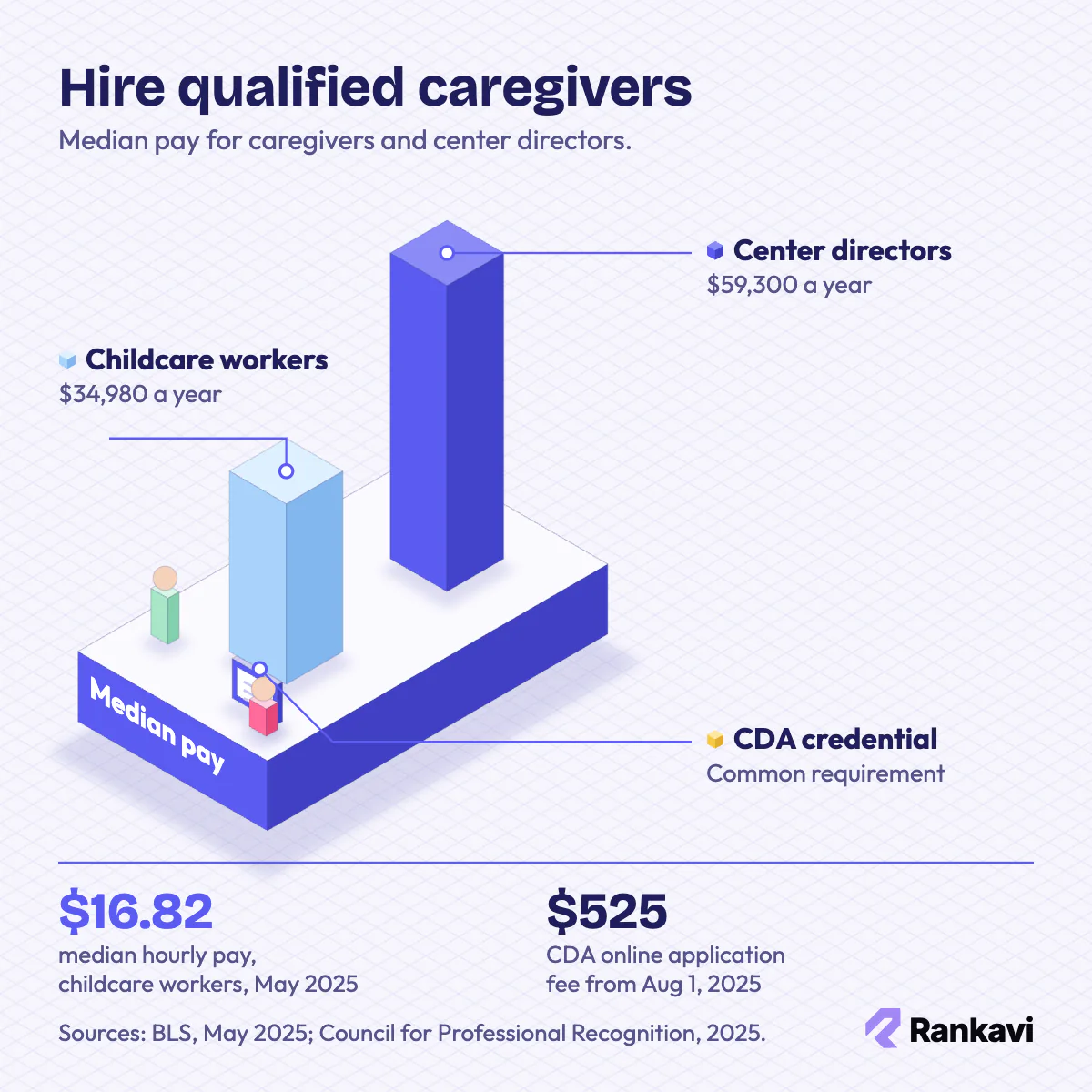
Caregiver qualifications vary by state. A high school diploma, early childhood coursework and the Child Development Associate (CDA) credential are common requirements.
The Child Development Associate credential comes from the Council for Professional Recognition, a nonprofit that certifies early childhood educators. Its initial online application fee rose to $525 on August 1, 2025.
Pay is low across the field, and turnover follows. BLS reported a median wage of $16.82 an hour, or $34,980 a year, for childcare workers in May 2025.
Center directors earn more. BLS put the median annual pay of preschool and childcare center directors at $59,300 in May 2025.
“The over head tends to be quite high and getting quality staff to stick around is tough.”
— A member of the Daycare.com forum
Owners who offer steady hours, paid training and a clear path to lead teacher keep staff longer. Ratios must hold every minute, including breaks and late shifts.
Substitutes are part of the staffing plan. A sick caregiver can break the ratio within minutes, so a short list of approved backups protects the license. Background checks must clear before a new hire is alone with children. In a small program, the owner often fills the director role until revenue supports a separate hire.
11. Market to Local Parents
Parents choose a daycare through trust, convenience and open seats. Marketing starts weeks before opening so that the first rooms fill on schedule.
A Google Business Profile is the free Google listing that parents see beside a map pin. It puts the daycare on Maps and local search. Hours, ages served, photos and reviews answer the first questions parents ask.
Tours convert interest into enrollment. A fast reply to every inquiry and two fixed tour windows each week keep families moving toward a deposit.
A written enrollment packet makes the next step easy. It lists tuition, fees, hours, policies and the deposit. A waitlist with a clear contact date keeps interested families from drifting to another center.
Referrals carry the most weight in child care. Happy families tell neighbors, coworkers and parent groups.
Nearby employers, pediatric offices and school staff meet many parents. A short flyer or a visit there reaches families who are already searching. Honest reviews on the Google listing then support those referrals.
12. Expand Through Accreditation and Food Programs
Growth in child care turns a licensed program into one that parents and funders trust more. Accreditation, meal programs and added services all build that trust.
The National Association for the Education of Young Children (NAEYC) is a nonprofit association of early childhood educators. Its accreditation reviews a center against health, safety and education standards set by the association.
The Child and Adult Care Food Program (CACFP) is a federal meal program run by the U.S. Department of Agriculture. It reimburses licensed centers and family day care homes for meals. Participation lowers food costs and improves the menu.
Added services widen the roster. After-school care, summer camps and extended hours fill gaps that working parents name in feedback.
Accreditation costs time and money and is optional, so it suits programs with stable enrollment. Meal programs need paperwork, because the program records each meal served. Both choices are easier once the license is held and the routines run smoothly.
13. Gain Daycare Mentions in Perplexity AI Answers
Parents increasingly ask Perplexity, ChatGPT and Google AI Overviews which daycare near them is safe and has openings. Those tools build their answers from parenting sites, local directories and review pages.
A new daycare benefits from being named on those third-party pages early. Rankavi is a software as a service (SaaS) platform that publishes brand mentions in articles on indexed third-party websites. A Perplexity citation service is one way to get a center named when parents research child care there.