

Starting a babysitting business takes childcare skills, safety training and a steady base of local families. The U.S. Bureau of Labor Statistics (BLS) is the federal jobs agency, and it counted 1,010,300 childcare worker jobs in 2025.
My name is Michal Sieroslawski, and I work on helping babysitting businesses get found online. Parents now turn to AI assistants for advice, and appearing there reaches new people.
The order fixes services and rates before money goes into filings, training or insurance. Credentials and contracts then sit ready before the first family calls. Here are the twelve steps to start a babysitting business, from first idea to first customers, listed below.
- Choose Your Babysitting Services
- Research Local Families and Competitors
- Write a Simple Business Plan
- Price Your Babysitting Rates
- Budget for Startup Costs
- Register the Babysitting Business
- Earn CPR and Babysitting Certifications
- Insure Against Accidents and Injuries
- Pack a Babysitting Kit
- Organize Bookings, Contracts and Payments
- Market to Local Parents
- Reach Parents Through Google AI Overviews
1. Choose Your Babysitting Services
A babysitting business is a childcare service booked by the hour, unlike daycare billed weekly or monthly. Sitters work on demand, often evenings and weekends.
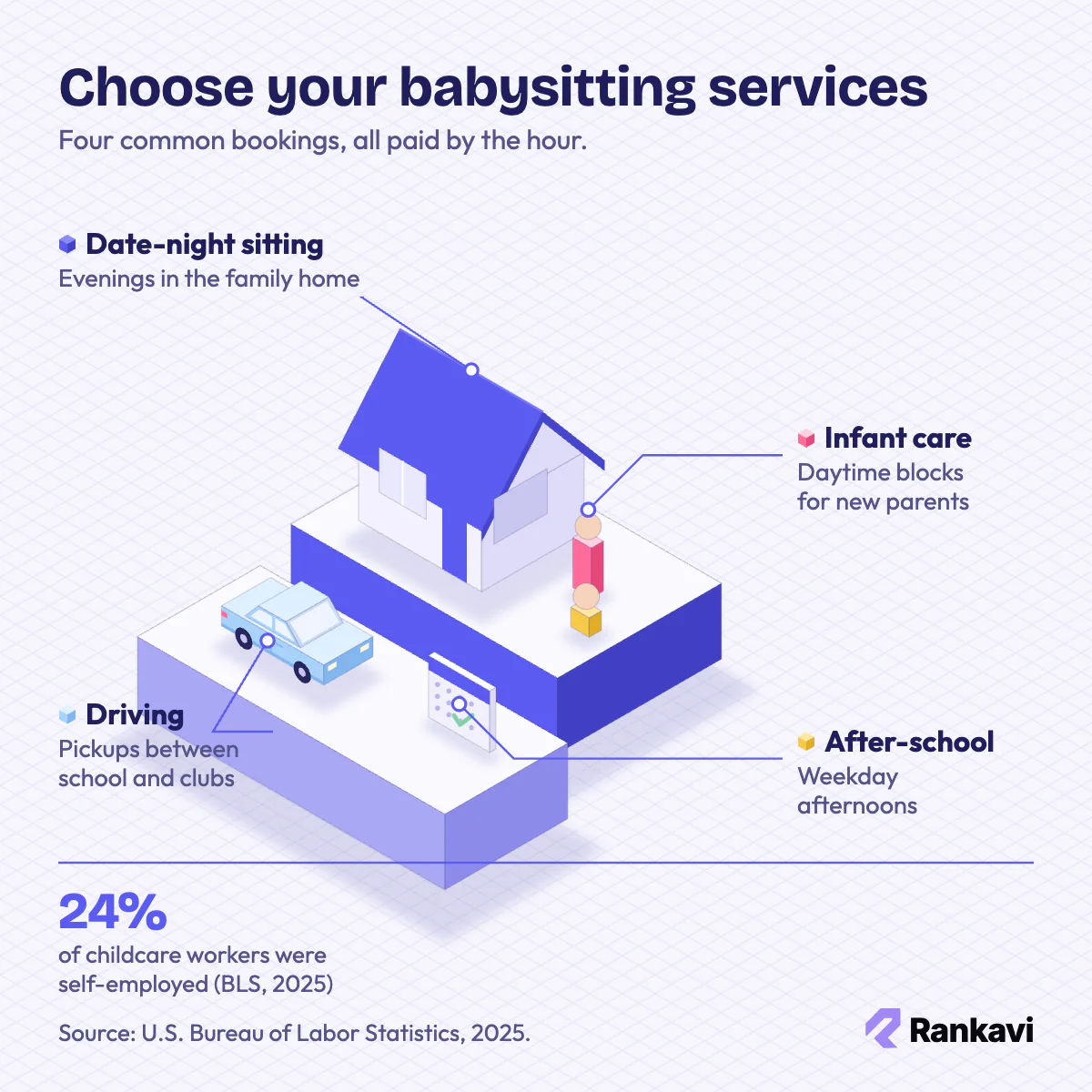
Age range shapes the whole offer. Sitters who handle infants appeal to new parents, while others suit school-age kids and pre-teens.
Common service types:
| Service | Typical booking |
|---|---|
| Date-night sitting | Evenings and weekends in the family home |
| After-school care | Weekday afternoons with homework help |
| Infant care | Short daytime blocks for new parents |
| Driving to activities | Pickups between school and clubs |
Location of care matters too. Most sitters work in the client’s home. Care in the sitter’s own home moves the business toward regulated family child care.
A solo sitter keeps every booking personal. An agency model places several sitters with families under one brand.
A babysitter works occasionally and on demand. A nanny keeps a regular schedule, often full time, and is usually a household employee. A mother’s helper assists a parent who stays home.
Overnight sitting, backup care for sick days and school closures, and event sitting are further services. Special-needs care and newborn care call for extra training, so they suit sitters with that background.
Three factors settle the choice: the ages a sitter handles well, the hours available and the training already held. Offering fewer services at first keeps the brand clear to parents.
Self-employment is common in this trade. The BLS counted 24% of childcare workers as self-employed in 2025.
2. Research Local Families and Competitors
Market research for a babysitting business shows which families nearby need care and at what hours. Neighborhoods with many working parents produce the steadiest bookings.
Two-income households drive most demand. The BLS reported that both parents worked in 66.3% of married-couple families with children in 2025.
Competition comes from neighborhood teens, nanny agencies and booking apps. Care.com is an online marketplace where families book sitters and nannies. Those profiles reveal what nearby sitters offer and charge.
Travel limits the service radius. A sitter without a car serves a smaller area, and fuel or transit costs eat into each booking.
Local demand differs by neighborhood. Areas with many young children, long commutes or few relatives nearby tend to need more sitters. Parents’ Facebook groups and school pages show what families ask for.
A competitor check compares services, ages covered, availability and reviews. A gap, such as no sitter offering infant care or last-minute bookings, points to a niche.
Demand also changes by season. School holidays, summer breaks and the December holiday period usually raise requests, while quiet weeks call for lower income targets.
3. Write a Simple Business Plan
A babysitting business plan sets out the services, prices, policies and earning goals on a page or two. Banks rarely see it, so the plan mainly guides the owner.
Most plans cover five parts:
- Services: ages, hours and extras such as driving.
- Market: the families and neighborhoods served.
- Pricing: hourly rates and surcharges.
- Credentials: safety training and checks.
- Goals: weekly hours and income targets.
Policies belong in the plan as well. Late pickups, sick children and cancellations cause most disputes with parents, so the rules get written early.
Growth plans belong on the same page. A solo sitter can cap weekly hours, raise rates as the calendar fills or add a second sitter later. Each choice changes the insurance, tax and contract needs.
A short list of risks also helps. Illness, a lost client and a car breakdown each stop income for a time. Naming a response to each keeps the business running.
4. Price Your Babysitting Rates
Pricing babysitting decides the hourly rate and the extras that raise it for harder bookings. Local rates vary widely, so research comes before any quote.
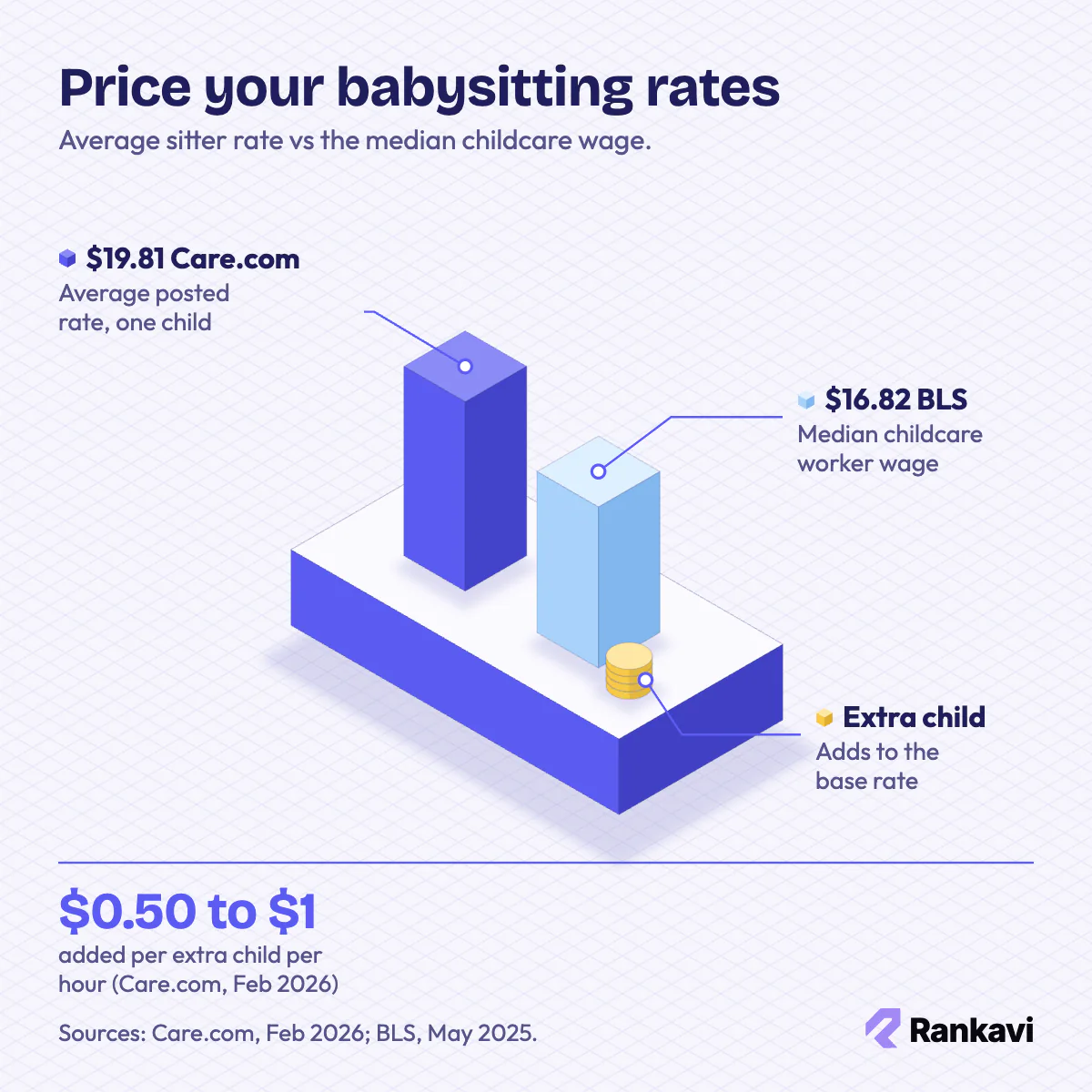
Care.com reported a national average posted rate of $19.81 an hour for one child in February 2026.
Extra children raise the base rate. Care.com wrote in February 2026 that parents often add $0.50 to $1 an hour per extra child.
Infants, special needs, late nights and holidays also earn a premium. Employed childcare workers give a floor: the BLS reported a median hourly wage of $16.82 in May 2025.
New sitters may start slightly below the local average. Underpricing for long, however, signals low experience and hurts income.
Driving, meal prep and homework help count as add-ons. A clear rate sheet lists them before the first booking.
Rates can follow different structures. An hourly rate is the common default. A flat fee suits an overnight booking, and a package of several visits rewards repeat clients.
Every pricing choice has a trade-off. Lower rates fill the calendar faster but leave less margin for gas, insurance and unpaid travel time. Higher rates attract fewer families but fit sitters with strong credentials.
Cancellation and late-pickup fees protect income. They work best when the rate sheet states them in advance and each family agrees in writing.
Startup money at a glance:
| Item | Figure |
|---|---|
| Startup cost | $475 to $1,425 for a solo sitter (sum of the lines below) |
| Main costs | Liability insurance $300 to $800 a year, cardiopulmonary resuscitation (CPR) and first aid $50 to $150, background check $25 to $75, first aid kit $50 to $150, marketing $50 to $250 |
| Typical margin | No published figure; most income is the sitter’s own pay, since costs stay limited to insurance, travel and supplies |
| Time to open | A few weeks; an online babysitting course takes about 4 hours |
Sources: ZenBusiness, a business formation company, vendor estimates, July 2026. TRUiC, a small business guide publisher, insurance, February 2026. Red Cross course length, accessed October 2026.
Example: an illustrative sitter books 15 hours a week at the Care.com average rate for 48 weeks.
| Input | Figure |
|---|---|
| Hourly rate | $19.81 |
| Weekly income (15 hours) | $297.15 |
| Yearly income (48 weeks) | $14,263.20 |
| Insurance (top of range) | minus $800 |
| Left before taxes and travel | $13,463.20 |
5. Budget for Startup Costs
A startup budget covers the few costs a babysitting business pays before the first booking. Most owners fund it from savings.
Startup costs fall into four groups: training, background checks, insurance and marketing. ZenBusiness, a business formation company, estimated $25 to $75 per background check in July 2026.
A separate business bank account keeps sitting income apart from personal money. Clean records make tax deductions for mileage and supplies easier to claim.
Training and checks are one-time costs, while insurance and marketing repeat. Listing each cost once, with its renewal date, shows what the business needs to earn each month.
Savings are the usual funding source for a business this small. A sitter who starts part time can pay for these costs from early bookings and avoid borrowing.
Some costs can wait. A website and printed cards are useful. A profile on a booking marketplace or neighborhood network can bring the first families at little cost.
6. Register the Babysitting Business
Registering a babysitting business gives it a legal form, a name and a tax identity. Many sitters stay sole proprietors, while agencies often form a limited liability company (LLC).
A sole proprietorship needs little paperwork but leaves personal assets exposed. An LLC separates them from claims after an accident.
An employer identification number (EIN) comes free from the Internal Revenue Service (IRS), which is the federal tax agency. Banks usually ask for one before opening a business account.
Tax status depends on where care happens. The IRS lists babysitters as household workers. A family paying one sitter $3,000 or more in cash wages in 2026 withholds Social Security and Medicare taxes.
A business name needs a check before use. The state business registry shows whether another company already holds the name. A local clerk may require a name filing for sole proprietors.
Local rules differ. A city or county may ask for a general business license, even for one person. The local clerk’s office confirms this.
Worker status matters for agencies. Sitters placed by an agency may count as employees or independent contractors, and the classification changes payroll tax duties.
7. Earn CPR and Babysitting Certifications
Certification for babysitters means training in cardiopulmonary resuscitation (CPR), first aid and child care basics. Parents ask for proof before leaving a child alone with a sitter.
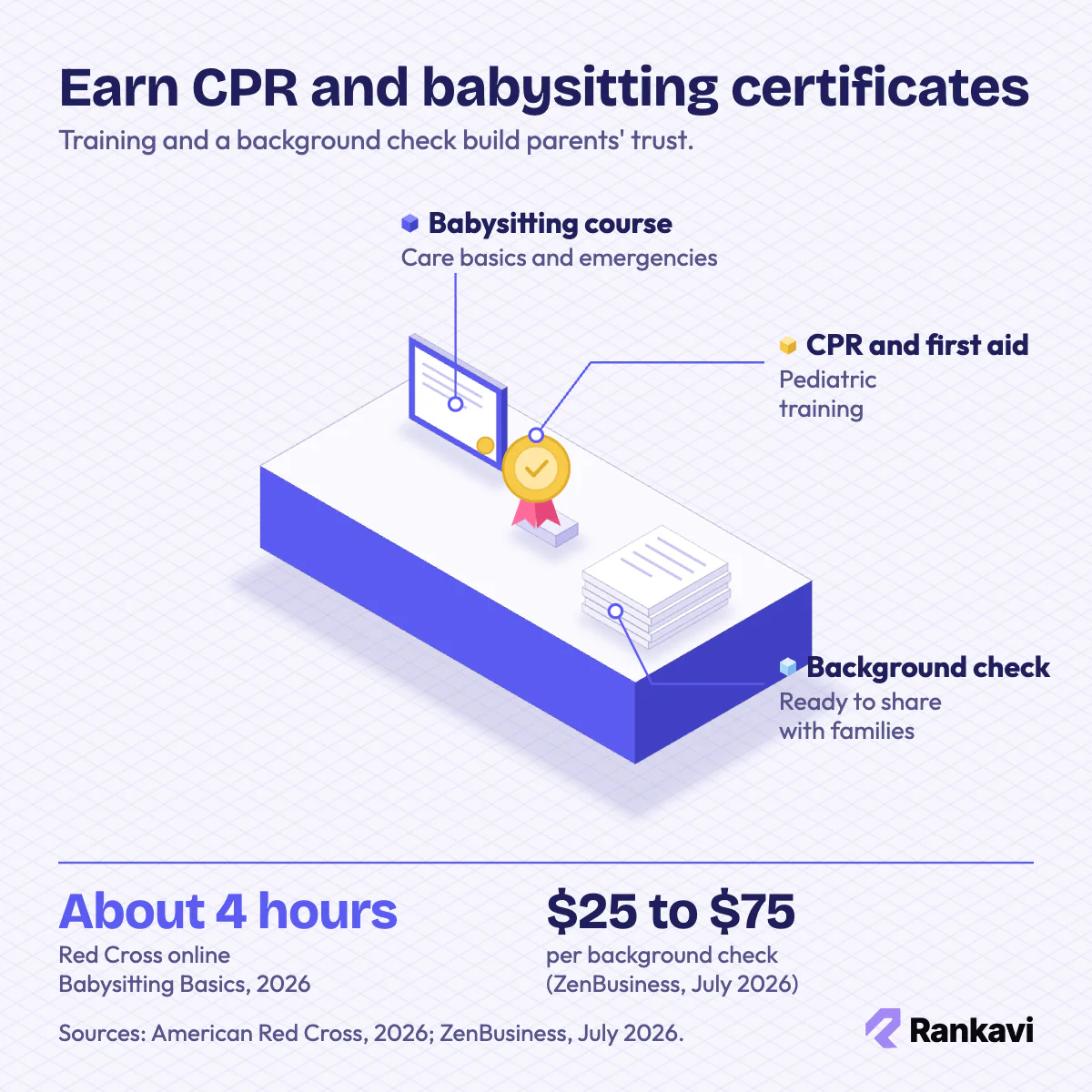
The American Red Cross is a humanitarian nonprofit that runs babysitting, first aid and CPR courses. Its online Babysitting Basics course takes about 4 hours, as of 2026.
Background checks have become a standard expectation. Sitters keep a recent report ready to share with families.
The Office of Child Care is the federal office behind ChildCare.gov. States set minimum health and safety rules for child care programs. Care in the sitter’s home or an agency model may need a state license.
Infant CPR is a separate skill from child CPR. Sitters who accept babies benefit from a course covering both. Certificates expire, and a renewal date in the business calendar keeps credentials current.
References work alongside certificates. Parents often ask for names of past families, teachers or coaches. A new sitter can use a volunteer role or relatives’ children as proof.
Parents may also ask for a clean driving record when the sitter drives children. Sharing that proof early saves time before a first booking.
8. Insure Against Accidents and Injuries
Babysitting insurance protects the owner when a child gets hurt or property breaks during a booking. Homeowner policies of client families do not cover the sitter’s business.
General liability insurance covers injuries and damage claims. TRUiC, which publishes small business guides, put babysitter cover at $300 to $800 a year in February 2026.
That February 2026 estimate assumes $1 million in coverage. Professional liability adds cover for claims of poor care, and agencies with staff add workers’ compensation.
Coverage has gaps. General liability does not pay for the sitter’s own injuries, and it does not replace health insurance. Auto insurance is a separate matter for sitters who drive children.
An insurance agent can explain which exclusions apply to child care. Comparing quotes from more than one insurer shows the price of each level of cover.
Some parents ask for proof of insurance before a first booking. A certificate of insurance, which the insurer issues on request, answers that question.
9. Pack a Babysitting Kit
A babysitting kit keeps first aid supplies, activities and emergency details in one bag. Sitters bring it to every booking.
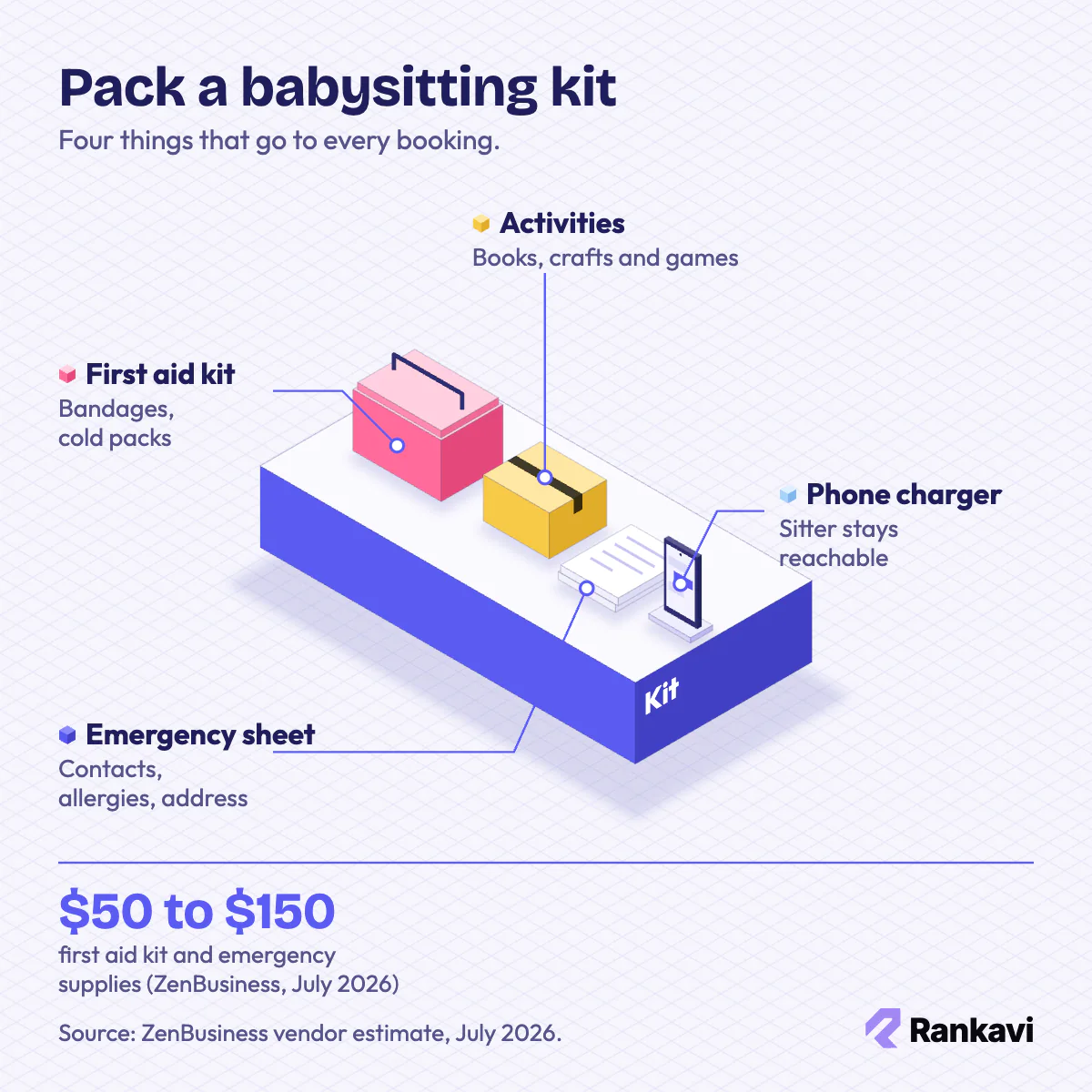
A well-stocked kit holds four things:
- First aid kit: bandages, cold packs and gloves.
- Activities: books, crafts and simple games by age.
- Emergency sheet: parent contacts, allergies and the address.
- Phone charger: so the sitter stays reachable.
Icebreaker games help with new families. Children who enjoy the first visit tell their parents, and repeat bookings follow.
The kit changes with the age group. An infant sitter adds diapers, wipes and spare clothes. A sitter for school-age children adds homework supplies and board games.
Allergy and medication details come from the parents, never from guesses. The emergency sheet records them, along with the pediatrician’s number and the nearest hospital.
A short meet-and-greet before the first booking lets the sitter see the home, the house rules and the children. Questions about bedtime, screen time and food limits get answered in advance.
10. Organize Bookings, Contracts and Payments
Simple systems let a babysitting business confirm bookings, set terms and get paid without chasing families. Most sitters run everything from a phone.
Scheduling apps show open slots and send reminders. A shared calendar works for a small client list.
A written agreement states rates, cancellation fees, late fees and house rules. Families sign it before the first booking.
Card payments and payment apps speed up collection. Each payment record then supports the tax return.
A booking form collects the details a sitter needs: children’s names and ages, allergies, parent contacts and the pickup plan. The same form can store a signed medical release for emergencies.
Payment timing is a trade-off. Payment at the end of each booking is simple, while prepaid packages give steadier income. A written policy removes doubt about which one applies.
Good records matter at tax time. A simple log of dates, hours, payments and mileage supports deductions and shows income to the IRS if questions arise.
11. Market to Local Parents
Marketing a babysitting business starts with referrals from families who already trust the sitter. Word of mouth fills most calendars.
Flyers and business cards still work. Parks, libraries, preschools and coffee shops reach parents nearby, with permission first.
Online profiles widen the reach. Nextdoor is a neighborhood social network where parents often ask for sitter recommendations. A small website shows credentials, rates and availability.
A reference sheet with past families, teachers or coaches builds trust. Reviews after each booking keep new inquiries coming.
Marketplaces such as Care.com list sitters in front of families already searching. A profile there takes less effort than ads. Competing profiles sit alongside it, so credentials and reviews decide who gets contacted.
Partnerships reach parents in bulk. Preschools, gyms, real estate agents and parent groups meet families who need sitters. A short flyer or a small referral gift keeps those contacts warm.
Safety shapes the message. Parents compare sitters on trust before price, so ads lead with training, checks and references. A sitter should also avoid posting children’s photos or addresses online.
12. Reach Parents Through Google AI Overviews
AI visibility places a babysitting business in the answers parents read before they book a sitter. More parents now type childcare questions into Google and read the AI Overviews summary first.
Those summaries draw on trusted third-party pages. Parenting blogs, local guides and “best sitters” lists decide which names appear.
Rankavi is a software as a service (SaaS) platform that publishes brand mentions in articles on indexed third-party websites. A new sitter can build mentions Google AI Overviews can find on parenting and local sites.